Tamil Nadu Election Shifts to Three-Way Contest as TVK Enters Arena
The upcoming state legislative assembly election features intense campaigning on welfare schemes, yet analysts suggest the actor-turned-politician lacks the organisational depth to displace incumbents.
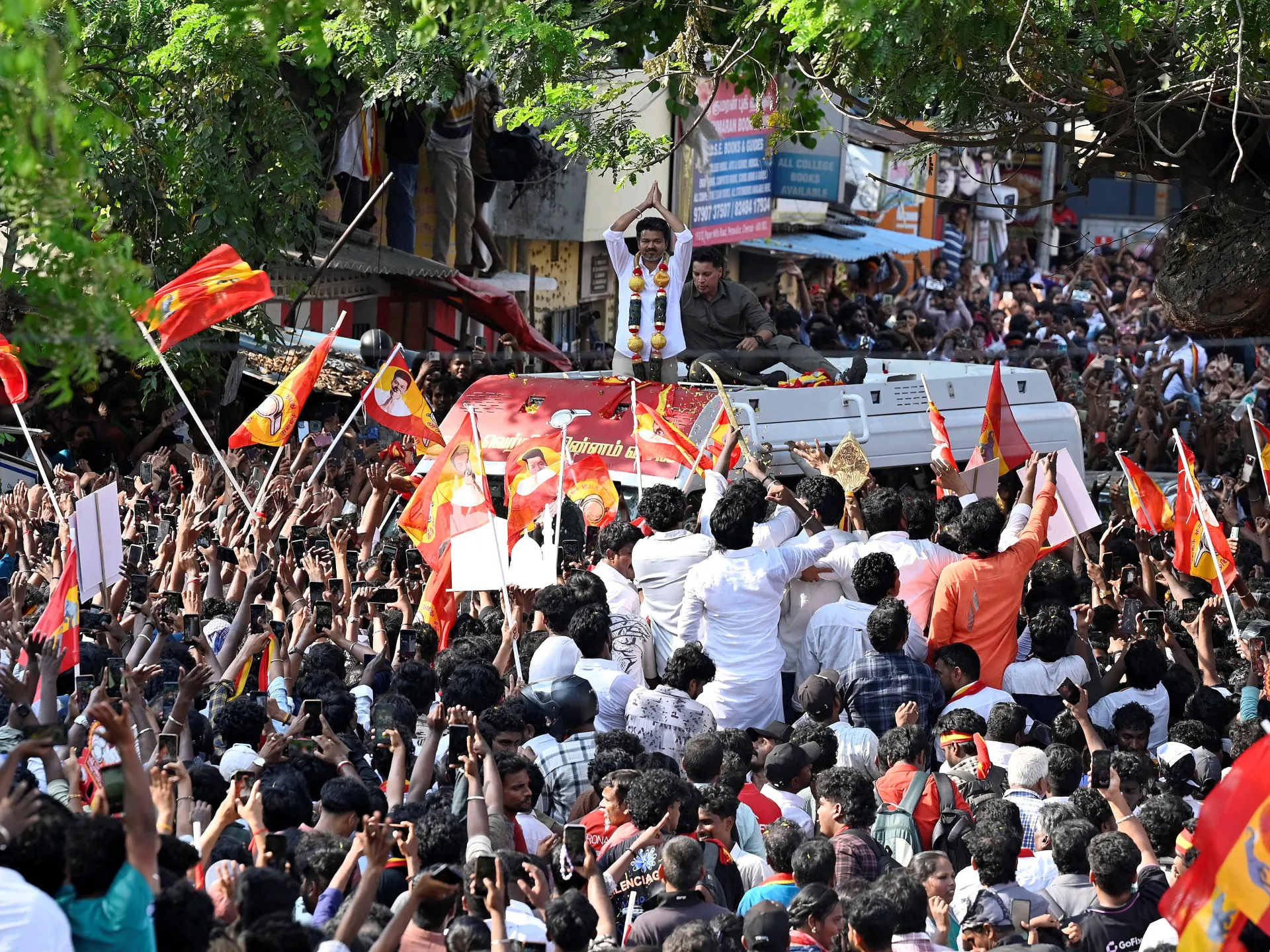
C Joseph Vijay has entered the Tamil Nadu state legislative assembly election as a significant third contender, challenging the incumbent Dravida Munnetra Kazhagam (DMK) and the All India Anna Dravida Munnetra Kazhagam (AIADMK). The actor, who launched his Tamilaga Vettri Kazhagam (TVK) party in 2024, aims to disrupt the decades-long dominance of the two Dravidian parties. However, political commentators suggest that while Vijay possesses personal charisma, his new party lacks a distinct ideology and the organisational machinery required to compete with established predecessors.
The election, scheduled for Thursday, has transformed a traditionally bipolar battle into a triangular contest. Vijay's campaign is built on the premise that his opponents have united solely to prevent him from becoming chief minister. He seeks to attract specific voter blocs, including younger voters aged 18 to 39 and women, by framing the election as a personal struggle against established forces. Despite allegations of poor crowd management, including a fatal stampede in September last year, his rallies continue to draw massive crowds, though experts caution that such attendance does not necessarily translate into electoral votes.
Campaigning has intensified around welfare promises, a hallmark of Tamil Nadu politics. The DMK coalition has pledged to double monthly women's allowances and build one million homes, while the AIADMK alliance offers similar financial support alongside free refrigerators. Vijay's TVK has responded with a suite of populist measures, including six free LPG cylinders annually, monthly cash support for female heads of households, and interest-free education loans. These pledges come amidst a backdrop of global fuel crises and allegations of corruption against the current administration.
The political landscape is further complicated by the historical context of film stars influencing governance in the state. Previous figures such as MGR and Jayalalithaa successfully leveraged cinema to build robust political movements rooted in social justice and identity politics. In contrast, Vijay's approach relies heavily on fan clubs and populist rhetoric that appeals to youth but fails to articulate a clear policy framework. Analysts note that Tamil Nadu is an ideologically evolved state where voters expect clear stances on social justice and centre-state relations, areas where TVK remains undefined.
Strategic dynamics within the existing coalitions suggest Vijay will act as a disruptor rather than a decisive winner. Commentators describe him as a blessing and a curse for both the DMK and AIADMK; he may siphon votes from the DMK-led coalition while simultaneously drawing support that might otherwise have gone to the AIADMK alliance. This fragmentation could alter the outcome of the 234-member assembly election, yet the lack of experienced candidates and a coherent party structure poses significant hurdles.
Ultimately, the contest hinges on whether Vijay can convert his cinematic appeal into a sustainable political force. While he banks on anti-incumbency sentiment and demographic shifts, established leaders like MK Stalin and Edappadi K Palaniswami have mobilised decades of organisational experience. The election will determine if a new entrant can survive in a state where political success is inextricably linked to deep-rooted ideological movements and robust ground operations.