North Korea’s war economy consolidates Kim Jong Un’s power amid elite boom and public hardship
An estimated $14 billion to $22 billion in income has transformed the capital’s skyline and strengthened the regime’s political standing, yet ordinary citizens face inflation and currency devaluation.
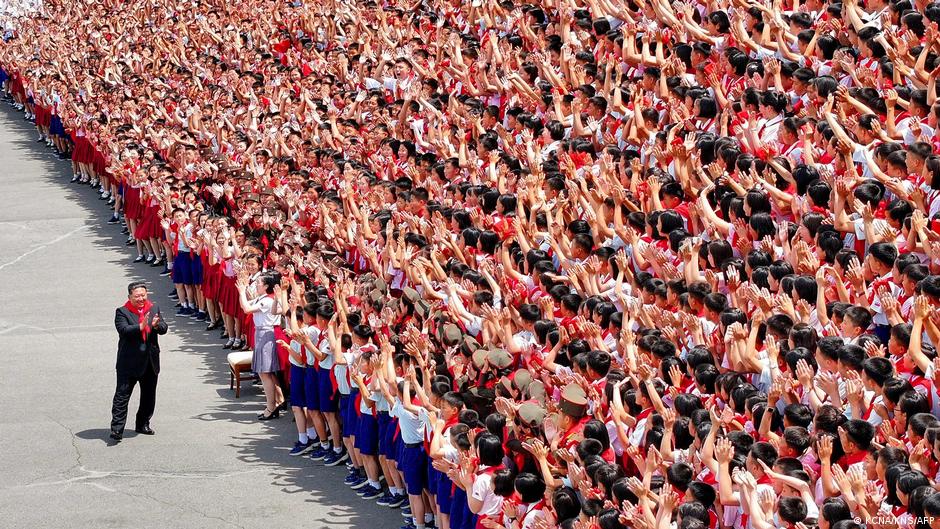
North Korea has generated substantial revenue, estimated between $14 billion and $22 billion, by supplying munitions and troops to Russia for its war in Ukraine. This influx of funds has enabled significant construction projects in Pyongyang and increased Kim Jong Un's political influence, although the economic benefits are concentrated among a small elite while the broader population faces rising food prices and currency devaluation.
Satellite imagery indicates that the illuminated area in the centre of Pyongyang has tripled in size since April 2020. This expansion serves as evidence that the regime has prioritised electricity supply to new streets and housing in the capital to showcase its achievements. At the last party congress in 2021, Kim Jong Un announced a plan to build 50,000 new apartments in the capital, a directive he has since embarked upon.
New neighbourhoods such as Hwasong feature high-rise apartment blocks shaped like Hwasong intercontinental ballistic missiles. Visitors report that the city now appears more modern, with imported electric cars from China, smartphone applications for payments and taxi services, and department stores stocking Western fashion brands and cosmetics. The regime has also completed construction of the country’s largest hospital and a hothouse the size of New York's Central Park.
In June 2025, Kim officially opened the five-kilometre-long beach resort of Wonsan-Kalma on the east coast, with capacity for 20,000 guests. The Wall Street Journal recently described North Korea as the "world's most unlikely growth story," attributing this sudden upturn to substantial income from its involvement in Russia's war against Ukraine.
According to a report by the South Korean Institute for National Security Strategy in March, North Korea earns between $7.7 billion and $14.4 billion from the sale of munitions to Moscow and the deployment of troops. Bloomberg Economics estimated that between 2022 and 2025, North Korea earned more than $14 billion by providing military support for Russia.
Kyiv estimates that in 2024 and 2025, North Korea supplied half the munitions Russia used at the front, including self-propelled guns, multiple rocket launchers and ballistic missiles. Ukraine states that North Korea is currently planning to transfer a missile unit to Russia, consisting of 90 soldiers, six launch pads and up to 120 missiles. Between 16,000 and 22,000 North Korean soldiers are already helping Russia to drive Ukrainian forces out of the border province of Kursk.
The arrangement is lucrative for the regime. The INSS report indicates that Kim receives $2,800 per North Korean soldier, $3,000 for an officer, and $6,000 to $10,000 for every soldier killed in action. In exchange for munitions, arms and soldiers, Russia supplies North Korea with crude oil, oil products, grain and military goods ranging from anti-aircraft systems to technologies for building drones and missiles.
This partnership has bolstered Kim’s political importance and military power, demonstrated by the launch of two 5,000-ton destroyers. In all 15 years he has been in power, the autocratic leader has never possessed this level of influence or financial resources. The partnership with Russia has also allowed North Korea to shed its status as a pariah in world politics and overcome its isolation.
Despite this economic upswing, observers note that it is not benefiting the majority of the population. Many households, already in a precarious situation and lacking access to foreign currency, have been hit hard by rising food prices and the devaluation of the won. In many families, women must now work outside the home to maintain living standards.
Kim promoted a "20x10" development program in the spring of 2024 for regions beyond the well-supplied capital. The plan foresees the construction of modern factories in 20 cities or regions annually, creating 200 regional industrial projects over 10 years. However, experts suggest that the majority of these projects fail due to a lack of infrastructure and unsuitable planned economy mechanisms.