Nepal’s Himalayan disaster exposes gaps in cross-border early-warning systems
An unprecedented ice and rock avalanche in Nepal’s Rasuwa district has killed over 1,400 people, prompting experts to argue that current single-hazard warning models are insufficient for the region’s evolving climate risks.
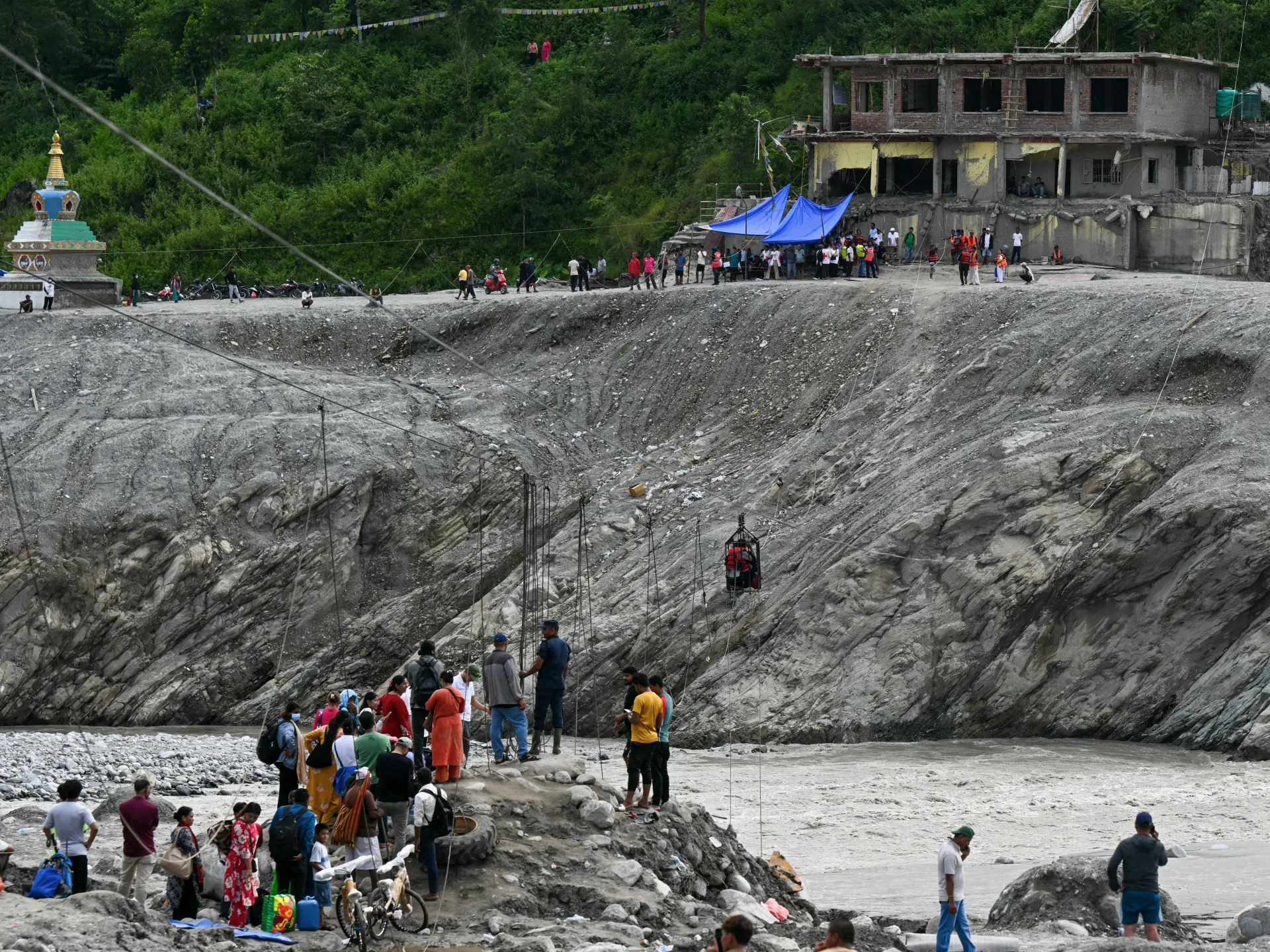
On 26 August, a mass of ice and rock broke loose in Nepal’s Rasuwa district, triggering a violent surge of water, mud and debris down the Lhende Khola River. The torrent swept through valleys, destroying settlements and critical infrastructure before reaching the Nepal-China border. By mid-September, more than 1,400 people had been reported dead and at least 6,000 remained missing in Nepal and Tibet. The disaster destroyed twelve hydropower plants and damaged the Gyirong border crossing, a key trade and pilgrimage route.
Basanta Raj Adhikari, director of the Centre for Disaster Studies at Tribhuvan University in Kathmandu, described the event to Al Jazeera as unprecedented in size, affected area and mechanism. His estimate suggested that the energy involved was greater than that released by the Hiroshima atomic bomb, a comparison intended to illustrate the scale of the physical forces involved rather than suggest the event was equivalent to a nuclear explosion. For scientists, the disaster demonstrated how quickly an event originating in a remote, high-altitude environment can become a regional catastrophe.
The incident has exposed a significant weakness in the design of current early-warning systems. Many existing frameworks are built around specific hazards such as rainfall, river level or glacial lake outburst floods. However, the Himalayas do not always respect these categories. In July, the International Centre for Integrated Mountain Development (ICIMOD) warned that a below-normal monsoon should not be interpreted as a safer one. Saswata Sanyal, a disaster risk reduction specialist at ICIMOD, noted that seasonal averages cannot capture the cloudbursts capable of producing catastrophic flooding in mountain valleys.
ICIMOD has classified the August event as an ice avalanche rather than a conventional glacial lake outburst flood, while other scientists have examined the role of local seismic activity. The immediate trigger was not simply heavy rainfall, but a complex sequence of processes that temporarily obstructed the river system before releasing a destructive surge. A warning system waiting for rainfall or a rising river may not provide enough time when the real trigger happens several kilometres upstream and above the line of sight of the communities below.
The challenge is particularly acute in places where roads, bridges and hydropower projects occupy narrow valleys. At least 900 workers were believed to have been inside tunnels and other facilities in the aftermath, making rescue operations extraordinarily difficult. Two workers were eventually pulled alive from a hydropower tunnel nine days after the disaster. The event highlights the need for anticipatory action rather than simple disaster response, as the era of preparing for a single, predictable hazard is over.
The Himalayas are divided among countries with different political systems and approaches to sharing information, yet rivers do not stop at international boundaries. The August disaster reached the Nepal-China border, raising questions about how quickly information about hazards in high mountain areas can move between countries. Experts argue that regional cooperation is essential, as a sensor positioned in one country can provide warning to people in another. The technical capability often exists, but the architecture connecting it is frequently missing.
A 2026 assessment of Himalayan disaster risks has argued for stronger monitoring, early-warning systems and regional coordination because hazards are increasingly interconnected. The idea is simple: information about a mountain hazard should not stop at the same line where a political boundary begins. As the region enters an era of increasingly complex mountain hazards, the measure of preparedness will be whether warnings reach people in time, regardless of where the initial collapse occurs.