Webb Telescope Provides Strongest Evidence for ‘Black Hole Star’ Model
Astronomers led by the University of Texas at Austin used the James Webb Space Telescope to identify spectral features consistent with a rapidly accreting black hole enveloped in a dense gas cocoon, resolving key aspects of early universe cosmology.
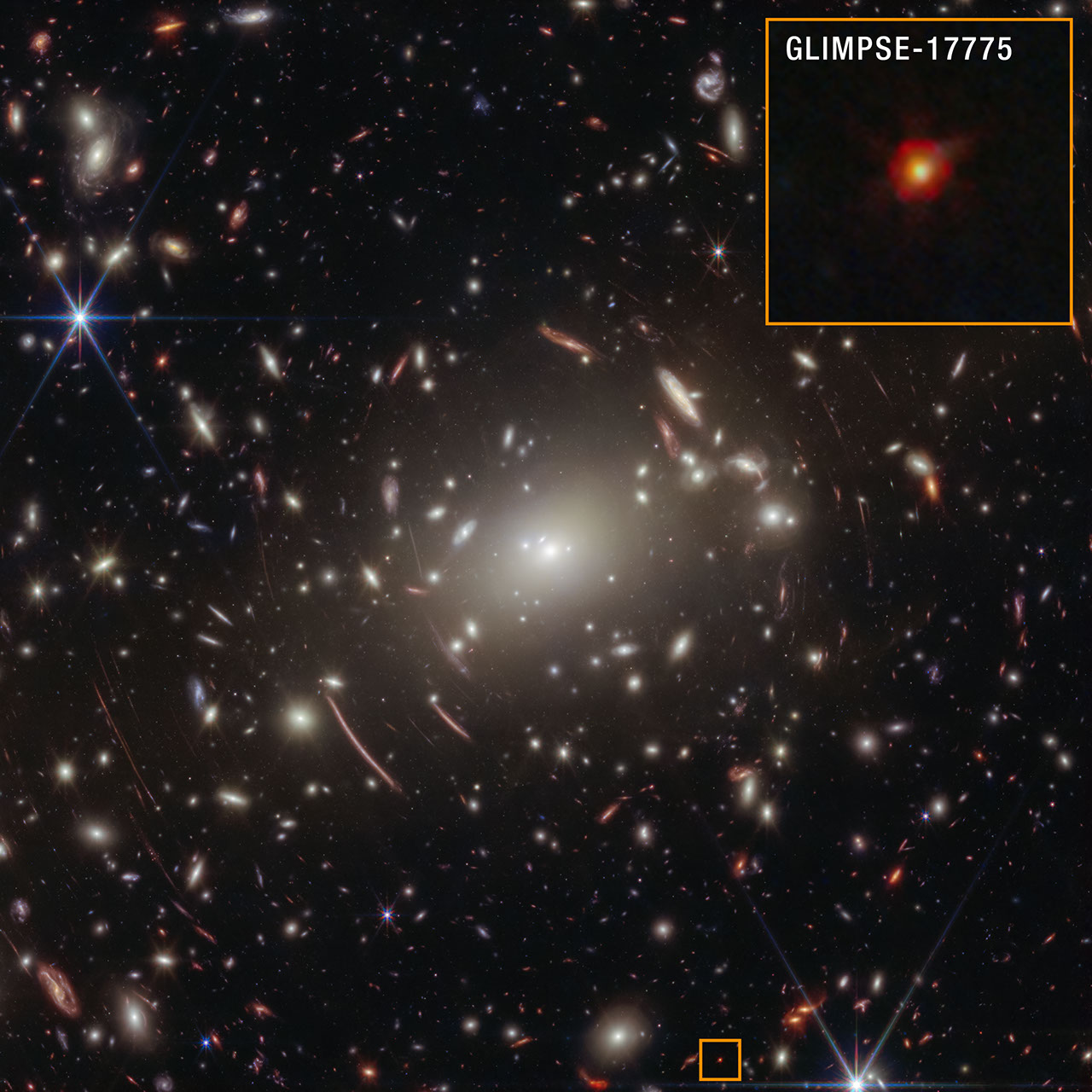
Astronomers led by Vasily Kokorev at the University of Texas at Austin have identified the strongest evidence to date for the ‘black hole star’ (BH*) scenario, utilising data from NASA’s James Webb Space Telescope. The study centres on a specific ‘little red dot’ designated GLIMPSE-17775, which was captured in a deep spectrum during observations of the galaxy cluster Abell S1063. Gravitational lensing amplified the signal, allowing the team to detect over 40 spectral lines. These lines, including an ‘iron forest’ and indicators of electron scattering, support the interpretation that GLIMPSE-17775 is a rapidly accreting supermassive black hole enveloped in a dense, partially ionised gas cocoon. The findings, published in The Astrophysical Journal, suggest that black hole star models can explain the properties of little red dots without requiring galaxy masses that would challenge current cosmological frameworks.
The research team analysed the deepest spectrum obtained to date of a little red dot, a type of object first discovered by Webb in 2022. These compact, red sources emerged approximately 600 million years after the big bang, prompting various scientific explanations. GLIMPSE-17775 was included in Webb’s imaging efforts for a project seeking Population III stars in the Abell S1063 cluster. Although the object is more distant than the cluster, gravitational lensing magnified its signal, making a 30-hour observation equivalent to 80 hours of telescope time. This combination of infrared sensitivity and natural magnification revealed more than 40 spectral lines, providing a level of detail previously unavailable for such sources.
Spectroscopic data from Webb contains multiple independent indicators aligning with the BH* scenario, which proposes that supermassive black holes form directly from the collapse of dense gas clouds. The detected lines for hydrogen, oxygen, and helium do not fit a simple rotating gas cloud model. Instead, the data shows a broadening effect known as electron scattering, indicating a dense, layered gas cocoon enshrouding the source. The strength and ratios of specific lines, particularly 16 iron lines forming an ‘iron forest’ and certain oxygen lines, require a high-energy source consistent with a rapidly accreting black hole. Additionally, fluorescence and absorption of helium suggest a dense medium enveloping a powerful central engine.
The BH* model also accounts for why most little red dots appear faint in X-rays, as such emission is likely absorbed by the dense gas cocoon. To address a missing element in the spectral data—the Balmer break, a signature characteristic of little red dots—the team incorporated ancillary data from NASA’s Hubble Space Telescope. The combined Webb and Hubble data indicate that a giant host galaxy surrounds GLIMPSE-17775, explaining why the Balmer break is weaker than typically observed. The black hole star model attributes excess blue light to stars in this host galaxy, resolving previous concerns that galaxy growth in the early universe appeared too rapid to fit existing cosmological frameworks.
Lead author Vasily Kokorev noted that while the scientific community is converging on the black hole star model, previous observations lacked the comprehensive evidence now presented by GLIMPSE-17775. The study demonstrates that black hole masses do not need to be as high to explain broad emission lines, suggesting the findings fit within the existing framework of the universe’s evolutionary history. Kokorev stated that while the evidence strongly points to a black hole, other theories remain under consideration, and further research is needed to determine what powers these sources. The James Webb Space Telescope, an international program led by NASA with partners ESA and CSA, continues to probe the mysterious structures and origins of the universe.