Saturn’s moon count surpasses Jupiter’s as NASA highlights six largest satellites
As of June 2026, the gas giant holds 293 confirmed moons, more than double Jupiter’s tally, with the largest, Titan, discovered over three centuries ago.
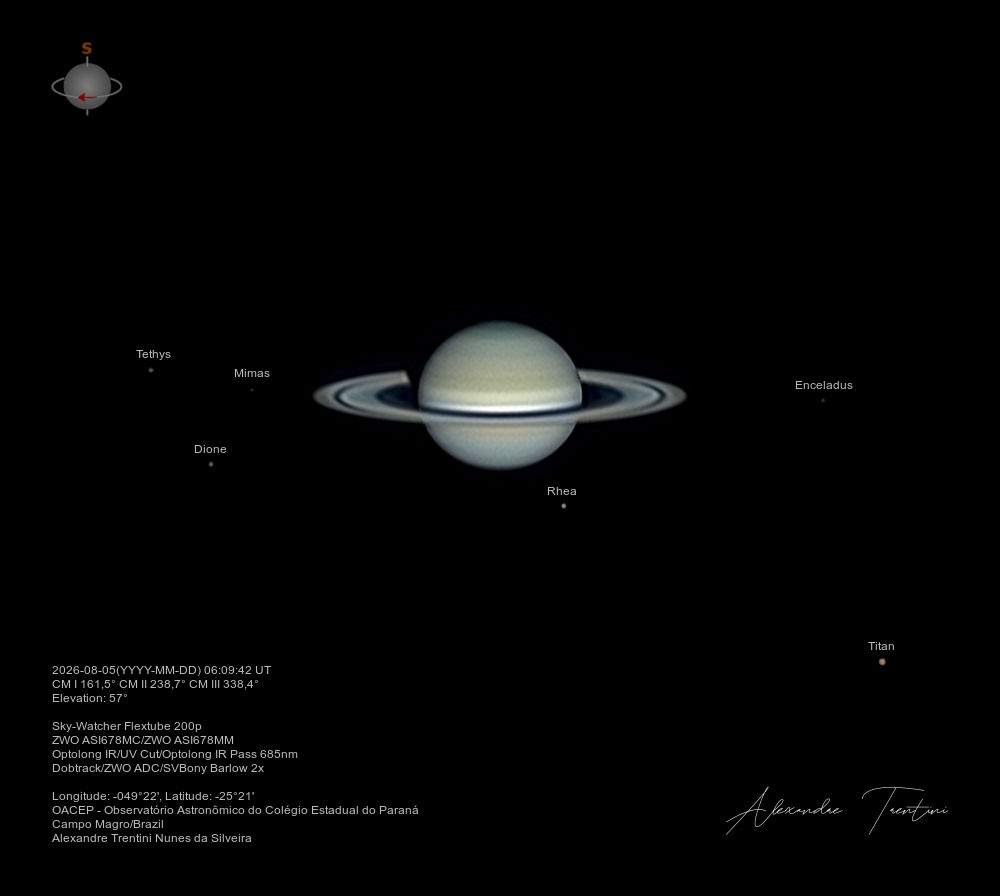
NASA’s Astronomy Picture of the Day for 11 August 2026 has drawn attention to the shifting dynamics of the outer Solar System, highlighting that Saturn now holds the record for the most confirmed moons. The post features a sharp telescopic image taken on 5 August by amateur astronomer Alexandre Trentini, which captures six of the planet’s largest satellites in a single frame.
The accompanying explanation notes that as of June 2026, Saturn possesses 293 confirmed moons, a figure that significantly exceeds Jupiter’s count of 115. This milestone marks a notable change in planetary classification, as Jupiter had historically been considered the ruler of moons in the Solar System. The total number of Saturn’s satellites is expected to continue growing as observational techniques improve and new discoveries are verified.
While the majority of Saturn’s known moons are small, irregular satellites measuring only a few kilometres across and orbiting in tilted outer paths, the image focuses on the six largest bodies. These include the icy major moons Mimas, Tethys, Enceladus, Dione, and Rhea, which are visible alongside the dominant presence of Titan in the lower right of the frame.
Titan stands out as the largest moon in the system, with a diameter of 5,150 kilometres. This makes it larger than Earth’s Moon and slightly larger than the inner planet Mercury. The moon was first identified in 1655 by Dutch astronomer Christiaan Huygens, marking it as Saturn’s first known natural satellite.
The discovery of Saturn’s extensive moon family has been bolstered by data from the space age, particularly through missions such as Voyager and Cassini. These expeditions have contributed significantly to the swelling ranks of known Saturnian satellites, transforming our understanding of the ringed gas giant from a solitary world to a complex system of dozens of celestial bodies.