US deploys three aircraft carriers to Middle East in largest naval concentration since 2003
The arrival of the USS George HW Bush, USS Abraham Lincoln, and USS Gerald R Ford marks a significant escalation in regional tensions, coinciding with a blockade enforced by 34 redirected vessels and over 15,000 soldiers.
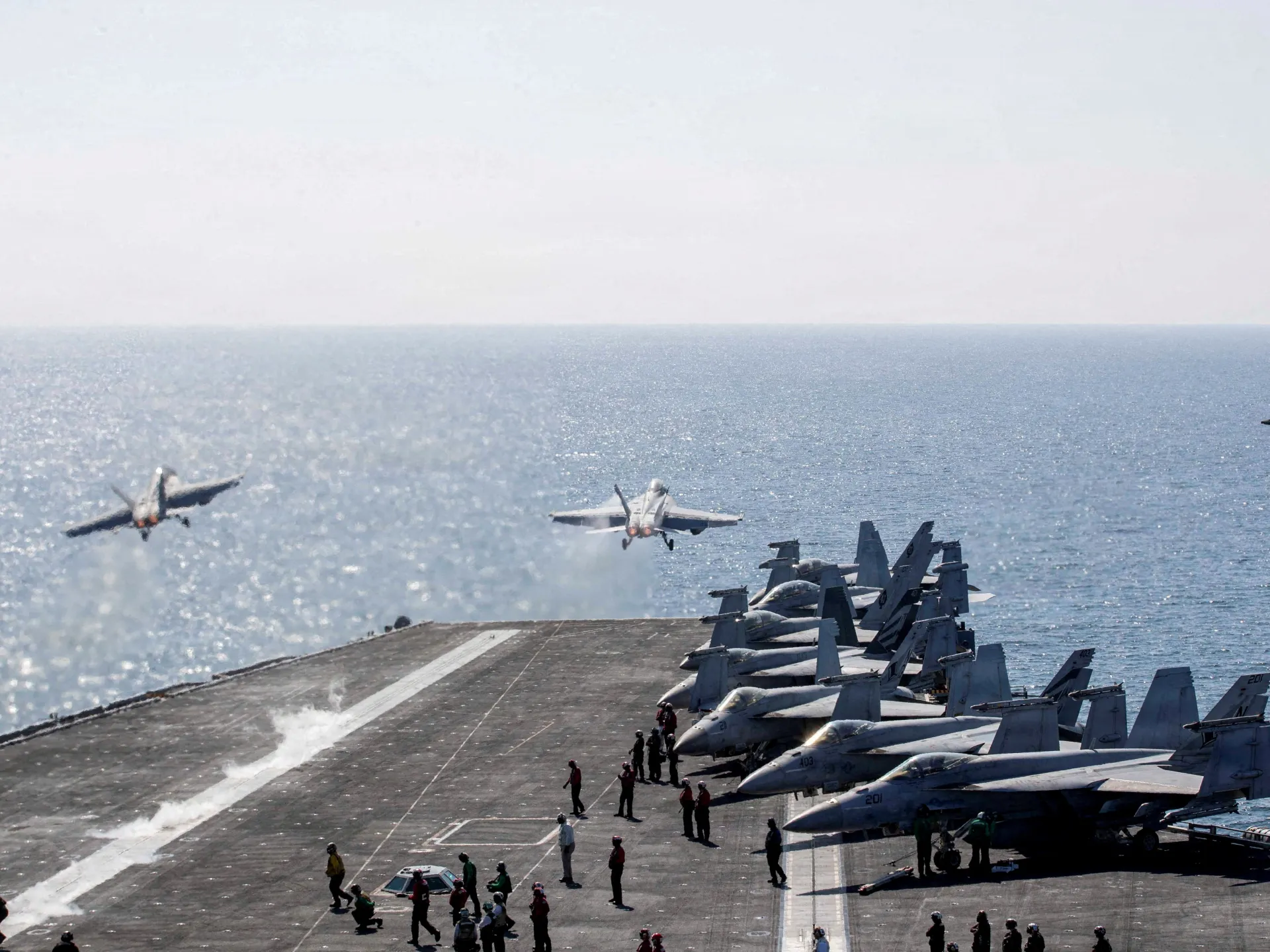
The United States military has confirmed the simultaneous presence of three aircraft carriers in the Middle East, a deployment not seen in the region since the lead-up to the 2003 invasion of Iraq. CENTCOM stated that the force includes the USS George HW Bush, the USS Abraham Lincoln, and the USS Gerald R Ford, accompanied by 12 other ships, more than 200 aircraft, and over 15,000 soldiers. This concentration of naval assets signals a strategic shift as Washington prepares for the possibility of renewed hostilities.
The deployment coincides with the continuation of a blockade against Iranian ports, which CENTCOM describes as involving the redirection of 34 vessels to enforce restrictions on ships entering or exiting the region. This naval siege persists despite diplomatic efforts to stabilise the fragile ceasefire between the United States, Israel, and Iran. The move underscores a policy of pressure, with President Donald Trump asserting that the blockade is depleting the Iranian economy while the US maintains a comfortable status quo.
President Trump has extended the current truce but indicated no immediate intention to lift the naval siege to facilitate further negotiations. In a social media post, he remarked that he has "all the time in the World" to wait for a proposed deal, arguing that the current arrangement imposes a low cost on the US while constraining Tehran. This approach has left diplomatic relations in limbo, with Iran setting the lifting of the US naval blockade as a precondition for resuming talks.
In response to the US actions, Iran has reblocked the Strait of Hormuz, reversing a declaration made last week that the waterway was completely open following an extension of the regional ceasefire to Lebanon. Iranian officials have characterised the US blockade as an act of war, a stance reinforced by reports that Iranian forces have captured foreign commercial ships in the strait, accusing them of violating maritime regulations.
The volatility of the security environment is further highlighted by the recent death of an Indonesian UNIFIL peacekeeper in Lebanon, a casualty that marks the grim toll of the ongoing conflict. Concurrently, Israeli Defence Minister Israel Katz declared that Israel is prepared to renew war against Iran, stating that military targets have already been marked pending a green light from President Trump. Katz noted that the Israeli military is ready for both defence and offence, awaiting a signal to return Iran to what he described as the "age of darkness".
The US military has previously threatened to destroy Iran's civilian infrastructure, including bridges, power stations, and water facilities, adding to the gravity of the situation. As the US maintains its naval siege and Israel awaits authorization to escalate, the region remains on high alert, with the largest concentration of US naval assets since 2003 serving as a stark indicator of the potential for renewed conflict.