Tyndall Glacier retreats further as ISS captures iceberg calving in Patagonia
Astronaut imagery from May 2026 reveals continued fragmentation of Tyndall Glacier, with glaciologist Mauri Pelto noting a 2.2-kilometre length loss since late 2022.
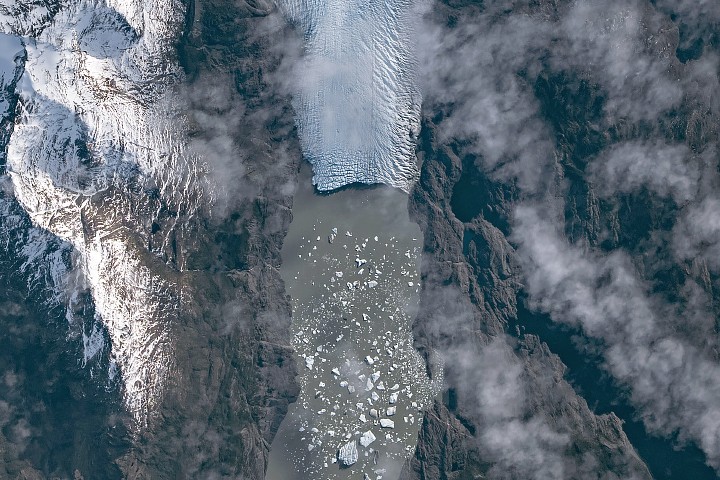
NASA’s Earth Observatory has released new imagery showing Tyndall Glacier in southern Chile continuing its retreat, with fragments of ice calving from its terminus and drifting across Lago Geikie. The photograph, captured on May 10, 2026, by an astronaut aboard the International Space Station, highlights the active fragmentation of the ice mass as it feeds into the growing glacial lake.
The Southern Patagonian Icefield, the largest expanse of ice in the Southern Hemisphere outside Antarctica, has been shrinking since the end of the Little Ice Age approximately 150 years ago. Tyndall Glacier is one of dozens of dynamic outlet glaciers that grind down from the Andes. While many terminate in the sea, Tyndall’s terminus now feeds into Lago Geikie, which formed around 1940 and has gradually expanded as the ice retreated.
Glaciologist Mauri Pelto of Nichols College notes that the glacier has lost 2.2 kilometres in length since November 2022. This recent acceleration in retreat follows a significant calving event in March and April 2023, during which satellites observed several large icebergs breaking away. Prior to this period, the glacier experienced about a decade of limited retreat accompanied by considerable thinning.
The May 2026 observations, taken with a Nikon Z9 digital camera using a 560-millimetre focal length by an Expedition 74 crew member, show that the calving process has become more incremental compared to three years prior. Pelto explains that the substantial crevasses crisscrossing the glacier near the calving front lead to the production of many smaller icebergs, whereas larger tabular icebergs tend to form when fewer deep crevasses are present and the ice is thinner.
Using shadow analysis from the astronaut photograph and data on the Sun’s position, Pelto calculated that the ice cliff at the terminus loomed 30 to 40 metres above the lake surface. He predicts a burst of iceberg production in the following autumn, citing the heavily crevassed appearance of the front. These orbital observations remain critical for monitoring remote regions where ground-based data is scarce.