NASA telescope may have captured predicted quantum effect in magnetar observations
Scientists used the IXPE mission to study magnetar 1E 1547-5408, potentially revealing a phenomenon physicists have theorised for nine decades.
Scientists using NASA’s Imaging X-ray Polarimetry Explorer (IXPE) have conducted extensive observations of the magnetar 1E 1547-5408, yielding data that may confirm a long-standing theoretical prediction about the nature of empty space. The observations, carried out between March and April 2025, spanned more than 140 hours and focused on one of the most extreme environments in the observable universe.
Magnetars represent a distinct class of neutron stars characterised by ultra-strong magnetic fields. These fields are described as the strongest of any object in the observable universe, measuring approximately a trillion times stronger than the most powerful permanent magnets manufactured on Earth. The intense magnetic environment surrounding 1E 1547-5408 provides a unique laboratory for testing fundamental physics under conditions that cannot be replicated on Earth.
The IXPE mission may have captured empty space behaving in a manner that physicists have predicted for 90 years, although such a phenomenon has never been directly observed previously. While the source material does not explicitly name the specific quantum effect, the data points to a deviation in how space behaves under the influence of such extreme magnetic forces, aligning with theoretical models developed in the mid-20th century.
The observations highlight the capability of the IXPE telescope to study the polarisation of X-rays, a technique essential for understanding the geometry and strength of magnetic fields in cosmic sources. By analysing the light emitted by the magnetar, scientists aim to verify whether the vacuum of space itself is altered by the presence of such powerful fields, a concept that challenges classical understandings of empty space.
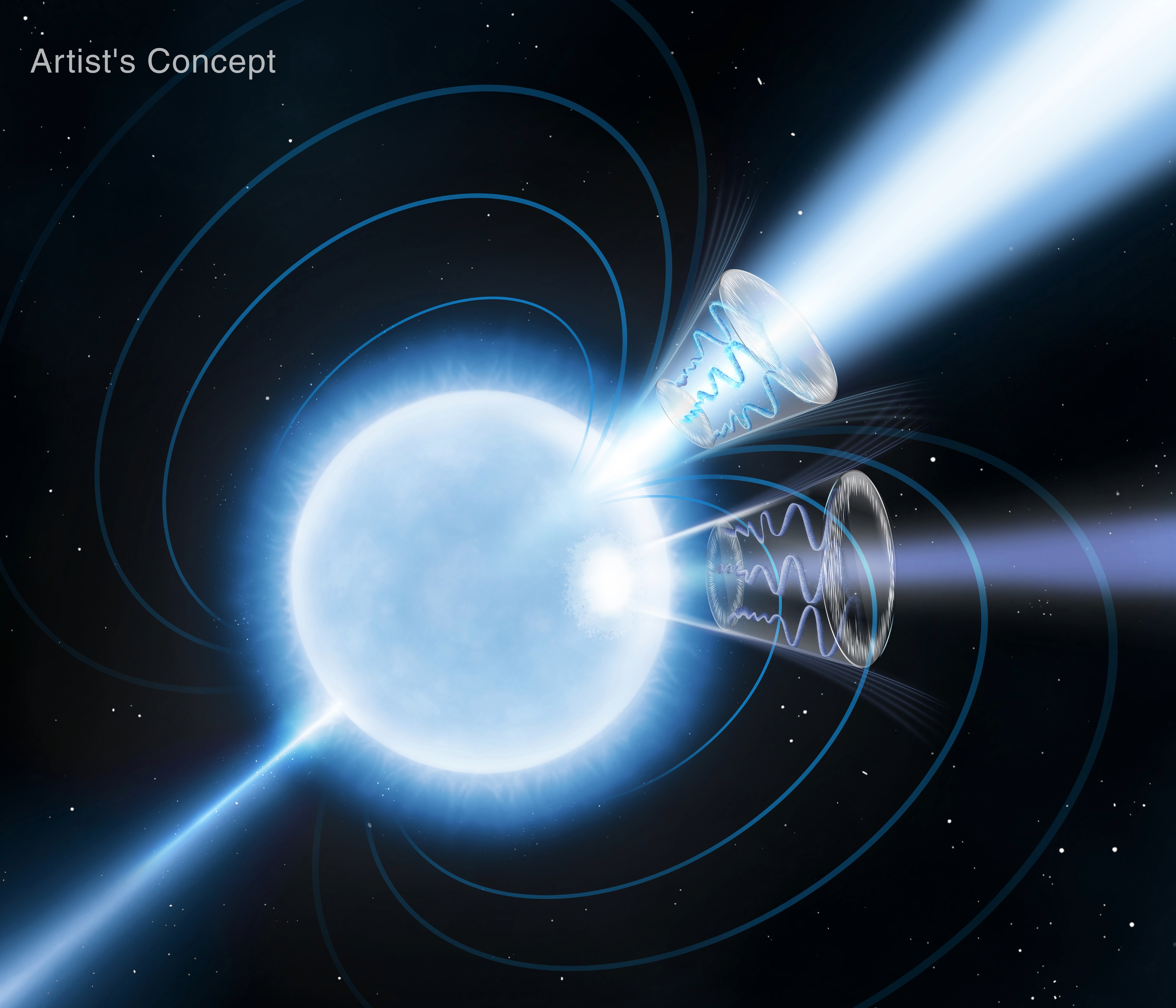
An artist’s concept illustrating the magnetar 1E 1547-5408 was released on 5 August 2026, credited to NASA/Pablo Garcia. This visual representation accompanies the ongoing analysis of the IXPE data, which continues to provide insights into the behaviour of matter and energy in the most magnetic objects known to science.
The report uses cautious language, stating that the observations "may have captured" the predicted behaviour, indicating that the findings are not yet confirmed as a definitive discovery. Further analysis is required to distinguish between instrumental effects and genuine physical phenomena, ensuring that any claims regarding the modification of empty space are rigorously substantiated.
This research underscores the importance of space-based X-ray astronomy in probing the fundamental laws of physics. As scientists continue to examine the data from the 2025 observation window, the potential confirmation of a 90-year-old prediction would mark a significant milestone in our understanding of quantum electrodynamics and the properties of the vacuum.