NASA APOD reveals optical illusion of Comet Tempel 2 and Messier 30
An image captured by Dan Bartlett shows periodic comet 10P/Tempel 2 appearing to pierce the globular star cluster Messier 30, though the objects are separated by 28,000 light-years.
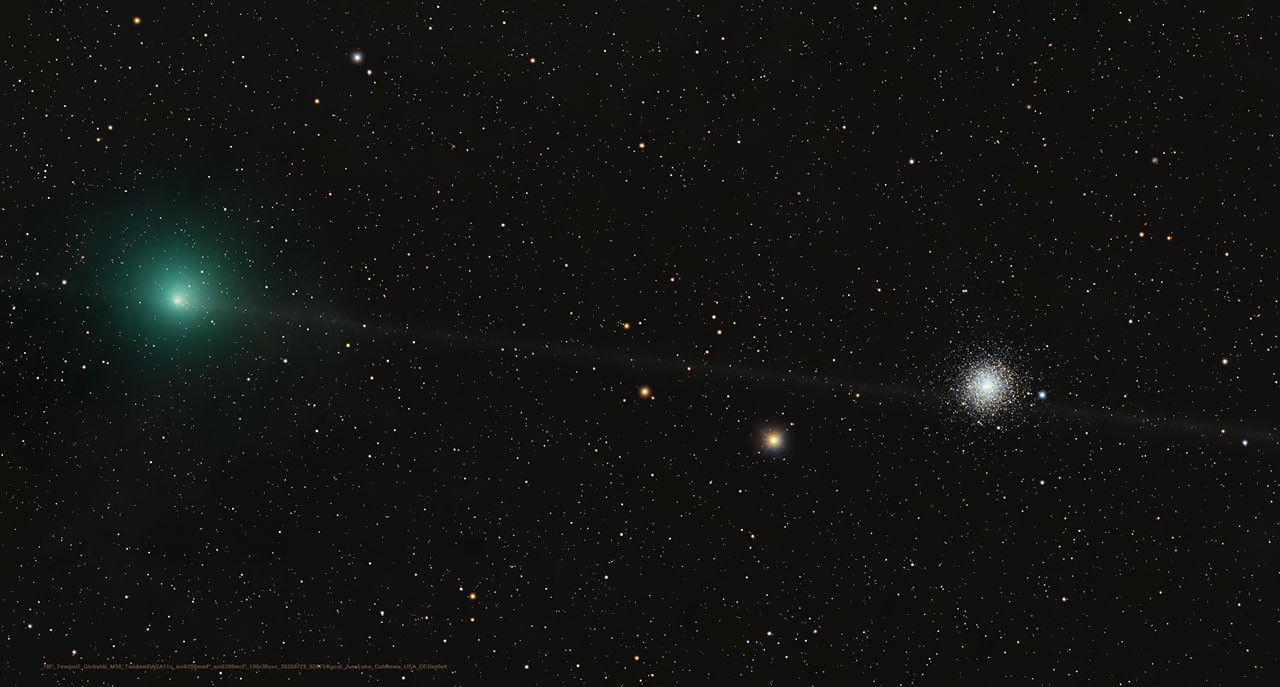
NASA’s Astronomy Picture of the Day (APOD) for 8 August 2026 features a striking image recorded on 29 July by photographer Dan Bartlett. The photograph depicts periodic comet 10P/Tempel 2 in close visual proximity to the globular star cluster Messier 30, also known as M30. While the comet’s faint, narrow orbital dust trail appears to intersect the cluster, the two celestial bodies are separated by vast distances in three-dimensional space.
According to the APOD entry, Tempel 2 is approximately 3.5 light-minutes away from Earth, whereas Messier 30 lies some 28,000 light-years distant. The visual alignment creates an illusion where the diffuse greenish coma of the comet seems to pierce the star cluster, but this is merely a perspective effect from the vantage point of modern telescopes.
The APOD explanation provides historical context regarding Charles Messier, the 18th-century astronomer who compiled his famous catalogue of nebulae and star clusters. Messier created the list to identify non-cometary objects that did not move against the background stars, aiding his primary goal of hunting for actual comets. M30 serves as the 30th entry in this catalogue of objects that are definitively not comets.
The entry notes that even with 18th-century technology, distinguishing between the two objects would have been challenging. In a telescope from that era, both the distant star cluster and the periodic comet would have appeared as similar-looking, faint, and fuzzy patches. Messier would have correctly identified M30 as a fixed object by tracking its lack of motion relative to the stars over successive nights.
The APOD is a service of the Astrophysics Science Division at NASA’s Goddard Space Flight Center, NASA Science Activation, and Michigan Technological University. The editorial team for the entry includes Jerry Bonnell, Cecilia Chirenti, Robert Nemiroff, and Keighley Rockcliffe. The image captures Tempel 2 as it briefly swept close to M30 on the sky, offering a modern perspective on a historical astronomical challenge.