NASA APOD highlights three distinct galaxy pairs in Centaurus Cluster
New analysis of the Centaurus Galaxy Cluster reveals varying stages of galactic interaction, from past collisions to future mergers.
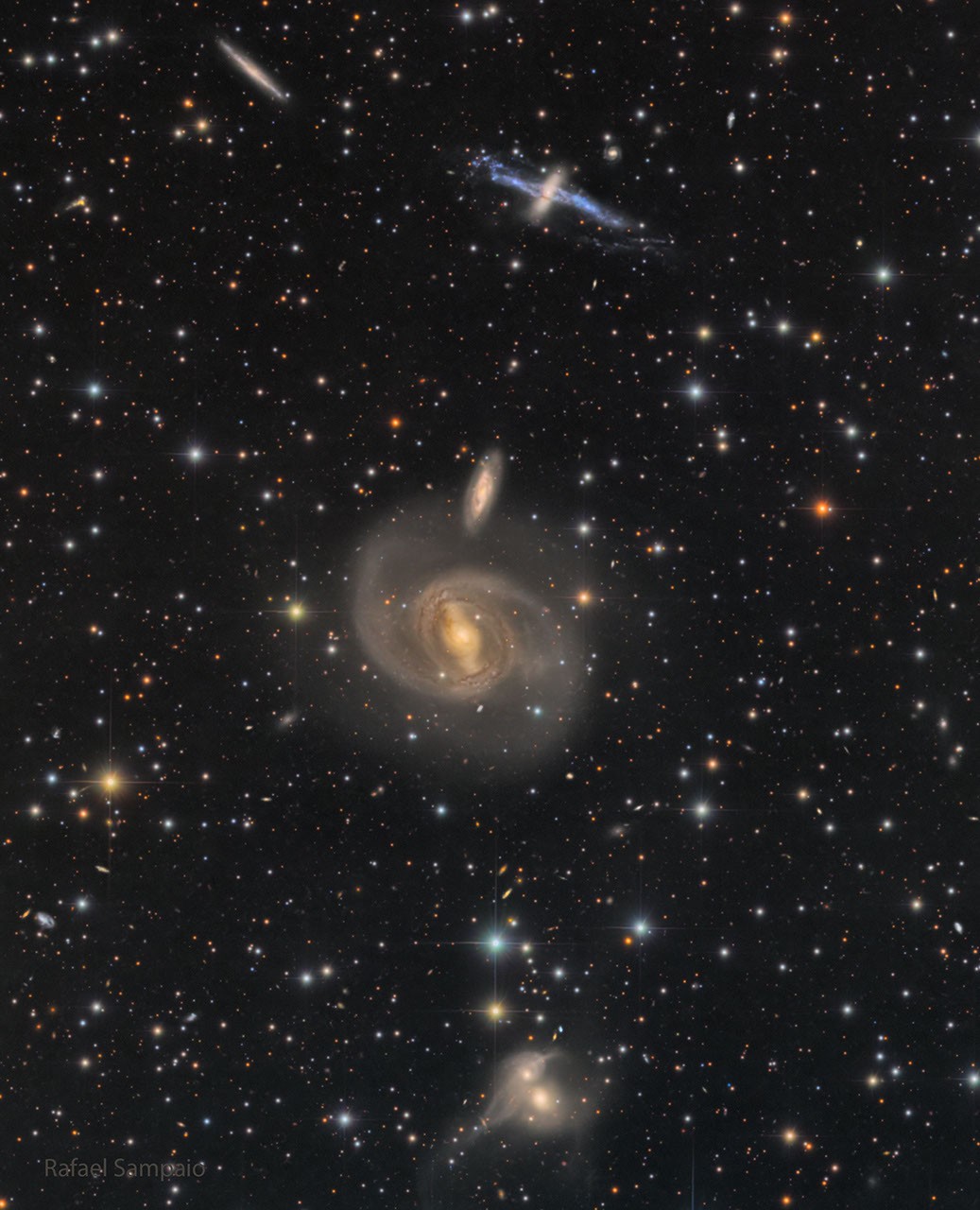
NASA’s Astronomy Picture of the Day (APOD) for 10 August 2026 presents a composite image of three distinct galaxy pairs, which are likely members of the larger Centaurus Galaxy Cluster. The feature, credited to Rafael Sampaio and edited by a team including Robert Nemiroff and Jerry Bonnell, offers a snapshot of cosmic dynamics ranging from isolated structures to active gravitational encounters.
The top section of the image displays NGC 4650A, a polar ring galaxy characterised by a prominent blue stripe. This structure is believed to be the remnant of a past galaxy collision, although the galaxy is not currently interacting with its companion. The visual distinctiveness of the polar ring highlights the complex evolutionary history of this specific system within the cluster.
In the middle of the frame, the barred spiral galaxy NGC 4650 is visible alongside a companion. While the two appear to be interacting gravitationally, their relative speeds suggest that a significant interaction is unlikely. The larger galaxy, NGC 4650, features a bright bar of stars across its centre, a common structural element in spiral galaxies that influences stellar formation and gas dynamics.
The bottom pair, comprising NGC 4622A and NGC 4622B, represents the most active system in the image. These two galaxies are currently interacting, and projections indicate they may merge into a single galaxy in approximately one billion years. This future merger contrasts sharply with the static or past-interaction status of the pairs above it.
The APOD service, a joint effort involving ASD at NASA / GSFC, NASA Science Activation, and Michigan Tech. U., continues to provide daily visual and explanatory content from professional astronomers. The selection of this image underscores the diverse evolutionary paths available to galaxies within dense cluster environments.