Libya’s Government Faces Paralysis Demands as Power Crisis Deepens
The Souq Al-Jumaa Movement calls for the dissolution of the Government of National Unity and House of Representatives, while US officials engage Prime Minister Abdul Hamid Dbeibah on security cooperation.
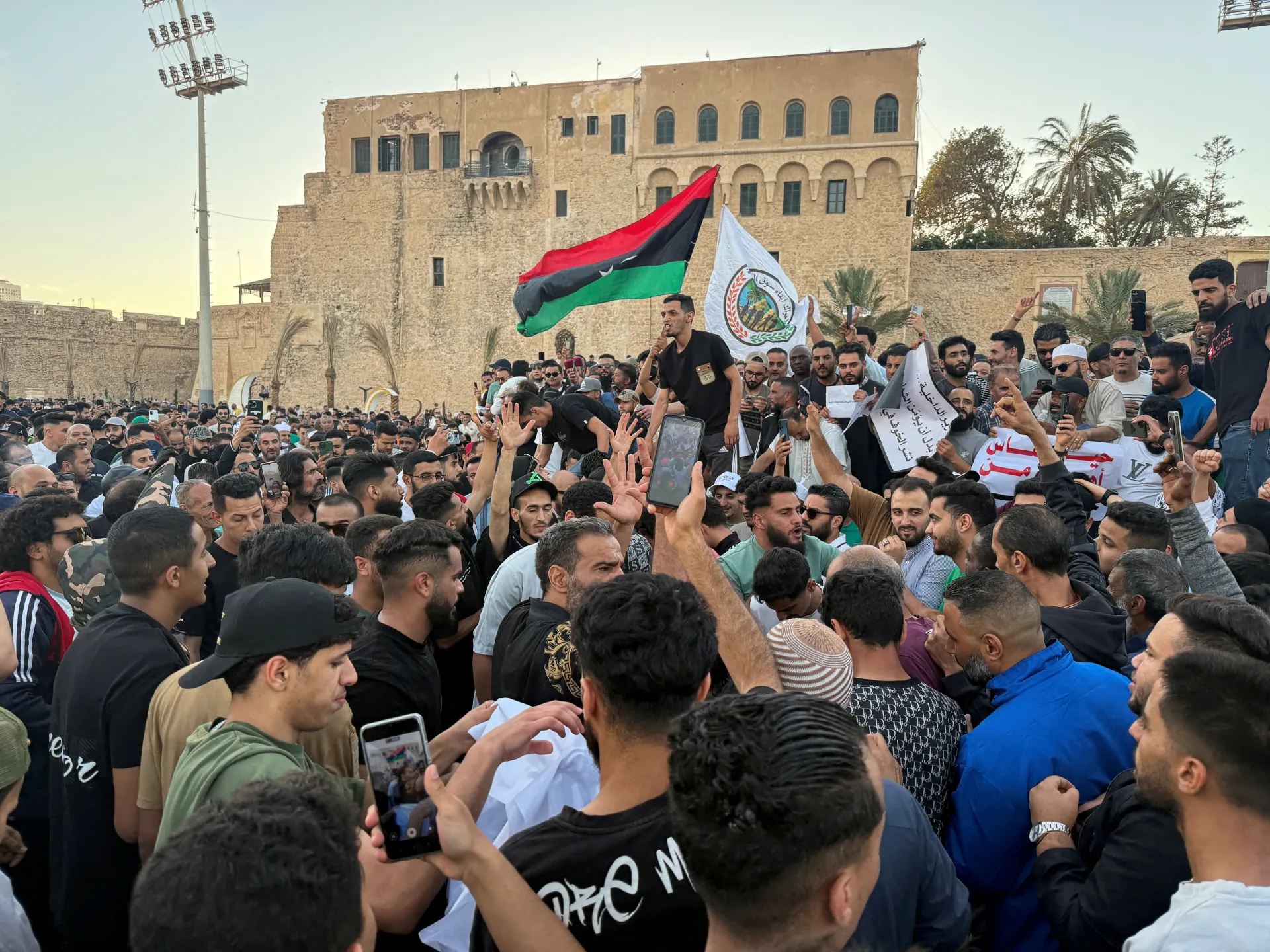
Protesters in Tripoli have escalated a civil disobedience campaign by blocking major roads and shutting down key public buildings, including the Ministry of Foreign Affairs and state telecommunications offices. The unrest, which has spread across multiple districts, is driven by anger over prolonged electricity blackouts that have reached up to 10 hours a day, compounding existing economic instability and inflation.
Verified footage shows demonstrators burning tyres and unloading trucks of dirt to obstruct access to the Ministry of Foreign Affairs in the Sater Turba district. In the Souq Al-Jumaa district, protesters closed the offices of state telecoms operator Libyana, while crowds also gathered outside the West Tripoli power station and blocked the coastal road in Janzour. Banners criticising Prime Minister Abdul Hamid Dbeibah were carried by the mostly young demonstrators.
The campaign was initiated by the Souq Al-Jumaa Movement in May 2025 and has since articulated demands for the dissolution of Libya’s existing political institutions. In a statement issued on Sunday, the movement clarified that its objective is to “completely paralyse the government” rather than disrupt daily life, calling for accountability regarding alleged corruption. It specifically demanded the dissolution of the Government of National Unity, the House of Representatives, the State Council, and the Presidential Council.
Unrest has also extended to the district of Tajoura, where the Tajoura Families and Youth Movement announced a full boycott of state institutions beginning on Monday. The group cited a severe decline in essential services, including electricity, water, education, and healthcare, alongside fuel and liquidity crises. The movement rejected both the unity government and the House of Representatives, accusing officials of prioritising political conflicts over public welfare.
In response to the deteriorating infrastructure, the state-run General Electricity Company has reinstated load-shedding measures after two years of relative network stability. The blackouts have exacerbated public frustration over currency instability and medicine shortages, with no immediate comment issued by the Government of National Unity regarding the escalating protests.
Separately, diplomatic efforts continue as Massad Boulos, the White House adviser for African affairs, held a call with Prime Minister Dbeibah on Sunday. Boulos described the discussion as productive, focusing on steps towards Libyan unification and security cooperation between eastern and western factions. He stated on X that Washington reviewed opportunities for further coordination and interoperability between Libyan forces and Africom, reaffirming US commitment to achieving durable peace and stability in the region.