Jordan joins Artemis Accords as 63rd signatory in Washington ceremony
Ambassador Dina Kawar signed the agreement at NASA headquarters, citing the nation's ambition to become a global technology hub alongside its recent space milestones.
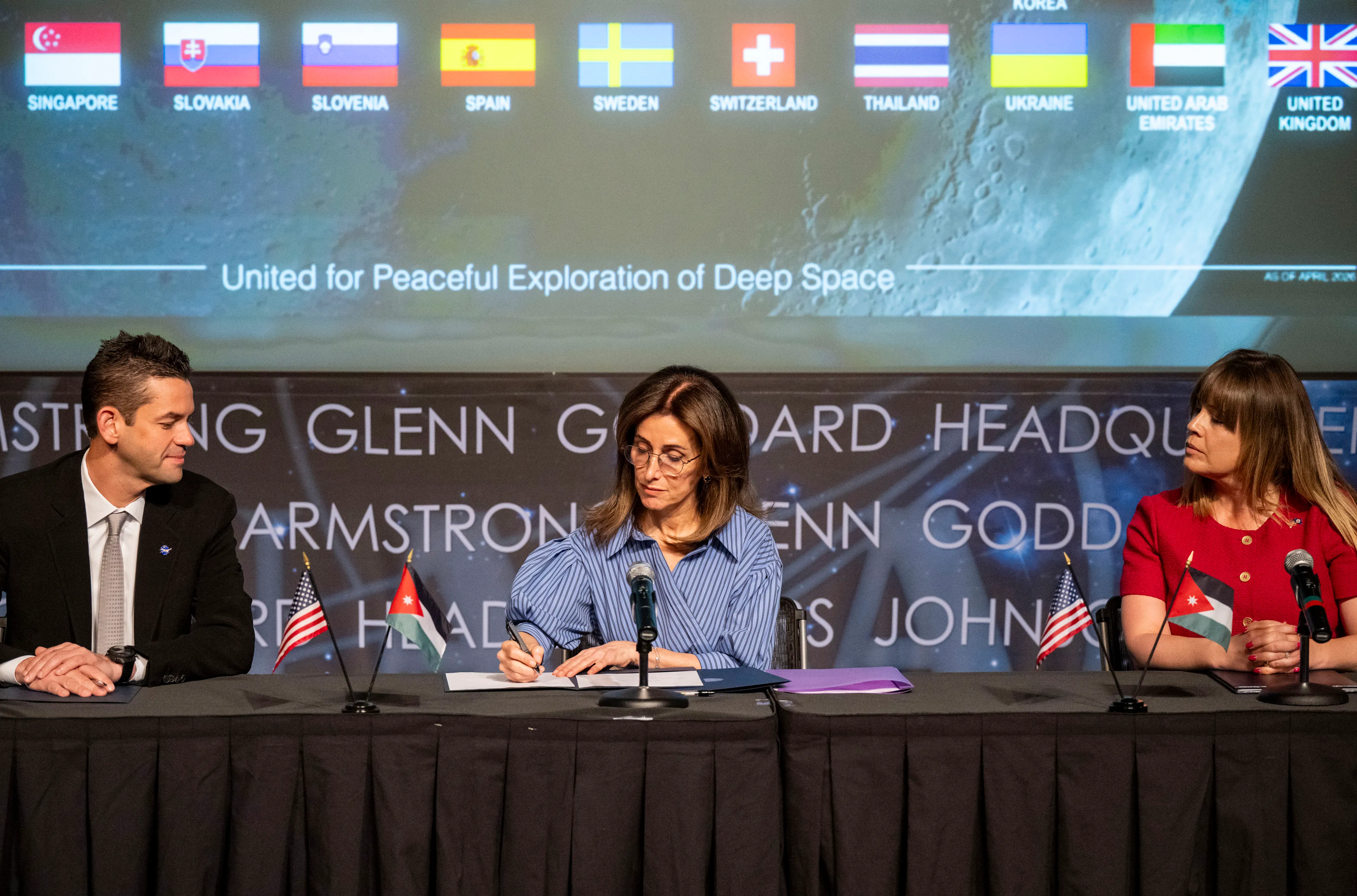
The Hashemite Kingdom of Jordan has officially joined the Artemis Accords, becoming the 63rd nation to sign the international agreement. The signing took place on Thursday during a ceremony hosted by NASA at its headquarters in Washington. Ambassador Dina Kawar signed the document on behalf of Jordan, marking a significant step in the country's engagement with global space exploration frameworks.
NASA Administrator Jared Isaacman welcomed Jordan's participation, noting that the nation brings valuable perspective and capabilities to the effort. The agreement establishes a set of practical principles designed to enhance safety and coordination among like-minded nations as they explore the Moon, Mars, and beyond. By joining, Jordan commits to exploring space peaceably and transparently, ensuring that activities do not interfere with those of others.
Ambassador Kawar emphasised Jordan's unique position in the global engineering landscape, stating that the country has more engineers per capita than almost any other nation. She highlighted the strategic direction provided by His Royal Highness Crown Prince Al Hussein through the National Council for Future Technologies. This initiative aims to transform Jordan into a regional and global technology hub across artificial intelligence, digital infrastructure, advanced manufacturing, and now space.
The nation's commitment is underpinned by tangible achievements in its space sector. Jordan previously launched the JY1 satellite in 2018, a CubeSat developed by university students that transmitted images and audio from orbit via a SpaceX Falcon 9 rocket. Furthermore, the country operates a privately run analog research facility in Wadi Rum, where the Jordan Space Research Initiative conducted the PETRA1 and PETRA2 missions in 2024 and 2025 to advance human spaceflight and planetary research.
The Artemis Accords were established in 2020 by the United States, led by NASA and the State Department, alongside seven other founding nations. The framework was created in response to growing interest in lunar activities by both governments and private companies. Signing the accord means committing to render aid to those in need, enable access to scientific data for all of humanity, and preserve historically significant sites and artifacts.
As more countries are expected to sign in the coming months and years, this agreement continues to shape the future of space exploration. The ceremony concluded with an invitation for American partners to build the next phase of lunar development alongside Jordan, reinforcing the collaborative spirit central to the Artemis programme.