Hubble reveals Andromeda galaxy’s star formation is winding down
Research published in The Astrophysical Journal shows star formation has dropped from one solar mass per year to one-fifth, driven by a natural cooling rather than a lack of material.
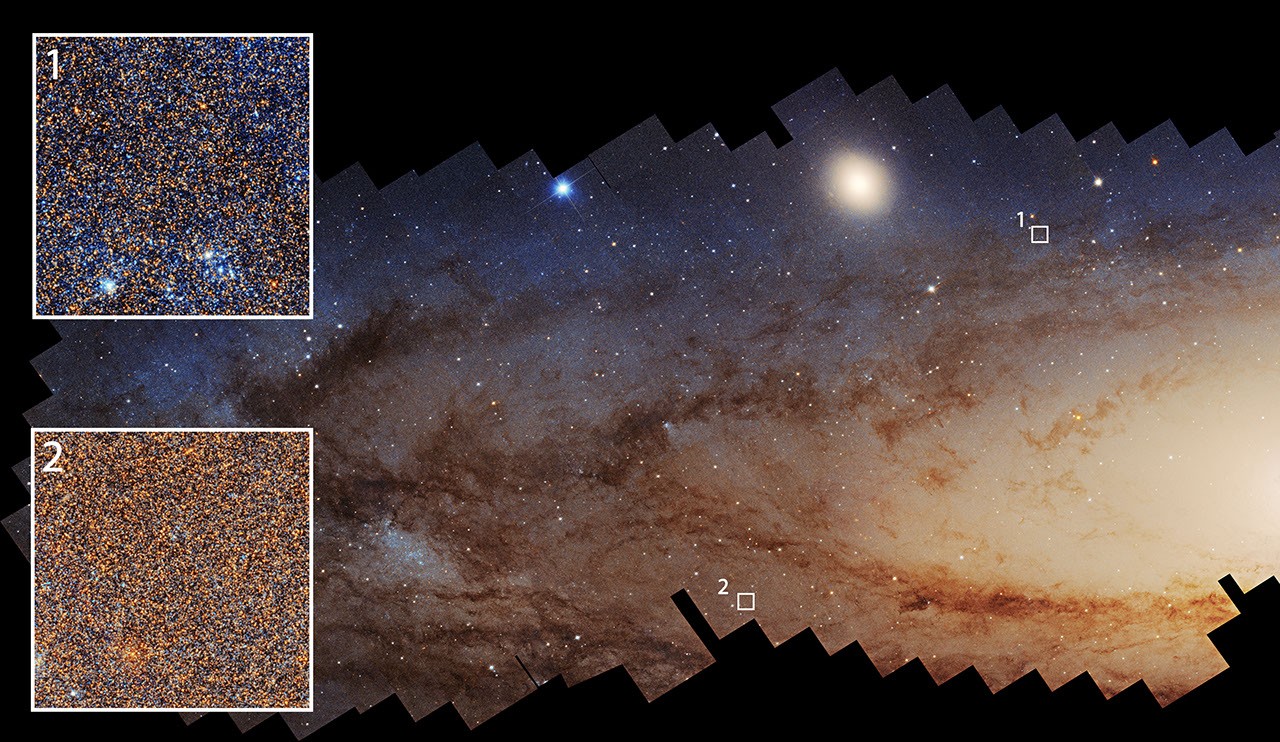
A new study utilising data from NASA’s Hubble Space Telescope has determined that star formation in the Andromeda galaxy has declined significantly over the past 500 million years. The research, published in The Astrophysical Journal, indicates that the rate of stellar birth has plummeted from approximately one solar mass per year half a billion years ago to roughly one-fifth of the Sun’s mass per year currently.
The findings are based on an analysis of approximately 200 million individual stars across two-thirds of Andromeda’s disk. Researchers combined data from the Panchromatic Hubble Andromeda Treasury and the Panchromatic Hubble Andromeda Southern Treasury surveys to map the galaxy’s stellar history in ultra-sharp detail. By dividing images into thousands of squares spanning 300 light-years, the team could determine the formation history within each parcel, treating individual stars as a fossil record of the galaxy’s evolution.
The study reveals that the decline has accelerated recently, with a steeper drop occurring in the last 40 million years. Lead author Tobin Wainer and co-author Ben Williams from the University of Washington, along with co-author Raja GuhaThakurta from the University of California Santa Cruz, attribute this reduction to a natural winding down from a previous period of high activity, rather than a depletion of the gas and dust required to form new stars.
Wainer compared the process to recovering after a marathon, suggesting the galaxy is simply taking a breather after a burst of activity roughly 2 billion years ago. This earlier surge was likely caused by an interaction or merger with another galaxy. The current low rate is not uniform across the galaxy; recent star formation is now concentrated in a ring located approximately 32,000 light-years from the centre, and the overall decline is largely driven by reduced activity within this specific region.
The team also investigated potential interactions with the satellite galaxy M32. While the 3D location of M32 remains uncertain, areas of Andromeda near the satellite showed signs of decreased star formation beginning roughly 60 million years ago. Researchers identified M32 as the most likely suspect for influencing activity in that specific area, though they noted they cannot explicitly confirm the interaction caused the decrease. The findings underscore the value of archival Hubble data in understanding the history of galaxies like our own Milky Way.