Guadalajara’s Urban Expansion Meets Volcanic History During 2026 World Cup
As Guadalajara hosts its third World Cup, satellite imagery highlights the westward growth of its metropolitan area into the Sierra la Primavera volcanic complex.
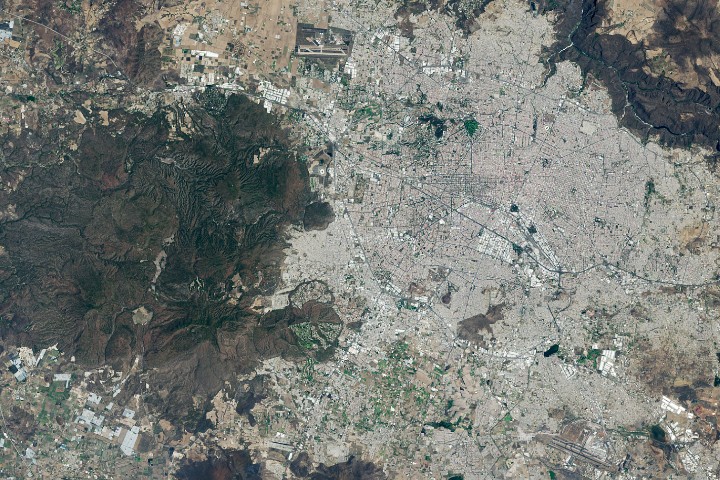
Guadalajara, Mexico, is currently hosting matches for the 2026 FIFA World Cup, marking the city’s third time staging the tournament. The event follows previous hostings in 1970 and 1986, with the 2026 opening round match between South Korea and Czechia taking place at Guadalajara Stadium on June 12. The city will host four first-round matches in total, including fixtures involving Mexico, Colombia, and Uruguay.
The landscape surrounding the new venue has changed significantly since the last World Cup in 1986. Satellite imagery from NASA’s Earth Observatory, using Landsat data, shows that the land where Guadalajara Stadium now sits was farmland at that time. The stadium, also known as Estadio Akron, was built in 2010 in Zapopan, a municipality northwest of Guadalajara. In 1986, matches were held at Jalisco Stadium in northeastern Guadalajara, as the current stadium had not yet been constructed.
Urban development has expanded westward into Zapopan, encircling the Sierra la Primavera volcanic complex. The metropolitan population has grown from approximately 2.7 million in 1986 to over 5.5 million. Zapopan has emerged as a burgeoning tech hub, sometimes referred to as “Mexico’s Silicon Valley,” with the appearance of Guadalajara Technology Park and new industrial parks. New greenhouses have also emerged in the area, particularly south of the reserve, used for growing fruits and vegetables.
The stadium’s design draws inspiration from the nearby volcanic terrain. It rises from a grassy earthen berm meant to resemble the flanks of a volcano, topped with a white roof reminiscent of a volcanic cloud. The Sierra la Primavera complex is a rugged landscape shaped by ancient volcanic activity, including a massive eruption about 95,000 years ago that formed a caldera 11 kilometers in diameter. Lava domes, such as Cerro del Colli, formed along the southern edge of the caldera, with the youngest dating to about 30,000 years ago.
Much of the original caldera is preserved as the La Primavera Biosphere Reserve, a forested area that has remained intact despite the encroaching urban development. The city is also commemorating its football history with a 9.5-metre bronze statue of Pelé, erected in May 2026 to mark Brazil’s 1970 World Cup victory, during which Jalisco Stadium hosted key matches.
Local festivities have extended to the Guadalajara Zoo, where animals including elephants, gorillas, and pumas are participating in match predictions. A puma named Muluk was reported to have predicted South Korea’s victory over Czechia by selecting a soccer ball. The city continues to celebrate its role in global football, blending its volcanic geography with rapid modern growth.