Expert warns EU sanctions policy permits Irish alumina exports aiding Russian war effort
Speaking on France 24’s Spotlight programme, Jordash contends that authorities must assess foreseeable supply chain risks rather than requiring proof of direct links between specific shipments and weapon systems
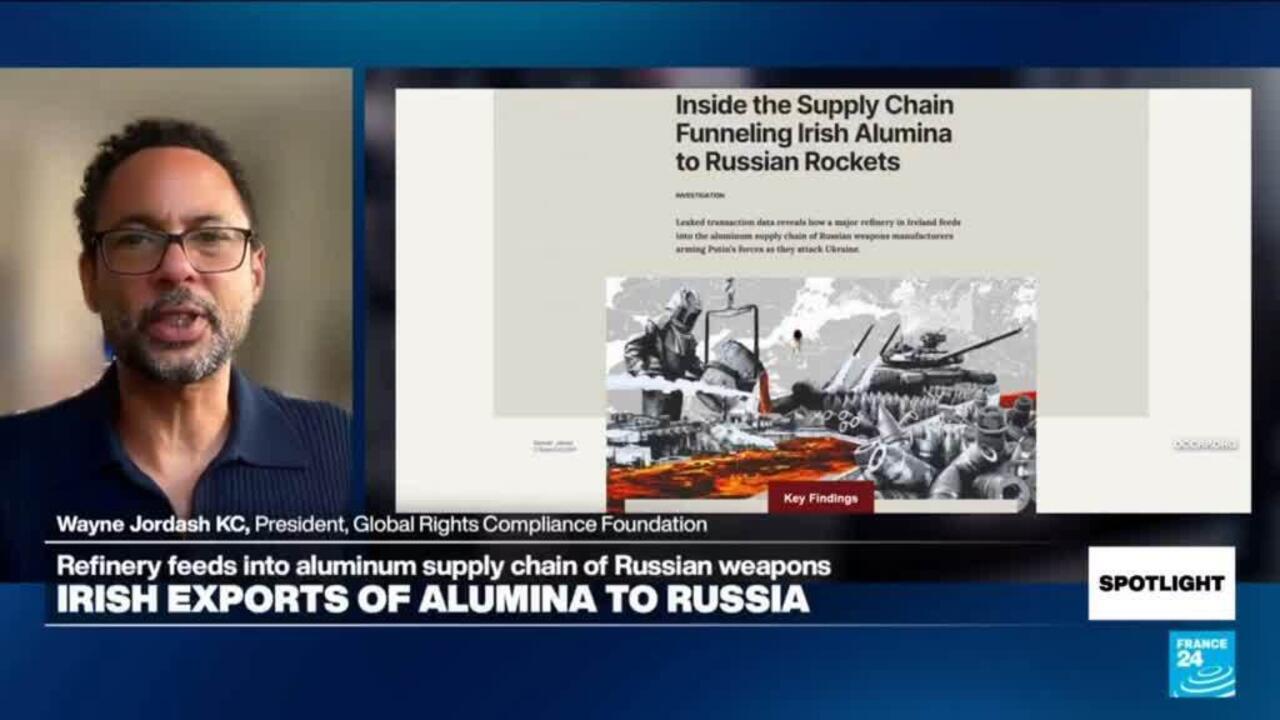
Wayne Jordash, president of the Global Rights Compliance Foundation, has accused an unnamed Irish company of assisting in the commission of crimes by supplying alumina to Russia. Speaking on the France 24 programme Spotlight on 23 June 2026, Jordash argued that the European Union’s current sanctions regime contains a fundamental flaw by permitting the export of this strategic raw material, which he contends supports Russian weapons production.
Jordash highlighted a contradiction in the bloc’s approach: while seeking to constrain Russia’s military-industrial capabilities through sanctions, European authorities continue to permit the export of materials that may ultimately support the production of armaments. He asserted that the critical issue is functional dependence and economic reality, suggesting that the scale of the Irish entity’s commercial ties to Russia creates de facto influence regardless of formal ownership structures.
The discussion touched on the potential ties between the Irish company and Russian oligarch Oleg Deripaska. Jordash suggested that whether Deripaska formally controls the company is less significant than the commercial reality of the relationship. He argued that such connections create a level of influence that warrants scrutiny under international law, irrespective of corporate governance formalities.
Jordash contended that governments have obligations extending beyond proving a direct link between a specific shipment and a specific weapon system. He argued that authorities must assess foreseeable risks throughout supply chains and address the possibility that commercial activity may facilitate international crimes. This stance challenges the current evidentiary standards often required to hold corporations accountable for their role in wartime supply chains.
The allegations were presented in the context of the ongoing Ukraine war, focusing on the intersection of sanctions policy, corporate accountability, and the flow of strategic raw materials. Jordash’s intervention underscores growing concerns that loopholes in the EU’s sanctions framework may inadvertently sustain the Russian military-industrial complex through indirect commercial channels.