Astronomers identify possible supernova remnant near Milky Way’s centre
The candidate remnant, located 26,000 light-years from Earth, challenges alternative explanations and adds to the understanding of stellar cycles near the supermassive black hole.
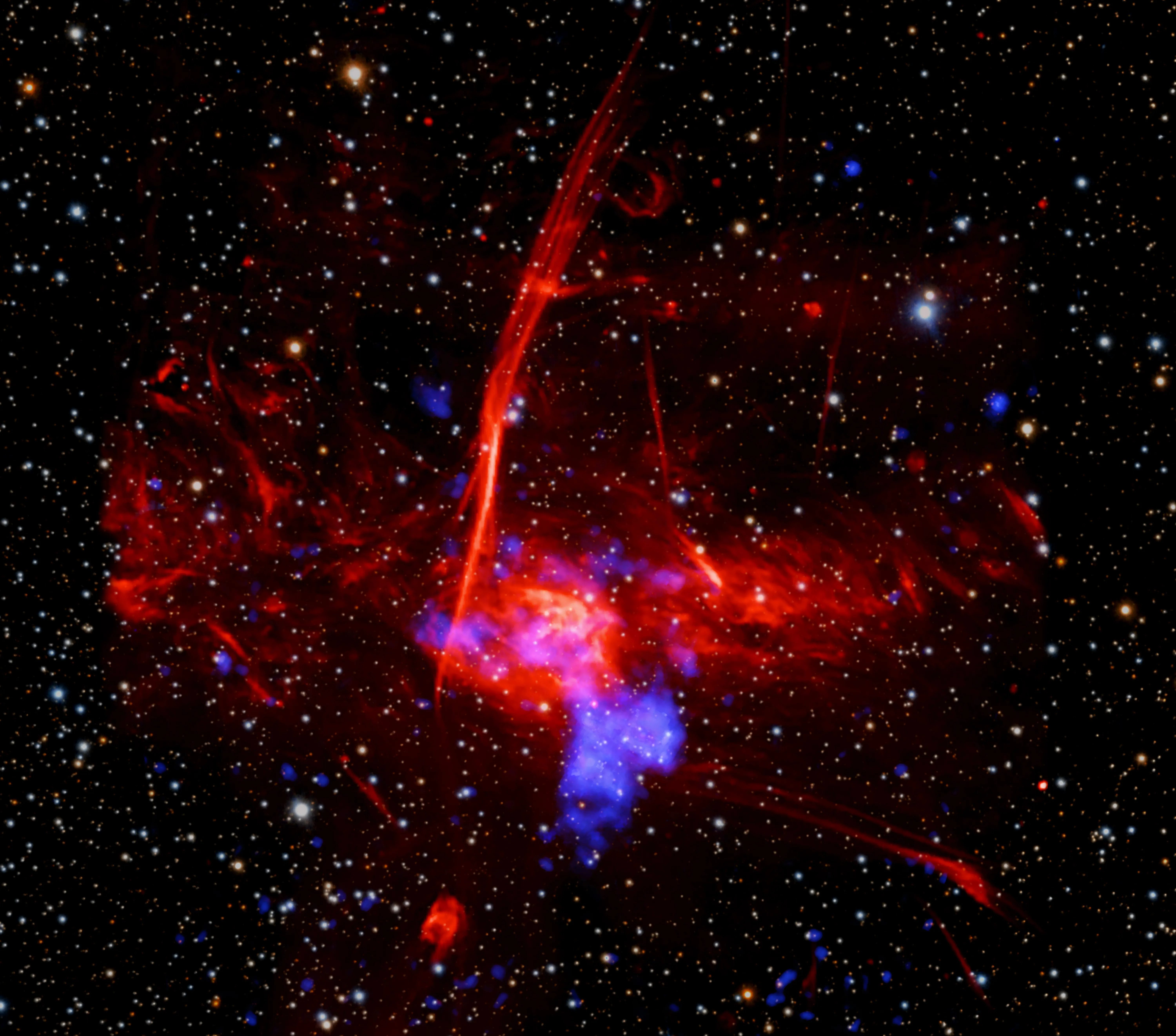
Astronomers have identified a candidate supernova remnant in the central region of the Milky Way, situated approximately 26,000 light-years from Earth. The discovery, detailed in a paper published in The Astrophysical Journal, utilises X-ray data from NASA’s Chandra X-ray Observatory and ESA’s XMM-Newton mission, alongside radio observations from South Africa’s MeerKAT telescope and optical data from Hawaii’s Pan-STARRS.
If the identification is confirmed, the object would rank as one of the closest supernova remnants to the supermassive black hole at the heart of the galaxy. The remnant is located within the Sagittarius C H II region, a bubble of ionised gas surrounding a massive, young star. It is expanding at roughly two million miles per hour and is estimated to be at least 1,700 years old.
The evidence for the remnant stems from a distinct “blob” of X-ray emission detected by Chandra and XMM-Newton. This emission is buried within a larger cloud of expanding gas. Previous observations from NASA’s now-retired SOFIA mission had already hinted at a stellar explosion in this location by revealing an expanding shell of gas surrounding Sagittarius C.
Researchers ruled out the possibility that the X-ray blob is caused by a cluster of massive stars. The study’s authors noted that the emission is more than ten times brighter than the X-ray output from known stellar clusters containing bright, massive stars. The team included Zhenlin Zhu and Mark Morris from the University of California, Los Angeles; Gabriele Ponti from Italy’s National Institute for Astrophysics; and Ping Zhou from Nanjing University.
While the team searched for enhanced amounts of key elements such as iron, oxygen, and silicon in the X-ray data, they did not detect a significant increase. The authors suggest this absence of elemental enhancement may indicate that the stellar debris has already mixed thoroughly with the surrounding gas. Supernova remnants are critical for distributing these elements, which are essential for the formation of planets and life.
The composite images released with the study highlight the complex environment of the Galactic Centre. Long filaments visible in the radio data are caused by energetic particles travelling along magnetic fields that are mostly directed perpendicular to the plane of the galaxy. The study underscores the exotic nature of the region, which is crammed with massive stars, dense gas clouds, and intense magnetic fields orbiting the central black hole.
NASA’s Marshall Space Flight Center manages the Chandra program, while the Smithsonian Astrophysical Observatory’s Chandra X-ray Center controls science and flight operations. The findings provide new context for the lifecycle of stars in the dense nuclear environment of the Milky Way.