Webb Telescope Reveals New Detail in Lion Nebula Structure
NASA’s James Webb Space Telescope has released fresh observations of NGC 2392, offering a clearer view of the planetary nebula’s remains than previous Hubble Space Telescope data from 2000.
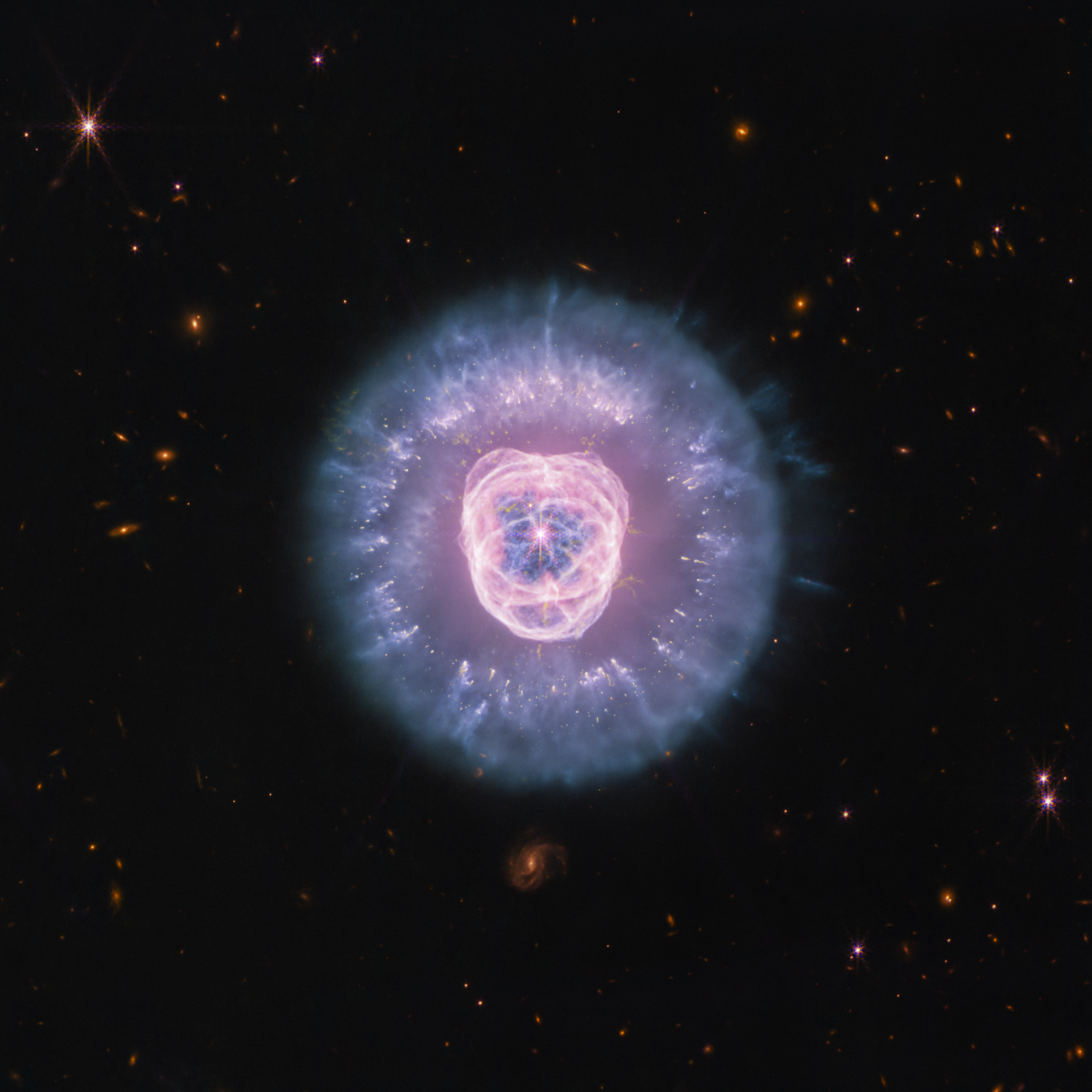
NASA’s James Webb Space Telescope has released high-resolution images of NGC 2392, a planetary nebula colloquially known as the Lion Nebula. The images, processed by Alyssa Pagan of the Space Telescope Science Institute (STScI), were released on 10 August 2026 and highlight the detailed structure of the celestial object’s “mane”.
The new observations utilise data from the telescope’s Near-Infrared Camera (NIRCam) and Mid-Infrared Instrument (MIRI). These instruments provide a clearer view of the remains of a dying star, specifically highlighting dust clumps and ionised gas surrounding the core.
These features were not visible in previous images captured by the Hubble Space Telescope in 2000. The release underscores the capability of Webb’s specific instruments to reveal details obscured in earlier observations, providing astronomers with new data on the nebula’s composition.
The image credits list NASA, the European Space Agency (ESA), the Canadian Space Agency (CSA), and the STScI. The release follows a pattern of recent Webb observations, including a study of the Tarantula Nebula led by Jennifer Rodriguez, which combined data from multiple observatories to investigate energy loss in star-forming regions.
While the images provide a detailed visual record of the nebula’s structure, the source material does not detail specific scientific conclusions regarding the evolution or chemical composition of NGC 2392 beyond the visibility of its dust and gas components.