Webb Telescope Reveals Detailed Structure of the Lion Nebula
New observations from the NIRCam and MIRI instruments provide a clearer view of the dying star’s remains, highlighting dust clumps and ionised gas that were not visible in previous Hubble Space Telescope images from 2000.
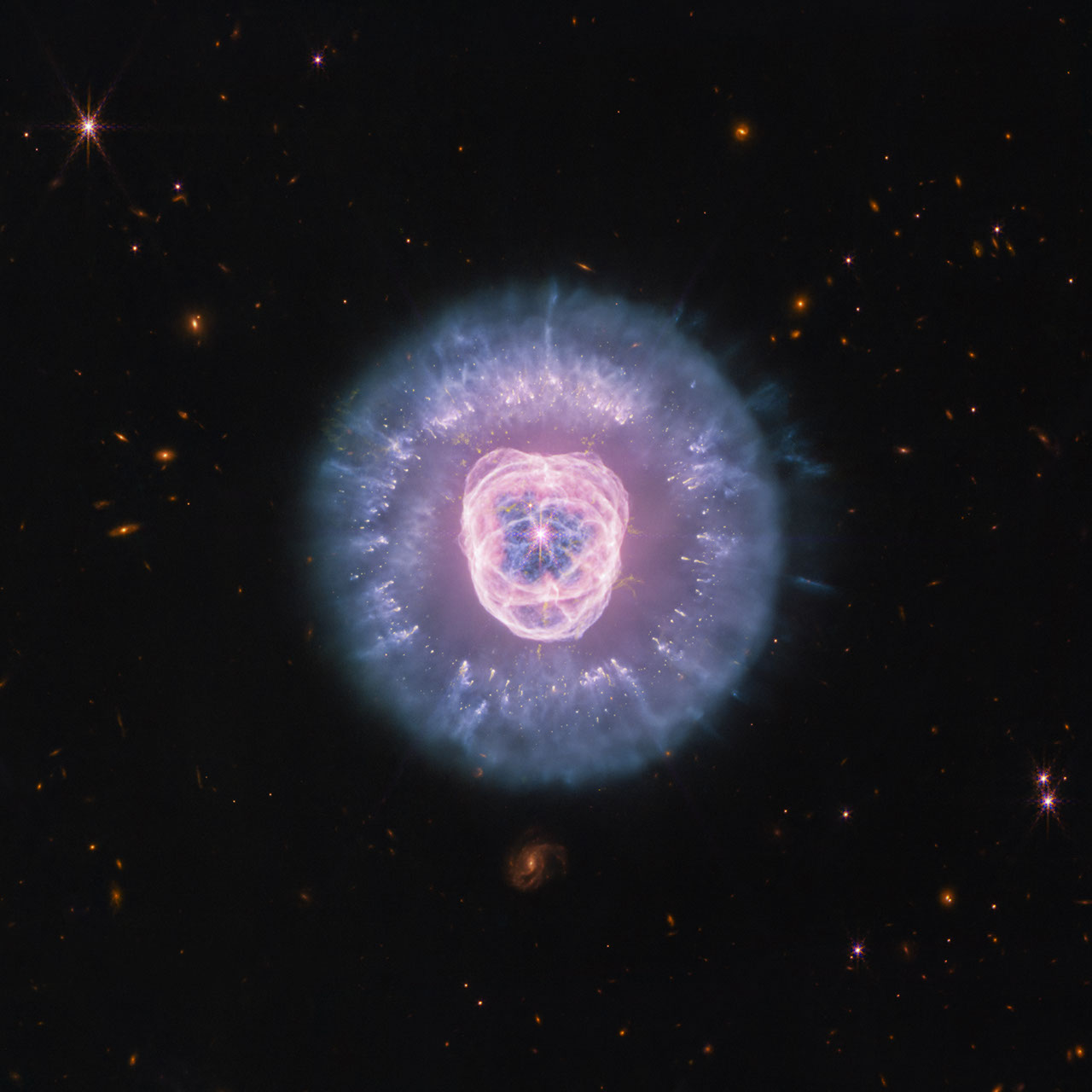
NASA’s James Webb Space Telescope has released new high-resolution infrared images of NGC 2392, a planetary nebula commonly known as the Lion Nebula. The imagery, captured using the Near Infrared Camera (NIRCam) and the Mid Infrared Instrument (MIRI), reveals intricate details of compact dust clumps and a haze of ionised gas surrounding the remains of a dying star. These observations offer significantly greater clarity than previous visible-light views obtained by the Hubble Space Telescope in 2000.
At first glance, the overall structure of the nebula in Webb’s infrared images may appear similar to Hubble’s earlier visible-light view. However, Webb’s infrared vision highlights specific features such as compact clumps of dust and a haze of ionised gas that were not as clearly defined in previous observations. The central white dwarf is described as “cooking” the surrounding material, producing a bubble of ionised gas that forms the lion’s face and is expanding over time.
The “mane” of the lion is identified as the interior of a dust shell illuminated by the white dwarf, while the “tufts” are compact clumps of dust that have survived the stellar core’s radiation. These dust filaments protect the material that lies behind them, creating a complex structure that astronomers estimate will disperse in approximately 10,000 years.
Planetary nebulae form when lower-mass stars, which can no longer sustain nuclear reactions in their cores, become unstable and shed their outer layers. The star’s radiation drives the ejected material away, leaving behind the very hot stellar core, also known as a white dwarf. In the Lion Nebula’s case, the death of the oxygen-rich central star has left behind a white dwarf that is powering the intricate structures seen here.
Understanding why the swept-up gas has a complex structure of rings and shells is an ongoing endeavor. The James Webb Space Telescope is an international programme led by NASA with partners ESA (European Space Agency) and CSA (Canadian Space Agency).