Victory Day parade in Moscow stripped of military hardware as Putin justifies war against Nato
President Vladimir Putin used the annual commemoration to frame the ongoing conflict in Ukraine as a necessary defence against an aggressive bloc, while a fragile truce announced by US President Donald Trump held briefly during the celebrations before mutual accusations of violations emerged.
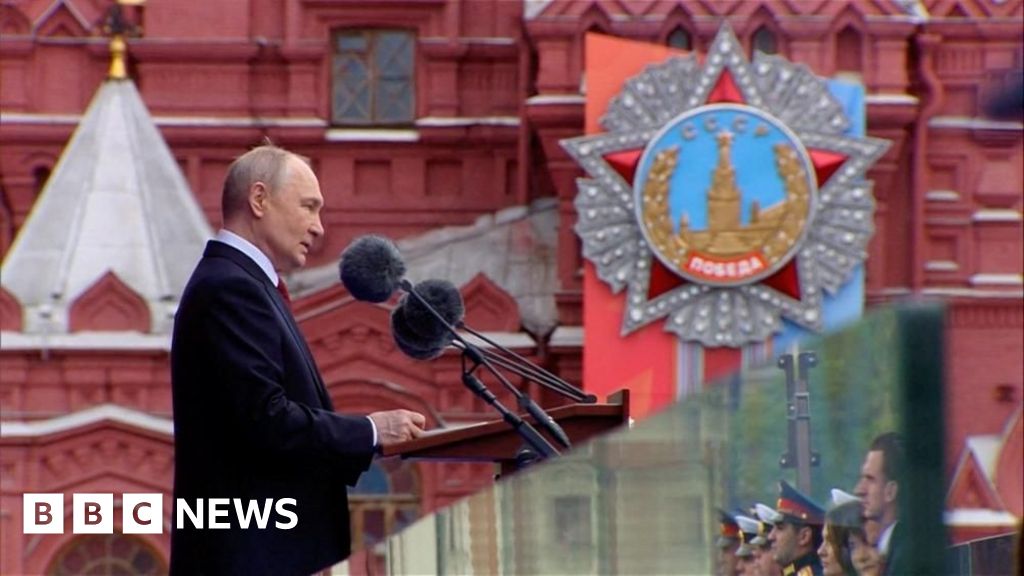
Russian President Vladimir Putin delivered his annual Victory Day address in Moscow's Red Square, utilising the platform to justify the continuation of the special military operation in Ukraine and to condemn the North Atlantic Treaty Organisation as an aggressive entity. Speaking before a gathering of military personnel and a limited number of foreign dignitaries, the President characterised the war as just, describing Ukraine as an aggressive force that is being armed and supported by the entire Nato bloc. This rhetoric serves to frame the ongoing conflict as a necessary defence of the nation against external threats, drawing parallels to the sacrifices made during World War Two.
In a significant departure from recent traditions, the Moscow parade featured no military hardware for the first time in nearly two decades. Officials cited the current operational situation and the need to keep equipment on the battlefield as the primary reasons for omitting tanks, missiles, and other ground-based armaments from the display. Russian MP Yevgeny Popov reinforced this explanation, stating that their tanks are currently busy fighting and are required more on the front lines than in a ceremonial parade. Security measures were also significantly tightened, with threats of Ukrainian drone attacks used to justify the scaling back of the event's visual spectacle.
Despite the absence of heavy weaponry, military personnel marched in large numbers across Red Square, maintaining the traditional focus on the human element of the armed forces. The event was flanked by Belarusian leader Alexander Lukashenko, while other attendees included Laos President Thongloun Sisoulith and Malaysia's King Sultan Ibrahim. However, the diplomatic turnout was markedly reduced compared to previous years, with high-profile leaders such as China's President Xi Jinping and Brazil's President Lula da Silva notably absent from the proceedings.
The celebrations took place under a three-day ceasefire announced by US President Donald Trump, which appeared to hold during the event as parades and commemorations unfolded across Russia. This truce, which ran from Saturday through Monday, was intended to ensure the safety of the commemorations marking the Soviet Union's victory over Nazi Germany. Yet, the stability of this pause remains precarious, with both nations subsequently accusing each other of extensive battlefield violations following the conclusion of the agreed period.
The decision to scale back the display coincides with a broader context of the full-scale invasion launched in 2022, which has now continued for over four years. While the central parade in Moscow was stripped of modern armaments, some smaller parades in eastern cities were expected to include military vehicles, though most were reported to be from the World War Two era rather than contemporary equipment. Other public celebrations were called off altogether, reflecting the tightened security posture and the operational constraints facing the state.
The annual event, traditionally a showcase of Russia's military might and a rallying point for national pride, has thus taken on a more subdued tone this year. By removing the heavy weaponry from Red Square, the state signals a prioritisation of battlefield requirements over ceremonial display, even as the President continues to utilise the occasion to articulate the ideological justification for the war and the perceived necessity of the special military operation.