The chameleon effect: how Trump and Xi’s matching suits played out in Beijing
As US and Chinese presidents met amid tensions over trade and AI, their identical blue suits drew expert attention to the psychology of visual mirroring in high-stakes negotiations.
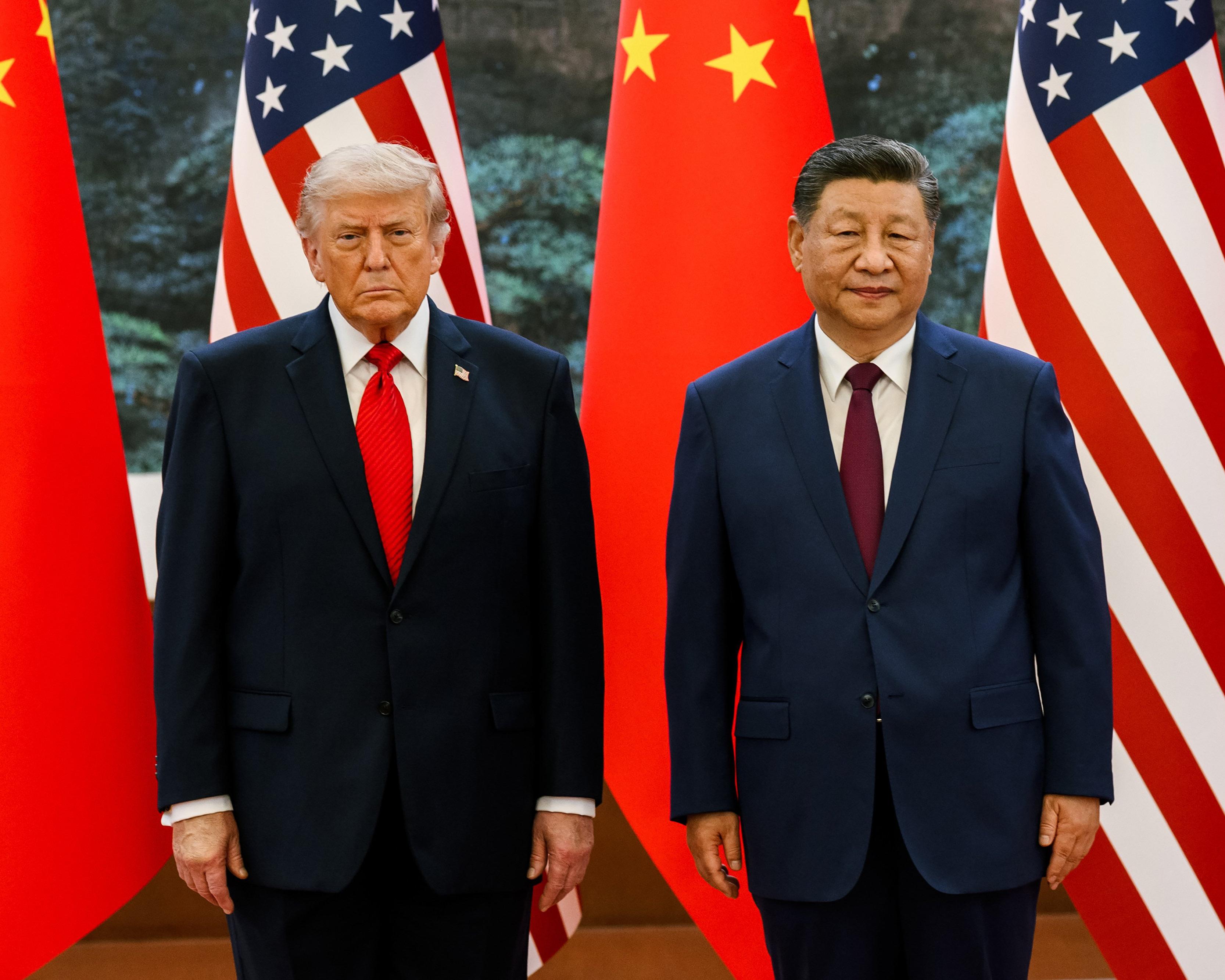
Donald Trump and Xi Jinping presented a striking visual symmetry during a welcome ceremony at Tiananmen Square in Beijing on 14 May 2026. Both leaders wore blue, single-breasted suits with flap pockets, featuring two buttons with only the top one fastened, paired with red ties. This coordinated appearance occurred as Trump arrived for a two-day summit accompanied by a delegation of major technology executives, including Elon Musk, Tim Cook, and Jensen Huang.
Enda Young, founder and CEO of the Centre for Negotiation and Leadership and a negotiation lecturer at Oxford University, suggested the attire utilised the 'chameleon effect' to build rapport. Young cited research indicating that people tend to warm more quickly to those who appear similar, noting that subtle mimicry in dress can signal alignment and mutual respect before negotiations even begin. This aligns with Robert Cialdini’s principle of 'liking', which posits that similarity increases trust and openness to influence.
The visual mirroring was distinct against the backdrop of the US delegation’s more varied sartorial choices. Stephen Miller and Pete Hegseth wore pocket squares, while Hegseth and Scott Bessent opted for flamboyantly stripy ties. Elon Musk stood out in a green tie, contrasting with the leaders’ uniform red. Young noted that for mirroring to be effective, it must feel natural rather than staged, a caveat supported by the fact that the look was consistent with Trump’s usual wardrobe and did not represent a significant departure for Xi, whose attire has historically included Mao suits and windbreakers.
Historical precedents for such diplomatic styling include the matching outfits worn by Emmanuel Macron and Luiz Inácio Lula da Silva during the 2024 Amazon summit, and the contrasting reception of Volodymyr Zelenskyy’s military-style attire in the Oval Office. Young warned that while twinning can signal camaraderie, it can also backfire if perceived as artificial, as seen in past political fashion missteps.
By the second day of talks, the visual mirroring ceased as Trump altered his presentation, wearing an open jacket with a striped blue tie, while Xi maintained his original look. Despite the shift in attire, Xi described the nations as "partners rather than rivals," and Trump referred to them as "true friends." The summit coincided with positive market movements, with the Dow Jones Industrial Average gaining 0.8%, the S&P 500 rising 0.3%, and Nvidia shares surging more than 2% following US approval.