SpaceX targets tower catch after Starship 13th flight intact splashdown
The 13th test flight from Starbase achieved a controlled Indian Ocean landing, while the Super Heavy booster suffered a hard splashdown in the Gulf of Mexico.
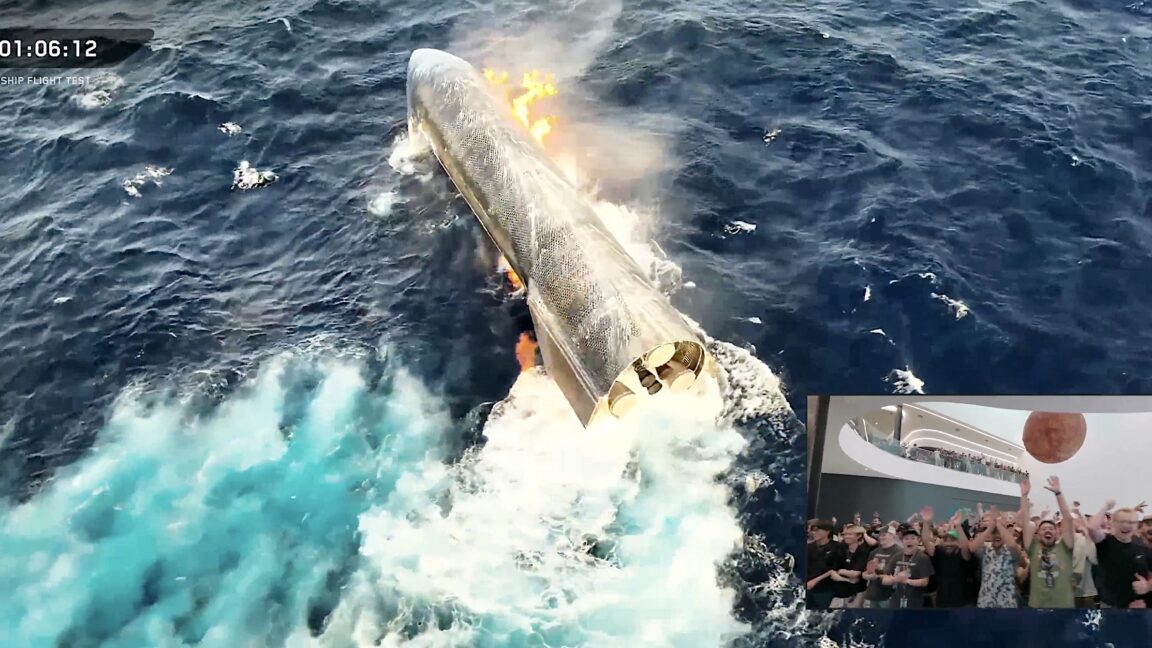
SpaceX successfully concluded its 13th Starship test flight on 25 July 2026, achieving the first intact splashdown of the Starship upper stage in the Indian Ocean. Launching from Starbase, Texas, the mission provided engineers with critical data on the vehicle’s heat shield, which withstood reentry temperatures of up to 2,600°F (1,430°C). The preservation of the more than 18,000 ceramic tiles insulating the stainless steel airframe allows for the first detailed inspection of the shield’s durability, a key requirement for the rapid reuse cycles SpaceX envisions for the programme.
Elon Musk indicated that the company will likely attempt to catch the Starship with launch tower mechanical arms on the next flight. This manoeuvre, which SpaceX has previously executed with the Super Heavy booster, would involve returning the upper stage to the launch site for capture. Musk stated on X that the attempt would proceed unless problems are identified during the post-mission data review, marking a significant escalation in the vehicle’s recovery strategy.
The Super Heavy booster, however, did not share the upper stage’s success. During the landing burn in the Gulf of Mexico, engine failures prevented a controlled descent, resulting in a hard splashdown. While the booster successfully completed the high-thrust boostback burn with all 33 Raptor engines for the first time with Version 3, it failed to relight all engines for the final landing phase. SpaceX officials noted that the booster ended the burn early and experienced a hard impact, highlighting ongoing challenges with recovering the latest iteration of the booster.
The mission also deployed 20 Starlink V3 satellites, which burned up in the atmosphere shortly after release. These larger, heavier satellites are designed for higher throughput and power but will not fit on Falcon 9 rockets. SpaceX received signals from the satellites via its Starlink broadband network, downloading key telemetry before their demise. This provided the first look at the performance of the upgraded satellites in space, supporting future direct-to-device connectivity goals.
NASA Administrator Jared Isaacman commented on the mission’s importance for the Artemis program, noting that Starship’s capabilities will be game-changing for lunar missions. The successful test flight follows SpaceX’s initial public offering in June 2026, which valued the company at approximately $1.77 trillion. As SpaceX prepares for orbital refueling demonstrations and operational Starlink deployments, the intact recovery of Starship represents a pivotal step in the company’s iterative development process.