S301: The Milky Way’s fastest star offers a new window into Sagittarius A*
A newly identified star orbiting the galactic centre’s supermassive black hole reaches 25,000 kilometres per second, providing astronomers with a critical tool to measure the black hole’s spin.
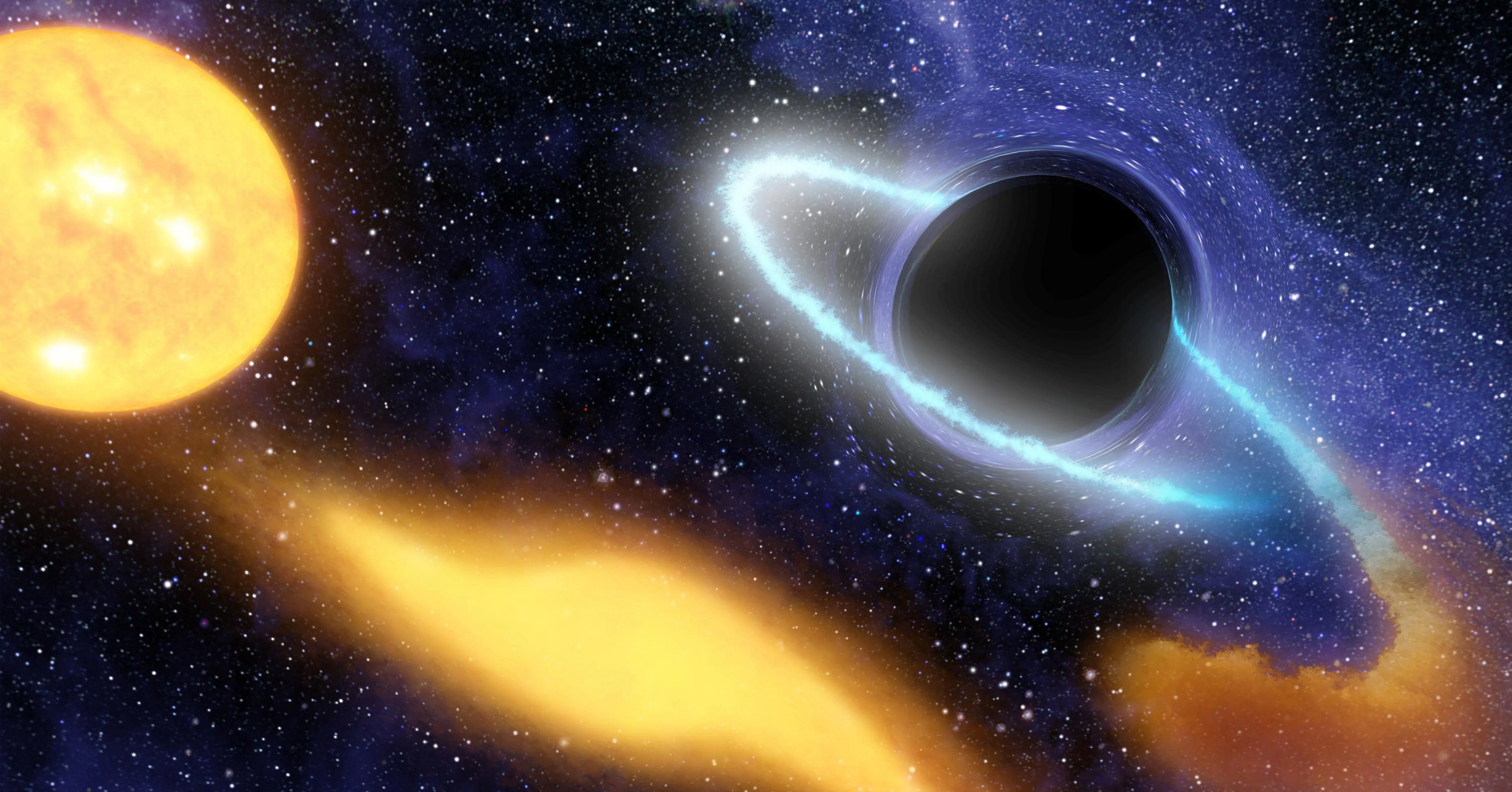
Astronomers have identified S301 as the fastest known star in the Milky Way, a celestial body that reaches peak velocities of 25,000 kilometres per second while orbiting Sagittarius A*. This supermassive black hole, located at the centre of our galaxy, possesses a mass equivalent to four million times that of the Sun. At its maximum speed, S301 travels at 8 per cent of the speed of light, moving more than 100 times faster than the Sun’s own orbital velocity of approximately 230 kilometres per second around the galactic centre.
The star’s extreme velocity is a direct result of its proximity to the black hole. S301 follows an extremely elongated orbit that brings it closer to Sagittarius A* than any other known star, with its closest approach comparable to the distance between Saturn and the Sun. This gravitational acceleration causes the star to complete one full orbit every 8.7 years, with its speed varying significantly as it moves between its closest and farthest points from the black hole.
S301 was first detected in 2023 using the GRAVITY instrument at the European Southern Observatory’s Very Large Telescope Interferometer in Chile. Researchers subsequently traced the star’s movement back to observations from 2017, allowing them to reconstruct its orbit with greater precision. The data confirmed that S301 passed its closest approach to Sagittarius A* in early 2023, with the next pericentre expected in 2031.
The origin of S301 remains a subject of scientific inference. Because stars are unlikely to form so close to a massive black hole, researchers believe S301 was part of a binary pair that was torn apart by tidal forces. In this scenario, the black hole’s gravity trapped S301 in its current orbit while the companion star was ejected from the galaxy at high velocity.
The primary significance of S301 lies in its potential to reveal the spin of Sagittarius A*. According to general relativity, a rotating black hole drags the spacetime around it, an effect that should slightly alter the orbit of nearby stars. While previous stars such as S2 have helped determine the black hole’s mass and test relativistic predictions, S301’s extreme proximity offers a unique opportunity to measure these deviations directly.
Astronomers anticipate that observations over the next decade will be sufficient to determine the rotation of Sagittarius A*, a fundamental property that is currently only partially understood. While there are signs that the black hole is spinning, the precise magnitude and direction of its spin remain undetermined. Measuring this property through S301’s orbital deviations could provide deeper insight into how a black hole’s spin warps the fabric of spacetime.