Russian logistics trucks adopt zebra camouflage to disrupt Ukrainian AI drone targeting
Experts warn that while the black-and-white stripes may confuse visual recognition algorithms, their efficacy against thermal imaging sensors remains unverified as the conflict enters a new phase of technological adaptation.
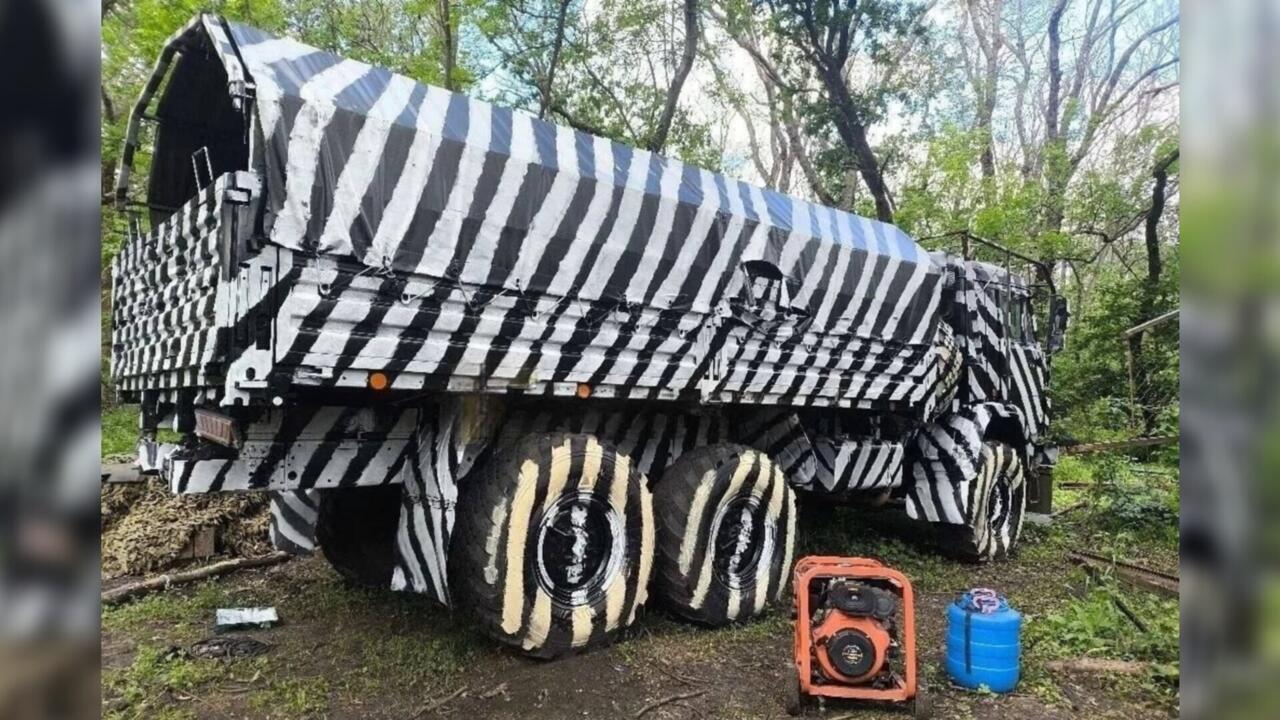
Russian military bloggers have reported the deployment of black-and-white striped camouflage on logistics trucks operating in Ukraine, a tactic designed to deceive artificial intelligence recognition systems used by Ukrainian drones. Images shared on Telegram since late May show Kamaz vehicles covered in the pattern, which proponents claim is intended to confuse the guidance systems of enemy drones, particularly the US-made Hornet kamikaze drone.
The strategy relies on "dazzle camouflage," a technique that does not attempt to hide an object but rather disrupts the ability to read its shape, size, or direction of movement. Branka Marijan, a researcher at the Centre for International Governance Innovation, explained that AI systems are trained to recognise specific visual profiles. By dramatically altering the truck's appearance with bold, contrasting patterns, the camouflage aims to break the recognition process, making it difficult for the system to match the vehicle against its training data.
James Patton Rogers, a drone warfare expert at Cornell University, noted that the rationale is almost certainly to complicate drone targeting. He emphasised that logistics vehicles are among the most important targets in the conflict, with both sides increasingly relying on drones and AI-assisted systems to find and track them. The move represents a low-cost, rapid deployment counter-measure in an environment where high-value assets are under constant surveillance.
However, the effectiveness of this tactic remains uncertain due to the nature of modern sensor technology. Marijan highlighted that Ukrainian drones reportedly utilise a combination of electro-optical cameras and thermal imaging. Because thermal sensors detect heat signatures from engines and bodies rather than visual patterns, the dazzle camouflage would offer little protection if infrared detection is the primary method. Nick Reynolds, a research fellow at the Royal United Services Institute, added that success depends on the fidelity of sensors and whether the paint reduces the vehicle's thermal signature.
This development mirrors historical precedents and previous adaptations in the conflict. Dazzle camouflage originated in World War I, developed by British artist Norman Wilkinson to create optical illusions for ships. In 2023, Russian bombers were covered in tyres to disrupt image-matching seeker capabilities, a tactic later cited by US officials as confusing computer vision models. Lauren Kahn of Georgetown's Centre for Security and Emerging Technology described the current deployment as the latest stage in a broader cat-and-mouse game, where drone proliferation drives investment in electronic warfare and greater autonomy.
There are also concerns regarding the potential for Ukrainian forces to adapt their algorithms to recognise these new patterns. Kahn noted that while systems can be updated, aggressive training on specific patterns risks false positives, such as flagging civilian vehicles with similar logos or markings. Marijan argued that the strategy aligns with a war of attrition, aiming to accumulate small advantages and force the opponent to waste resources adapting to experimental tactics.
The actual impact of the zebra camouflage on combat outcomes will only be determined by experience. As the conflict evolves, militaries are increasingly reverting to lower-tech solutions, such as fibre-optic guided drones, to bypass jamming and AI detection, underscoring the complex interplay between traditional tactics and emerging technologies.