Rubio tours Gulf to reassure allies on US-Iran deal
Marco Rubio’s diplomatic visit to Abu Dhabi, Kuwait, and Bahrain aims to stabilise regional relations after a 100-day conflict that left infrastructure damaged and maritime trade disrupted.
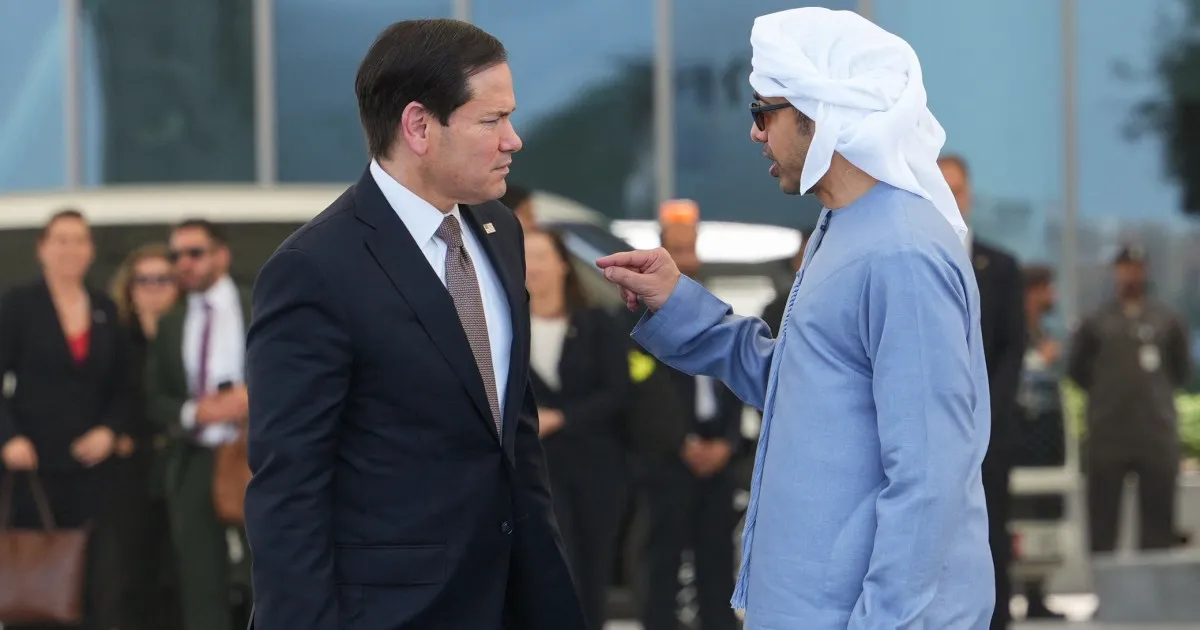
US Secretary of State Marco Rubio has commenced the second day of a diplomatic tour across the Gulf region, seeking to alleviate security and economic concerns among allies regarding a recently signed memorandum of understanding with Iran. The agreement, concluded last week, extends a fragile ceasefire and initiates a 60-day period for talks aimed at ending more than 100 days of war between the United States and Iran.
During a working lunch in Abu Dhabi on Wednesday, Rubio met with United Arab Emirates President Sheikh Mohamed bin Zayed Al Nahyan, alongside National Security Advisor Sheikh Tahnoun bin Zayed Al Nahyan and Foreign Minister Sheikh Abdullah bin Zayed Al Nahyan. Rubio told reporters that the United States is committed to ensuring that the views of its partners are considered, acknowledging their specific security and regional economic anxieties. He is scheduled to continue his engagements in Kuwait and Bahrain in the coming days.
The memorandum of understanding outlines several key provisions, including the resumption of traffic through the Strait of Hormuz, the removal of a US blockade on Iranian ports, a waiver on US sanctions, and the unfreezing of Iranian assets. However, the accord does not address Iran’s ballistic missile capabilities or its relations with regional allies, issues that remain significant points of contention for Gulf states.
The diplomatic push follows a conflict launched by the US and Israel on 28 February, which resulted in the death of Iran’s Supreme Leader Ali Khamenei in initial strikes. In response, Tehran attacked all six Gulf Cooperation Council countries. The UAE was targeted by approximately 2,800 missiles and drones, while Kuwait’s airport, ports, and desalination plants sustained hits. Qatar’s Ras Laffan Industrial City also suffered significant damage from missile attacks.
Uncertainty persists regarding the future operation of the Strait of Hormuz, a critical maritime chokepoint for Gulf energy exports. While Iran’s military command previously threatened to target vessels, US President Donald Trump posted on Truth Social that no tolls, insurance costs, or charges of any kind should be applied to ships transiting the strait. It remains unclear whether Iran intends to impose such fees despite previous suggestions from senior Iranian officials. A proposed $300 billion reconstruction fund for Iran, conditional on Gulf state backing for specific infrastructure projects, forms part of the agreement’s second phase.