Rubin Observatory captures half a million galaxies in COSMOS field
The NSF-DOE Vera C. Rubin Observatory in Chile has delivered a high-resolution view of the COSMOS field, revealing more than 500,000 galaxies in a patch of sky several times larger than the full moon.
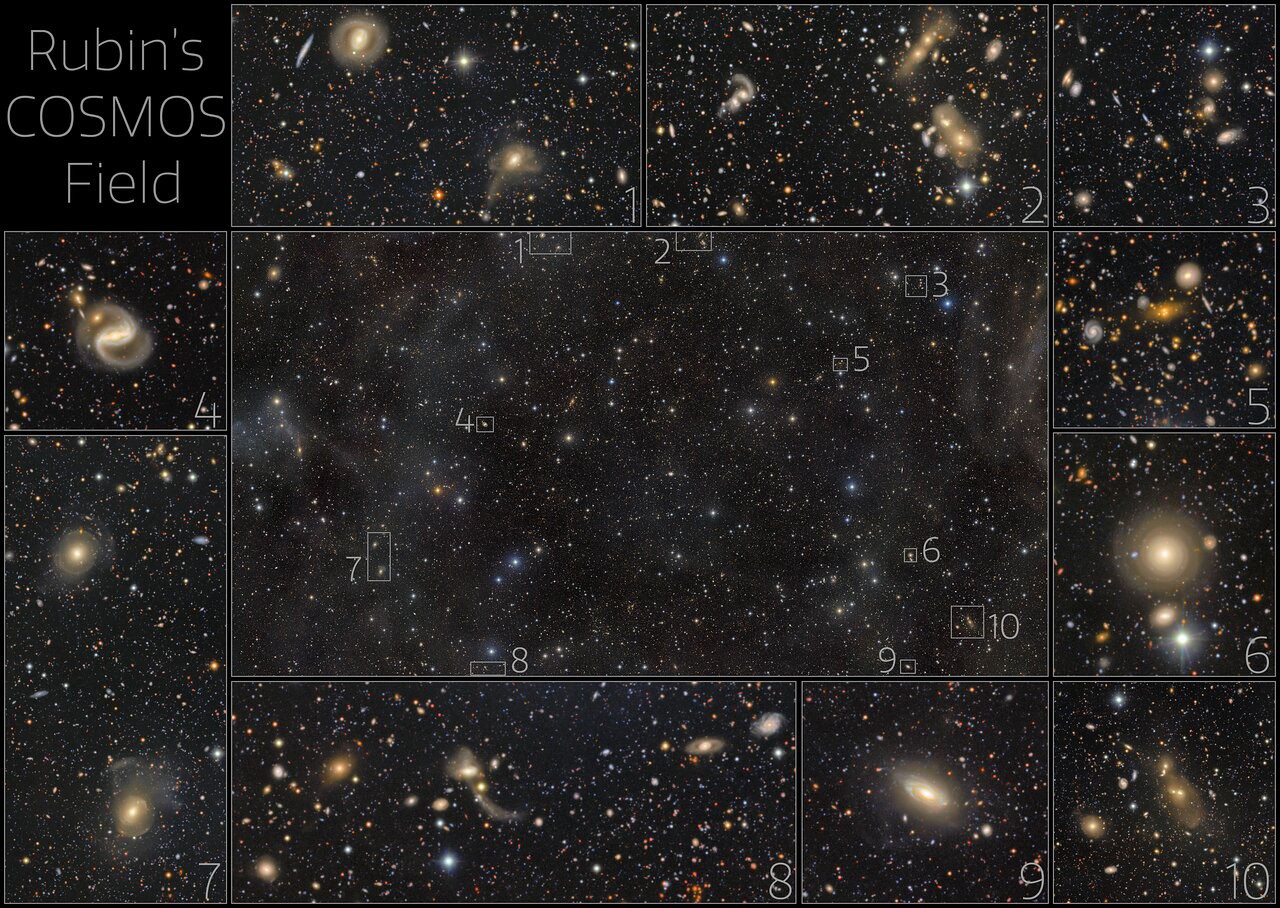
NASA’s Astronomy Picture of the Day for 7 August 2026 showcases a composite image from the NSF-DOE Vera C. Rubin Observatory in Chile, highlighting the COSMOS field. The central panel of the image contains more than half a million galaxies within a region of the sky that spans several times the diameter of the full moon.
The COSMOS field was first observed by the Hubble Space Telescope and has since been studied by the James Webb Space Telescope and other instruments. Astronomers selected this particular patch of sky because it contains comparatively few bright stars from the Milky Way, providing a relatively unimpeded view of distant galaxies outside our own galaxy.
The featured image includes ten outer panels, numbered one to ten, which display zoomed-in views of specific regions highlighted in the central panel. These close-ups reveal a variety of galaxy shapes and sizes, with some objects so distant that their light has travelled for billions of years before reaching Earth.
The Rubin Observatory is scheduled to revisit the COSMOS field every couple of days as part of its ten-year Legacy Survey of Space and Time. This recurring observation strategy will allow astronomers to monitor changes in the sky over time, offering a dynamic view of how the COSMOS field evolves.
The image is credited to the NSF-DOE Vera C. Rubin Observatory, NOIRLab, SLAC, and AURA. The accompanying explanation was written by professional astronomers Cecilia Chirenti, Jerry Bonnell, Robert Nemiroff, and Keighley Rockcliffe. The Astronomy Picture of the Day is a service of the Astrophysics Science Division at NASA’s Goddard Space Flight Center, NASA Science Activation, and Michigan Technological University.