Pashinyan re-elected in polarised Armenian vote amid democratic concerns
Dr Narek Sukiasyan of the Friedrich Ebert Stiftung notes that while the result signals a continued shift towards the European Union, the campaign was marred by extreme polarisation and hate speech, with voters driven primarily by security and economic vulnerabilities.
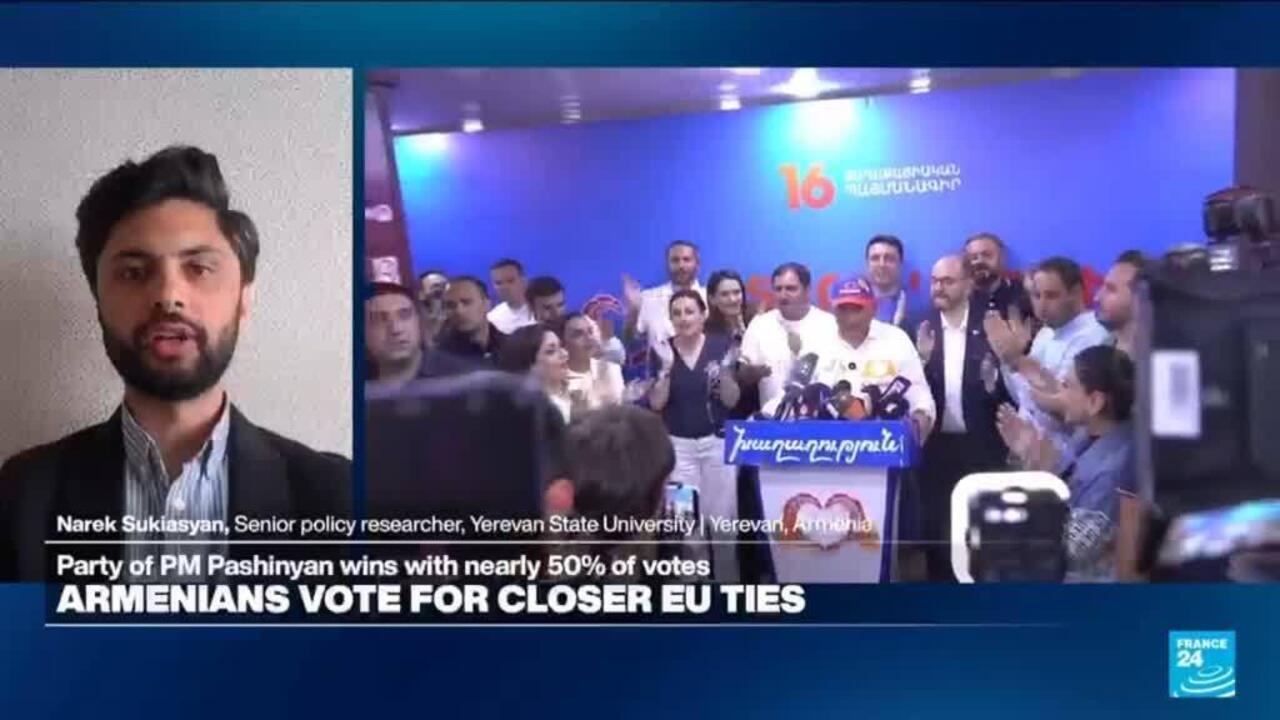
Prime Minister Nikol Pashinyan has secured re-election in Armenia, a result that Dr Narek Sukiasyan of the Friedrich Ebert Stiftung describes as indicative of a continued strategic pivot towards the European Union. However, the victory comes against a backdrop of intense domestic division, with the election campaign characterised by extreme polarisation, hate speech, and stigmatization.
Dr Sukiasyan, a Senior Policy Researcher at the Friedrich Ebert Stiftung Armenia and Adjunct Lecturer at the American University of Armenia, cautioned that these dynamics suggest a trend of democratic backsliding. The analysis, provided during an interview with FRANCE 24’s Charles Pellegrin, highlights that the electoral outcome reflects deeper societal fractures rather than a unified mandate for foreign policy realignment.
According to Dr Sukiasyan, voter behaviour was driven by factors extending well beyond international relations. Security concerns, social issues, economic vulnerability, and the lingering legacy of recent conflict were equally central to the decisions made by the electorate. This suggests that the political landscape is currently defined by immediate survival and stability concerns rather than abstract geopolitical ambitions.
The Prime Minister now faces the formidable task of managing Armenia’s continued dependence on Russia while navigating a complex transition between war and peace. Dr Sukiasyan noted that the country is simultaneously moving between dependence and diversification, as well as between polarisation and democratic consolidation. These overlapping transitions present significant governance challenges for the incoming term.
While the election result signals a continued ouverture towards the West in the shape and form of the European Union, the path forward remains precarious. Pashinyan must carefully balance these external aspirations with the internal realities of a polarised society and a population deeply affected by the recent history of conflict. The immediate priority appears to be stabilising the domestic environment while maintaining critical security partnerships.
The election thus marks a critical juncture for Armenian governance, where the imperative to diversify international relations must be weighed against the urgent need to address social and economic vulnerabilities. As the country navigates these multiple transitions, the ability to mitigate polarisation and restore democratic norms will be as crucial as foreign policy achievements.