Northrop Grumman’s Robotic Servicer Set to Extend Optus Satellite Life
The US defence contractor’s new autonomous system aims to shift high-orbit satellite operations toward a sustainable, in-orbit maintenance model.
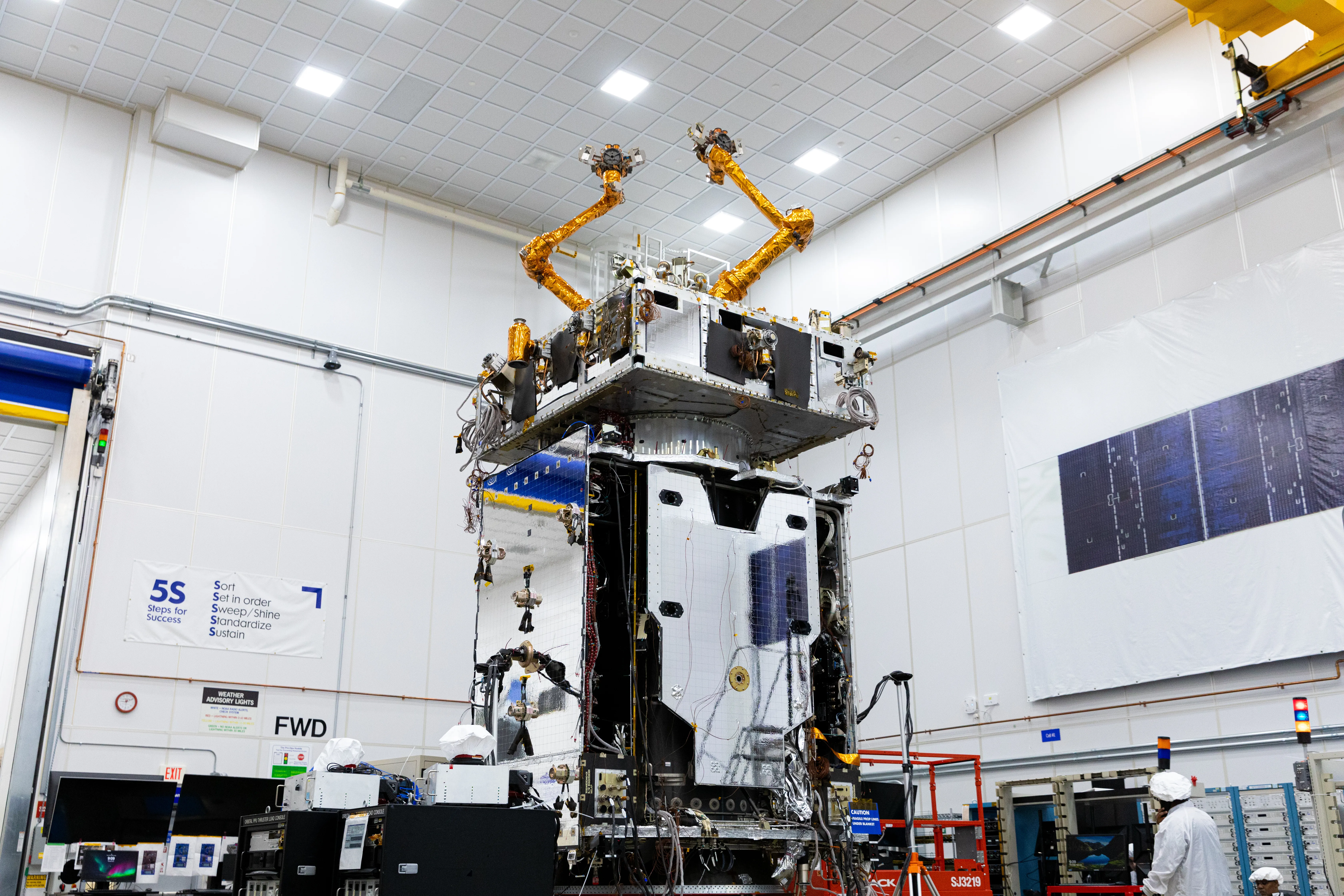
Northrop Grumman’s Mission Robotic Vehicle (MRV) is scheduled to attach a new Mission Extension Pod (MEP) to the Optus communications satellite in 2027, extending its operational life. The current Mission Extension Vehicle (MEV) has been attached to the satellite for over a year and is now departing to make way for the MRV. The MRV, developed with DARPA, features robotic arms to autonomously dock and service satellites, aiming to provide a sustainable model for in-orbit maintenance and life extension.
The MRV, developed with DARPA, is equipped with two advanced robotic arms designed to autonomously attach MEPs to satellites, representing an evolution from the MEV’s docking probe method. The MRV is designed to be refuelled in orbit, serving as a proof of concept for future in-orbit servicing capabilities. Satellite operators will purchase and own the MEPs, which will be permanently attached to their spacecraft, allowing the MRV to service multiple vehicles and reduce costs.
The Optus satellite, launched in 2009, is expected to generate revenue for an additional six years if the servicing mission is successful. Northrop Grumman’s director of logistics and servicing, Cassie Wong, stated the goal is to shift space infrastructure towards sustainability and resilience.
The Optus satellite was designed for a 15-year lifespan but typically fails due to fuel depletion rather than system failure. Two previous MEVs, launched in 2019 and 2020, have extended the life of three customers, including two Intelsat spacecraft and the Optus satellite. MEV-1 is currently in a parking orbit, while MEV-2 is attached to an Intelsat customer until 2030.
The trend in low Earth orbit (LEO) involves deploying cheap, replaceable satellites, whereas high-orbit satellites are often expensive and benefit from life extension. The U.S. Space Force has previously characterised Chinese servicing spacecraft with robotic arms as potential weapons due to their ability to grapple satellites. Katalyst Space is attempting a similar mission to extend the life of a NASA space telescope following recent malfunctions.