Nepal flood crisis exposes gaps in state disaster preparedness
With hundreds dead and over 1,300 missing, officials admit the scale of the flash floods in Nuwakot, Rasuwa, and Dhading districts was unprecedented.
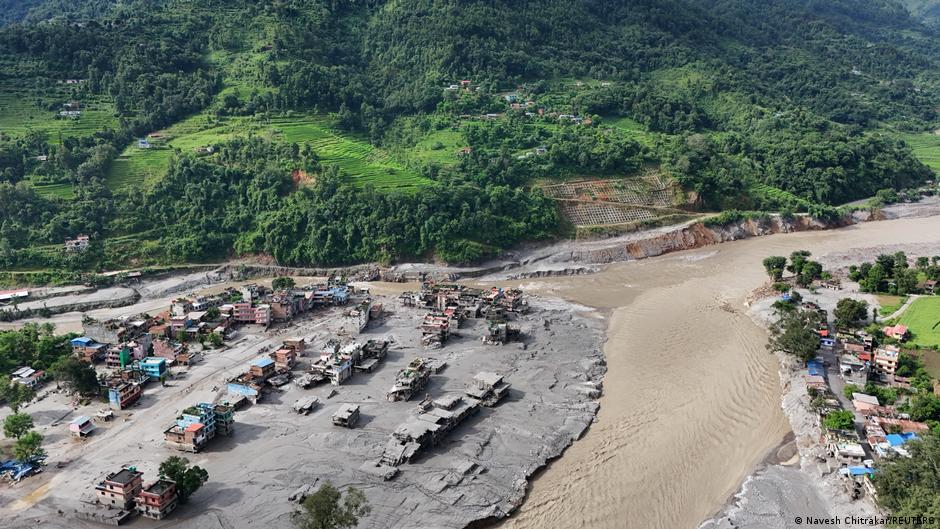
Massive flash floods that struck Nepal on Wednesday have left the death toll in the hundreds, with more than 1,300 people still missing, including hundreds of foreign nationals. The disaster, which devastated the Nuwakot, Rasuwa, and Dhading districts, has exposed significant fractures in the country’s disaster response capabilities as villages remain physically and electronically cut off from the capital, Kathmandu.
Nepal’s Minister for Information and Communication, Bikram Timilsina, acknowledged the institutional shortcomings in a statement to Deutsche Welle. Timilsina, who represents the flood-hit Nuwakot-1 constituency, stated that the state mechanism had not anticipated a disaster of such magnitude. While the government has mobilised all available resources, including more than a dozen helicopters, the minister noted that entire villages have been swept away, leaving many residents out of contact.
The logistical challenges are compounded by severe infrastructure damage. Authorities reported that more than three dozen bridges, including motorable and suspension structures, along with a dozen hydropower dams, have been destroyed. The main bridge over the Trisuli River, which connects Dhading district headquarters with Kathmandu, was swept away, isolating key areas. By mid-day Thursday, at least 414 stranded individuals, including 164 foreigners, had been airlifted to safety, with India and China coordinating with Kathmandu on the broader disaster response.
The precise cause of the flooding remains a subject of scientific debate. While Beijing claimed a high-altitude glacier collapse triggered the event, Nepali scientists point to an avalanche on the Nepal-China border. Sudip Thakuri, a climate scientist at Tribhuvan University, explained that preliminary assessments suggest a massive avalanche blocked a river flowing from the Tibetan Autonomous Region. When the resulting landslide dam burst, it likely swept away a subglacial lake downstream, triggering the massive flood.
The risk of further inundation remains high. Rijan Raj Kayastha, a climate scientist at Kathmandu University, warned of potential flooding from other glacial lakes in the area. Chinese authorities have separately issued a warning that a lake in Tibet’s Gyirong is overflowing, with three million tons of water expected to enter the area over the next three days.
Local accounts highlight the confusion surrounding early warning systems. While opposition politician Usha Kiran Timsena stated that police and local officials did issue a warning of a massive flood, many residents did not account for the scale and speed of the water. Journalist Bidhya Rajput, whose home in Sole village was destroyed, noted that residents had the chance to flee to higher ground as they did in previous years, but the suddenness of this event deprived them of that opportunity.