NASA’s Swift Observatory Detects ‘Wandering’ Supermassive Black Hole Shredding Star
An orphan supermassive black hole, located 30,000 light-years from its host galaxy’s core, was identified devouring a star, offering a new method to find invisible cosmic heavyweights.
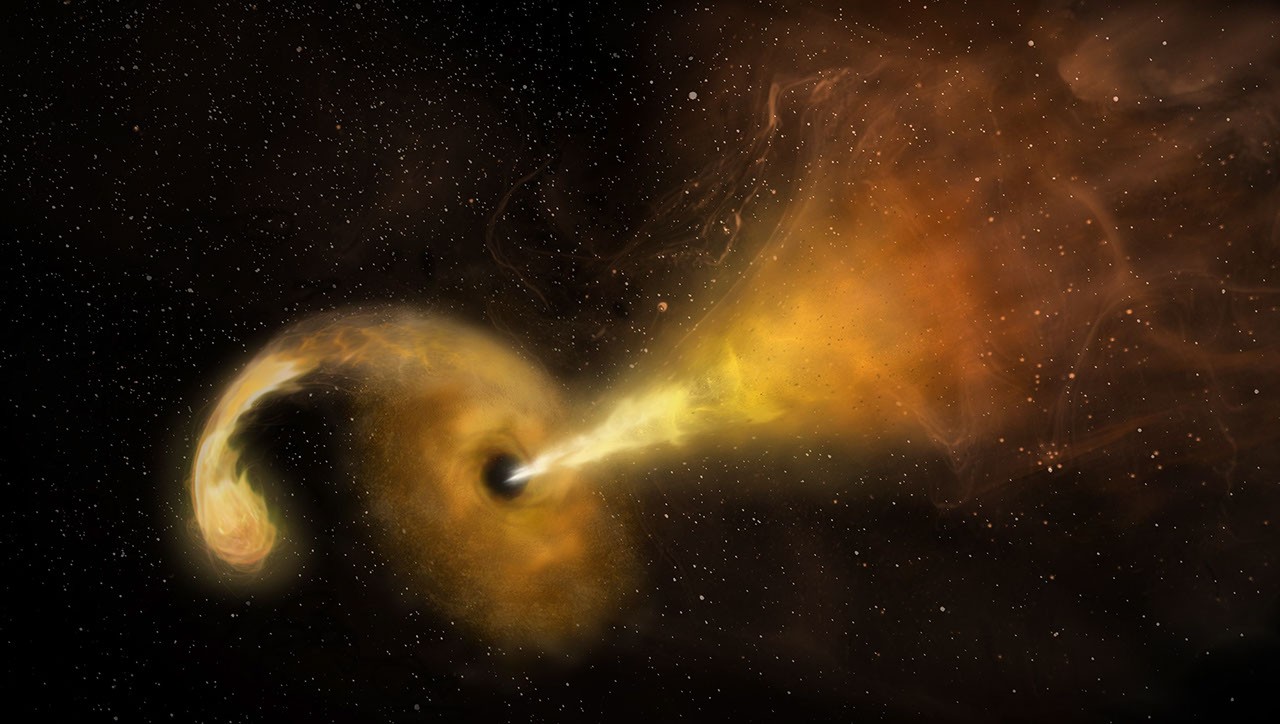
NASA’s Neil Gehrels Swift Observatory has captured a rare tidal disruption event involving an “orphan” supermassive black hole located on the outskirts of a galaxy approximately 750 million light-years away. The black hole, estimated to weigh about one million times the mass of the Sun, was found more than 30,000 light-years from its host galaxy’s core. This discovery, led by Robert Stein of the University of Maryland and NASA’s Goddard Space Flight Center, validates a new technique for hunting invisible supermassive black holes that have been displaced from galactic centres, likely due to galaxy mergers. The findings were published in The Astrophysical Journal Letters.
The black hole’s existence was first flagged in November 2025 by the Zwicky Transient Facility (ZTF), which uses an artificial intelligence algorithm to identify flares resembling tidal disruption events. Out of half a million flashes detected each night, the algorithm recognised a flare that looked like a tidal disruption event despite its unusual location. The event involved the black hole devouring a star, causing a flare that temporarily outshone the entire host galaxy in ultraviolet wavelengths, radiating with the light of about 10 billion suns.
Swift’s Ultraviolet/Optical Telescope (UVOT) measured the flare’s temperature at approximately 54,000 degrees Fahrenheit (30,000 degrees Celsius). The SOAR telescope in Chile provided spectral data that supported the interpretation of the event as a tidal disruption event. Jonathan Carney, a doctoral student at the University of North Carolina at Chapel Hill, took the first spectra supporting the flare’s interpretation. The combination of data helped researchers rule out other explanations and confidently identify the phenomenon.
Nearly every galaxy is anchored by a supermassive black hole in its centre, and tidal disruption events are typically observed there. Prior to 2024, such events had only been seen in galaxy cores. This new discovery, located more than 30,000 light-years from the centre, suggests the black hole may have originated in a small galaxy that merged with the larger one. Scientists propose that gravitational interactions during galaxy mergers could have flung the lighter black hole to the outskirts.
Future searches for such events will utilise data from the Vera C. Rubin Observatory and NASA’s Nancy Grace Roman Space Telescope. Swift’s primary mission ran from 2004 to 2006, and the spacecraft is currently awaiting an orbit boost planned for summer to extend its lifetime against atmospheric drag. Once normal operations resume, Swift could continue searching for more examples of out-of-place black holes, helping astronomers complete a census of the universe’s behemoth black holes.