NASA releases composite image of Black Eye Galaxy
New composite view highlights counter-rotating gas structures potentially caused by ancient galactic merger
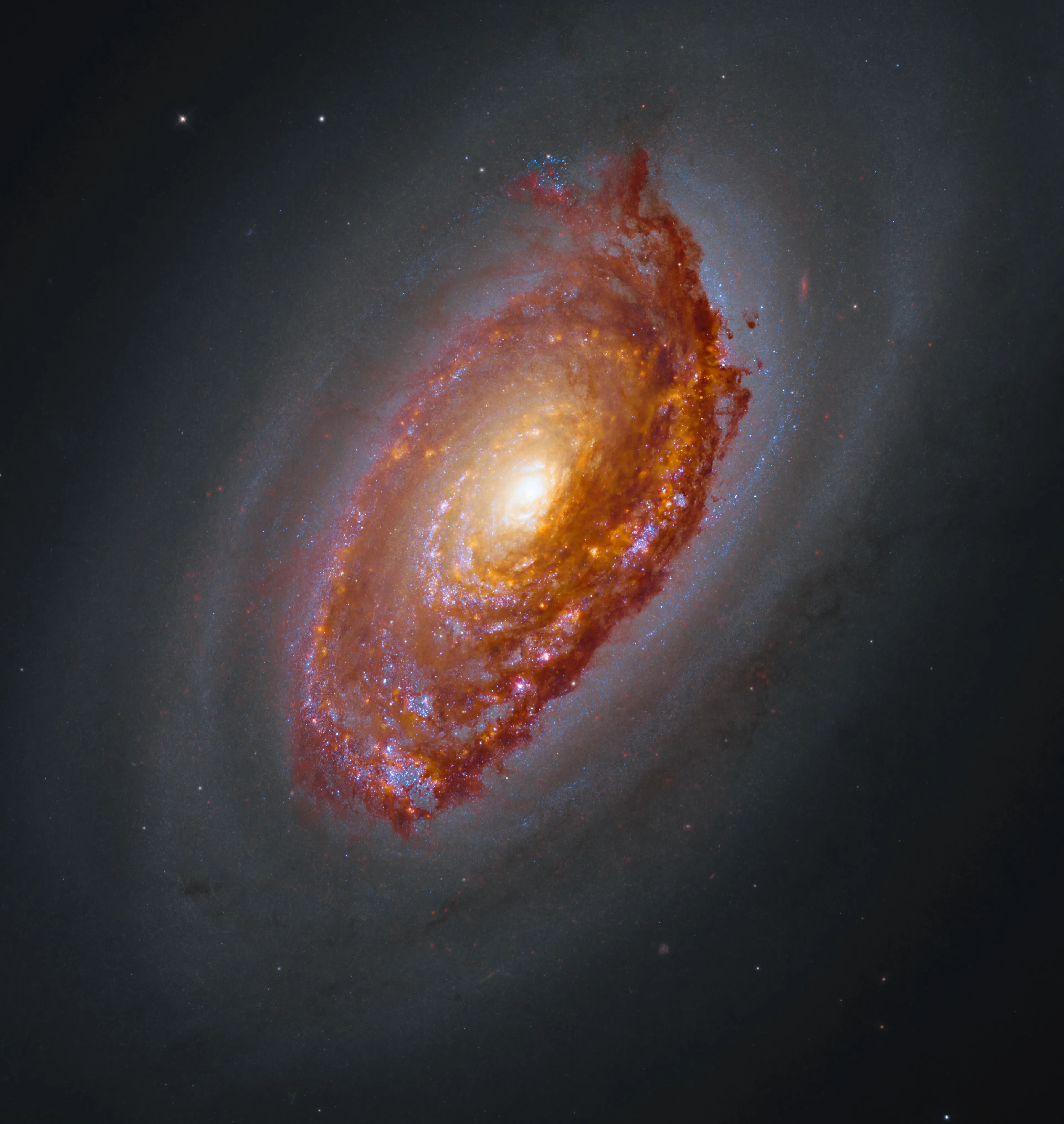
On 20 March 2026, NASA released a composite image of Messier 64, widely known as the Black Eye Galaxy. The release combines observational data from two of the agency’s premier instruments: the James Webb Space Telescope and the Hubble Space Telescope. This collaboration allows astronomers to view the spiral galaxy across a broad spectrum of light, merging infrared data with ultraviolet and visible wavelengths.
The James Webb Space Telescope captured the galaxy in near- and mid-infrared wavelengths, providing insight into the cooler dust and stars within the structure. In contrast, the Hubble Space Telescope contributed data in ultraviolet, visible, and near-infrared light. The resulting image offers a detailed look at the galaxy’s composition and its distinct internal motion.
Messier 64 is characterised by what NASA describes as bizarre internal motion. The gas in the outer regions of the spiral galaxy rotates in the opposite direction to the gas and stars in its inner regions. This counter-rotating structure creates a unique dynamic within the galaxy’s disc, setting it apart from many other spiral galaxies.
Astronomers suggest that this strange behaviour may be the result of a merger between Messier 64 and a satellite galaxy over a billion years ago. While the exact timeline and details of this interaction remain inferred from current observational data, the counter-rotating gas disks are often associated with past galactic interactions.
The image credits include contributions from F. Belfiore of the European Southern Observatory in Germany, J. Lee from the Space Telescope Science Institute, A. Leroy from The Ohio State University, and D. Thilker from The Johns Hopkins University. The image processing was conducted by Gladys Kober from NASA and the Catholic University of America.