NASA Deep Space Network strained as wildfire forces Madrid complex evacuation
With the Madrid 70-meter antenna offline and the equivalent US facility under repair until 2028, NASA relies on a single Australian antenna to support critical missions including Artemis and Voyager.
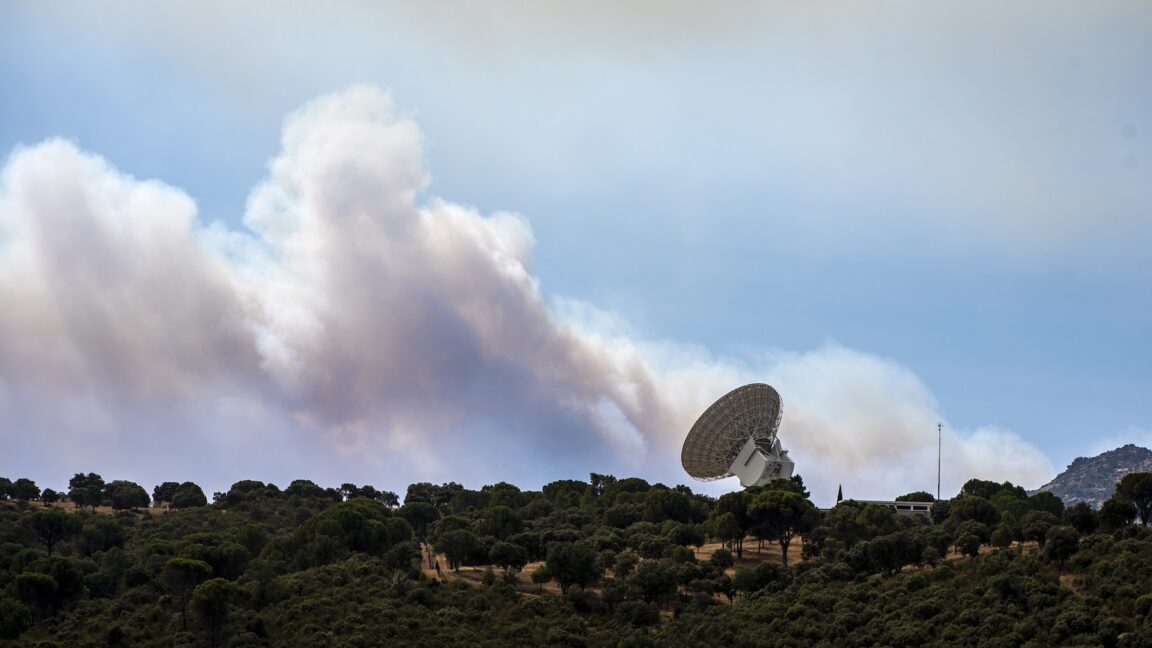
A fast-moving wildfire near Madrid, Spain, has forced the evacuation of personnel and the temporary suspension of operations at NASA’s Madrid Deep Space Communications Complex (DSCC). The incident, which occurred on Friday, coincides with broader regional fires that have prompted Spanish authorities to order the evacuation of more than 19,000 residents from towns west of the capital. NASA confirmed that the tracking station, located in the hills nearly 40 kilometres west of central Madrid, was threatened by flames and smoke plumes rising over its antenna array.
The DSCC is anchored by a 230-foot (70-metre) radio dish and several smaller 34-metre antennas. Photos and video from the area showed the severity of the threat to the infrastructure. A NASA spokesperson stated that any potential damage will be assessed when it is safe to do so, while the agency coordinates with local authorities and the US Embassy to monitor the evolving situation. The safety of personnel remains the highest priority, with NASA expressing concern for families and neighbours in the surrounding communities.
To ensure continuity of service, NASA seamlessly transitioned mission support to its Goldstone Deep Space Communications Complex in California. The Deep Space Network, managed by NASA’s Space Communications and Navigation and the Jet Propulsion Laboratory, typically operates on a “follow the Sun” model, allowing control centres in Australia, California, and Spain to remotely operate the entire network during local daytime hours. With the Madrid site offline, antennas at the California and Australia locations were communicating with spacecraft such as Voyager 2 and Juno.
The evacuation highlights a significant vulnerability in NASA’s deep space tracking capabilities. The Madrid site’s 70-metre antenna is currently offline for maintenance, and the equivalent antenna in California has been non-operational since last year due to mechanical damage. The California incident involved an over-rotation of the structure that damaged cables and water lines, flooding the base with 200,000 gallons of glycol-contaminated water. Cleanup and repairs, which are being combined with planned upgrades, are projected to cost between $4.1 million and $4.6 million and are expected to keep the antenna offline until 2028.
Consequently, the Deep Space Network is currently reliant on a single operational 70-metre antenna in Australia to support more than 40 missions ranging from the Moon to the edge of the Solar System. This includes critical support for the Artemis programme, the James Webb Space Telescope, and the twin Voyager spacecraft. The next Artemis mission to the Moon, Artemis III, will now fly in low-Earth orbit to test the Orion capsule with commercial landers, while the first planned lunar landing with astronauts, Artemis IV, is targeted for no earlier than 2028. A separate deep space tracking station owned by the Spanish government and the European Space Agency, located nearby, was also evacuated.