JCB Hydromax claims hydrogen land speed record at Bonneville
RAF Wing Commander Andy Green pilots the twin-engine machine, marking a significant milestone in JCB’s pivot from diesel to hydrogen combustion technology.
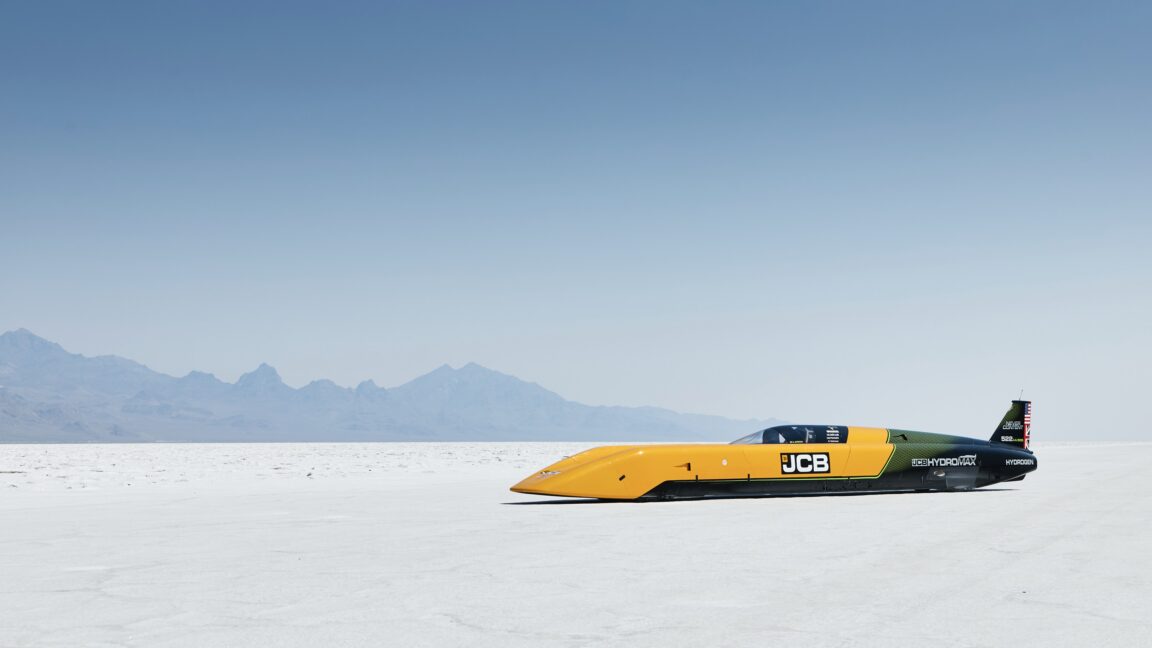
The JCB Hydromax has established a new world land speed record for hydrogen-powered vehicles, achieving a two-way average of 406.320 mph (653.91 km/h) at the Bonneville Salt Flats in Utah. Piloted by RAF Wing Commander Andy Green, the purpose-built car utilises two custom hydrogen-burning internal combustion engines, each delivering 800 hp (597 kW). The achievement, recorded on 12 August 2026, eclipses previous records for hydrogen combustion, fuel cell, and electric vehicles.
JCB, a UK-based manufacturer of heavy industrial and agricultural equipment, initiated its hydrogen research in 2020 after determining that fuel cell technology was too expensive and fragile for commercial applications in farming and construction. Rather than adapting existing diesel architectures, the company engineered a new powertrain based on its production diesel experience but modified for hydrogen’s distinct properties. The engines feature direct fuel injection, double overhead camshafts, and dry-sumping, with air cooled from 392°F (200°C) to below 50°F (10°C) using ice tanks.
Green, who previously drove the Thrust SSC through the sound barrier in 1997 and the JCB Dieselmax to a 350 mph record in 2006, described the vehicle as stable, strong, and fast. The Hydromax’s combined output of 1,600 hp (1,193 kW) and 2,600 lb-ft (3,525 Nm) of torque, delivered via all-wheel drive, enabled a fastest run of 412.135 mph (663.27 km/h) in one direction and 400.623 mph (644.74 km/h) in the other.
The new benchmark significantly outpaces the previous hydrogen combustion record of 185.5 mph (298.53 km/h) set by the BMW H2R in 2004, as well as the hydrogen fuel cell record of 303 mph (488 km/h) held by the Venturi Buckeye Bullet 2 since 2009. It also surpasses the electric vehicle record of 341 mph (549 km/h) set by the VBB3 in 2016.
Despite this milestone, the Hydromax does not challenge the overall wheel-driven land speed record of 449 mph (722 km/h), which remains held by the nitromethane-fuelled Challenger II. The record stands as a testament to JCB’s strategy of pursuing hydrogen combustion as a viable alternative to diesel for heavy machinery, a sector where carbon emissions targets necessitate robust, commercially viable power solutions.