Indonesia commissions first aircraft carrier as Prabowo expands defence reach
The former Italian vessel Giuseppe Garibaldi has been renamed KRI Sriwijaya, marking a significant shift in Jakarta’s approach to maritime logistics and regional security.
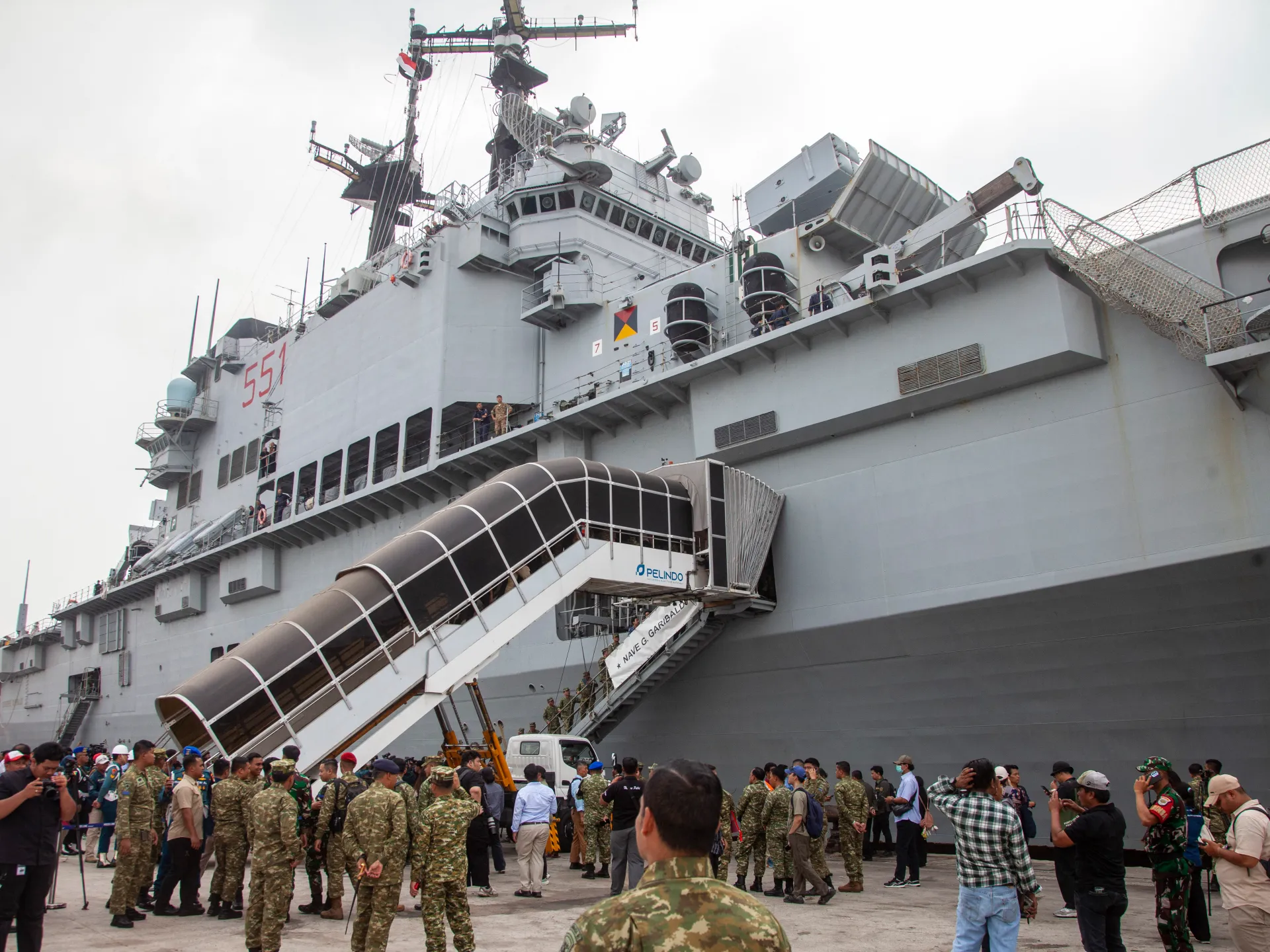
Indonesia has officially received its first aircraft carrier, a 180-metre vessel formerly known as the Giuseppe Garibaldi, which docked at the Tanjung Priok seaport in North Jakarta on Friday. The ship, which sailed from Italy via Colombo and the Malacca Strait, will be renamed KRI Sriwijaya in honour of the historic maritime empire that dominated Southeast Asian trade between the seventh and 13th centuries.
Indonesian Navy Chief of Staff Muhammad Ali described the acquisition as primarily a logistical asset for disaster relief. He noted that the vessel’s capacity to carry up to 18 helicopters and accommodate 830 personnel makes it well-suited for dropping supplies to remote areas during emergencies. However, Ali acknowledged that the ship retains the capability to be deployed for combat missions if necessary.
The arrival of the carrier is a central component of President Prabowo Subianto’s broader strategy to modernise the Indonesian military. The former Italian navy vessel, commissioned in 1985 and retired in 2014, was gifted to Indonesia in March to bolster bilateral defence engagement. For Italy, the transfer also served to offset the costs associated with decommissioning the ship.
Navy officials estimate that the vessel’s current condition is sufficient for another 15 to 20 years of service. Indonesia’s Finance Ministry approved $450 million in financing for the programme in 2025, although opposition politicians have raised concerns that the total cost of integration and maintenance could be significantly higher.
This acquisition follows a series of high-profile defence agreements signed under Prabowo’s administration. These include an $8.1 billion contract for 42 French Rafale fighter jets, a confirmed supply of long-range missiles from India, a major defence cooperation partnership with the United States, and a security treaty with Australia.
The move signals a deliberate effort by Jakarta to deepen its international defence ties while addressing domestic infrastructure gaps. By positioning the carrier as a humanitarian platform with secondary combat utility, the government aims to justify the expenditure while expanding its operational reach across the archipelago.