Humanity and endurance define a viral moment at the 130th Boston Marathon
While defending champions John Korir and Sharon Lokedi secured victories with a Kenyan sweep, a spontaneous act of kindness involving three strangers from different nations captured global attention.
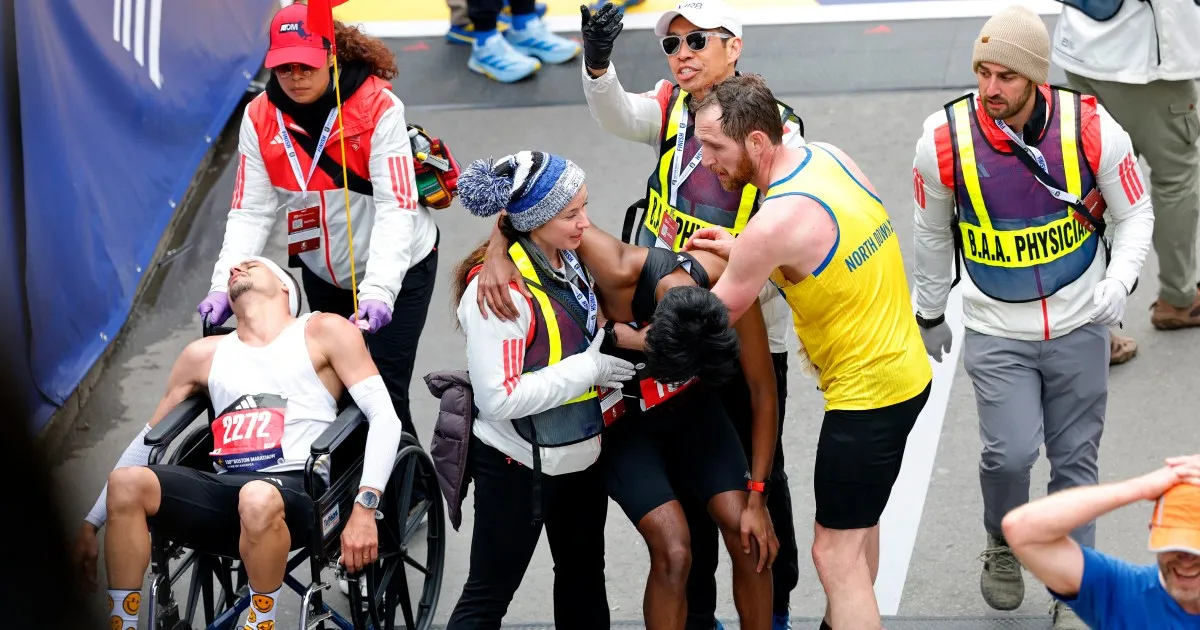
The 130th edition of the Boston Marathon concluded on Monday with the defending champions, John Korir and Sharon Lokedi, completing a dominant Kenyan sweep of the event. Korir set a new course record in the men's race, while Lokedi finished just one second short of her previous mark. However, the race's most significant talking point emerged not from the podium, but from a display of compassion near the finish line that has since resonated far beyond the track.
Northern Irish runner Aaron Beggs became the focal point of a viral video after he stopped to assist 21-year-old competitor Ajay Haridasse, who had collapsed from exhaustion. Footage captured by bystanders from multiple angles shows Haridasse attempting to rise repeatedly before buckling under the physical strain. Beggs, who had been monitoring his own time, described his decision to intervene as a "natural instinct" once he observed the struggling athlete.
Beggs did not act alone; Brazilian runner Robson De Oliveira joined him to support the exhausted competitor. Together, the two men helped Haridasse to his feet and slid under his shoulders to carry him across the finish line, ensuring the young runner completed the historic race. Beggs expressed deep gratitude to De Oliveira, noting that the shared journey of three strangers from Northern Ireland, the United States, and Brazil would create a story they would remember for the rest of their lives.
In an interview with Al Jazeera, Beggs reflected on why the footage spread so rapidly across social media platforms. He suggested that the video went viral because audiences were craving a positive narrative to counteract the "vortex of negativity" often found in modern news cycles. Beggs emphasised that in an era where headlines frequently focus on conflict or disaster, a moment of pure kindness serves as a necessary reminder of human connection.
The incident highlights a distinct contrast between the competitive nature of elite athletics and the spontaneous solidarity that can emerge among participants. While the race results were defined by the achievements of the defending champions, the assistance provided by Beggs and De Oliveira underscored the broader social fabric of the event. Their actions transformed a moment of individual failure into a collective triumph of endurance and empathy.
As the video continues to circulate, it serves as a testament to the impact of small, uncalculated acts of generosity. Beggs' comments on the need for "nice stories" to bring happiness and tears of joy suggest that such moments are vital for public morale. The event remains a powerful example of how shared humanity can transcend national borders and competitive boundaries.