Hubble Telescope Captures New Image of Galaxy Cluster MACS0329-0211
Data gathered in visible and infrared light reveals elliptical, spiral, and lenticular galaxies, alongside gravitationally lensed distant galaxies, aiding research into the evolution of the universe’s structure.
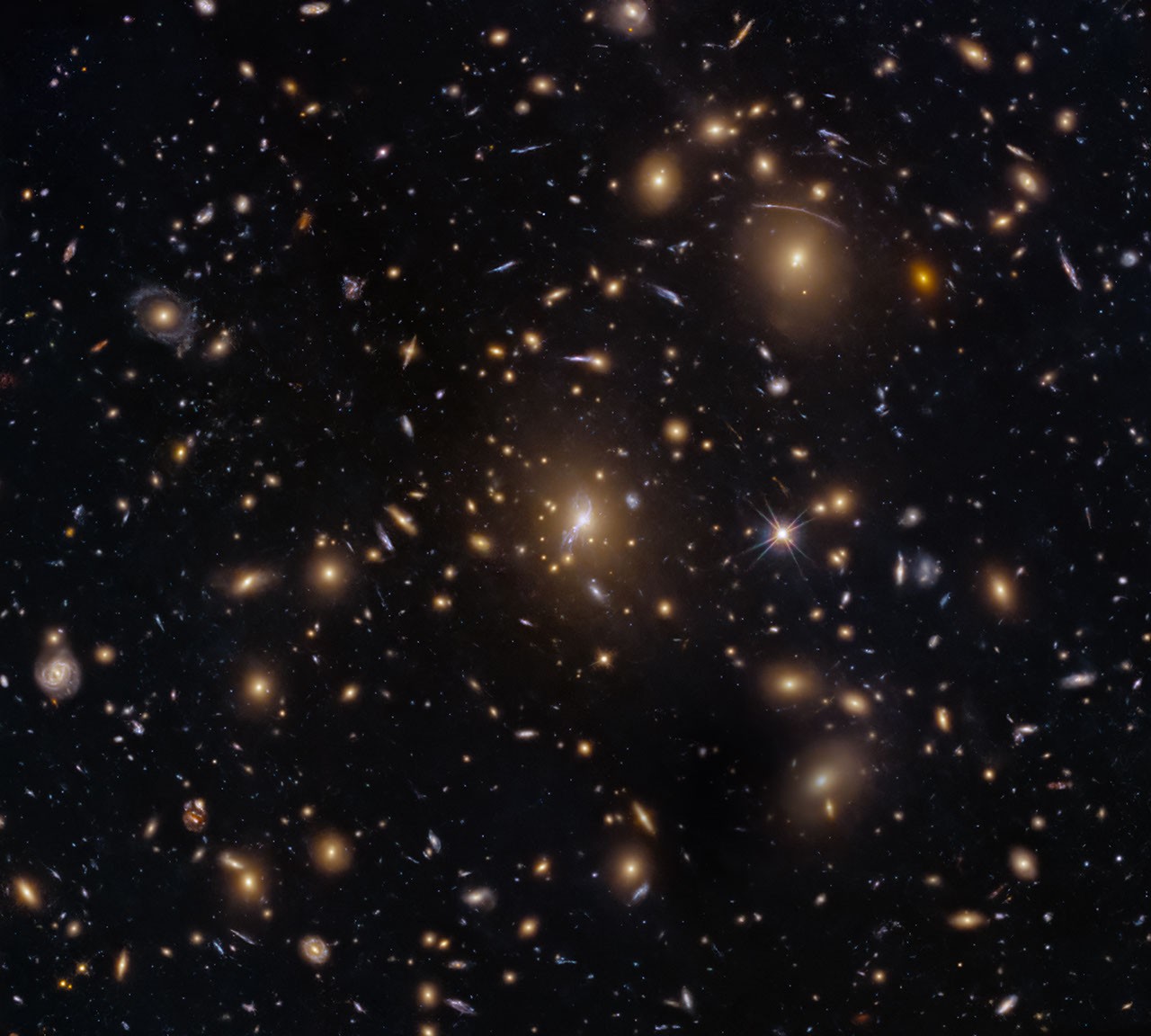
NASA’s Hubble Space Telescope has captured a new image of the galaxy cluster MACS0329-0211, utilising its Advanced Camera for Surveys and Wide Field Camera 3. The observation forms part of an ongoing programme focused on X-ray bright galaxy clusters, with data collected in both visible and infrared light. The resulting image provides astronomers with a detailed view of the cluster’s composition and its role as a gravitational lens.
The cluster contains a diverse array of galaxy types, including large, oval-shaped elliptical galaxies, as well as thin spiral and lenticular galaxies viewed from the edge. Face-on spiral galaxies with visible curving arms are also present within the swarm. These structures are set against the backdrop of the cluster’s massive gravity, which distorts and magnifies light from objects located further away.
In the upper-right quadrant of the image, faint arcs are visible, representing distant galaxies that have been gravitationally lensed by the cluster. The largest of these arcs appears above the bright oval shape of a giant elliptical galaxy. Closer inspection of the image’s centre reveals bright-white intersecting curves resembling a distorted figure eight, which researchers suggest may be another distant galaxy whose light has been magnified and distorted by the cluster.
Galaxy clusters such as MACS0329-0211 serve as critical signposts for understanding how the structure of the universe has evolved over time. By acting as natural telescopic lenses, these massive clusters allow astronomers to view galaxies from the earliest stages of the universe that would otherwise be too faint to detect. The ability of Hubble to observe across a broad spectrum of light makes it a valuable tool for analysing the nature of these clusters.
Since its launch in 1990, the Hubble Space Telescope has significantly altered the fundamental understanding of the universe. Claire Andreoli from NASA’s Goddard Space Flight Centre in Greenbelt, Maryland, is the contact for this release. The data gathered from this observation contributes to the broader effort to map the cosmos and comprehend the forces that shape its large-scale structure.