Gritt exits stealth with $34 million to automate solar plant construction
Founded by Carnegie Mellon-trained roboticists, Gritt has secured a $26 million Series A led by Obvious Ventures to scale its systems for high-volume solar installation.
Gritt, a robotics startup founded by Carnegie Mellon-trained roboticists Puneet Puri and Vishal Dugar, has exited stealth mode with $34 million in total funding. The capital raise includes a $26 million Series A round led by Obvious Ventures, with participation from Union Square Ventures and Active Impact Investment. This follows an earlier seed round supported by First Round Capital, Climactic, Congruent Ventures, and VSC Ventures.
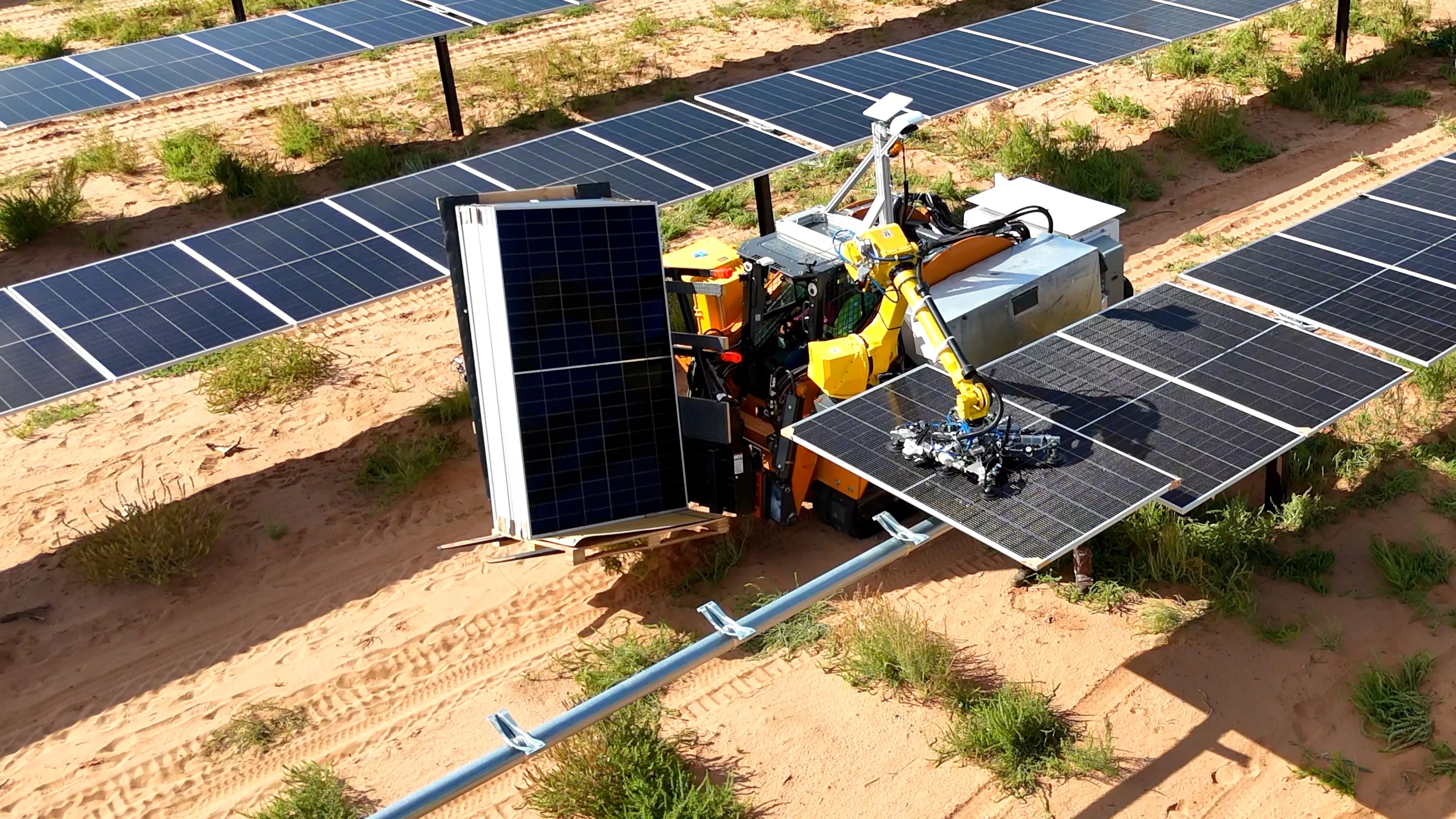
The company utilises off-the-shelf hardware, including rented skidders and robotic arms from manufacturers such as Kawasaki, controlled by proprietary AI models rather than building custom robots from scratch. This approach is designed to address the global solar energy build-out’s labour market challenges, where limited worker supply struggles to meet growing demand for installation.
Gritt claims its systems increase installation capacity from a typical 800 panels to 3,000–4,000 panels per day for an eight-person crew. The initial deployment focuses on unloading large glass solar panels, transporting them to metal frames, and positioning them with sub-millimetre accuracy for manual fastening. Two systems are currently deployed in the field, collecting data to improve AI behaviour.
The firm has contracted to install 2.8 gigawatts of solar panels over the next 18 months, with customers including three of the top 10 US power construction companies. Gritt aims to operate 48 of its systems within the next six months. Andrew Beebe, partner at Obvious Ventures, noted the founders’ background in high-precision aerospace engineering and their focus on scaling dirty, dull, and dangerous jobs.
Gritt competes with companies such as Luminous Robotics, Cosmic, and China’s Trinabot, which are developing their own custom hardware rather than relying on off-the-shelf components. The startup plans to expand its manipulation tasks to include fastening panels, drilling posts, and building racks, with longer-term ambitions to tackle tasks such as tying rebar.
The founders anticipate the systems will also provide site management intelligence, such as alerting workers to weather risks or missing inventory. Puri stated that the rise of new AI models has made it possible to create generalizable systems that can be reused and improved across tasks, reducing the time required to train the system for new duties.