Gaza Genocide Tapestry Exhibition Opens at Venice Biennale
Co-curated by a journalist and Ibrahim Muhtadi, the installation features 100 panels created by Palestinian women in occupied Palestine, Lebanon, and Jordan
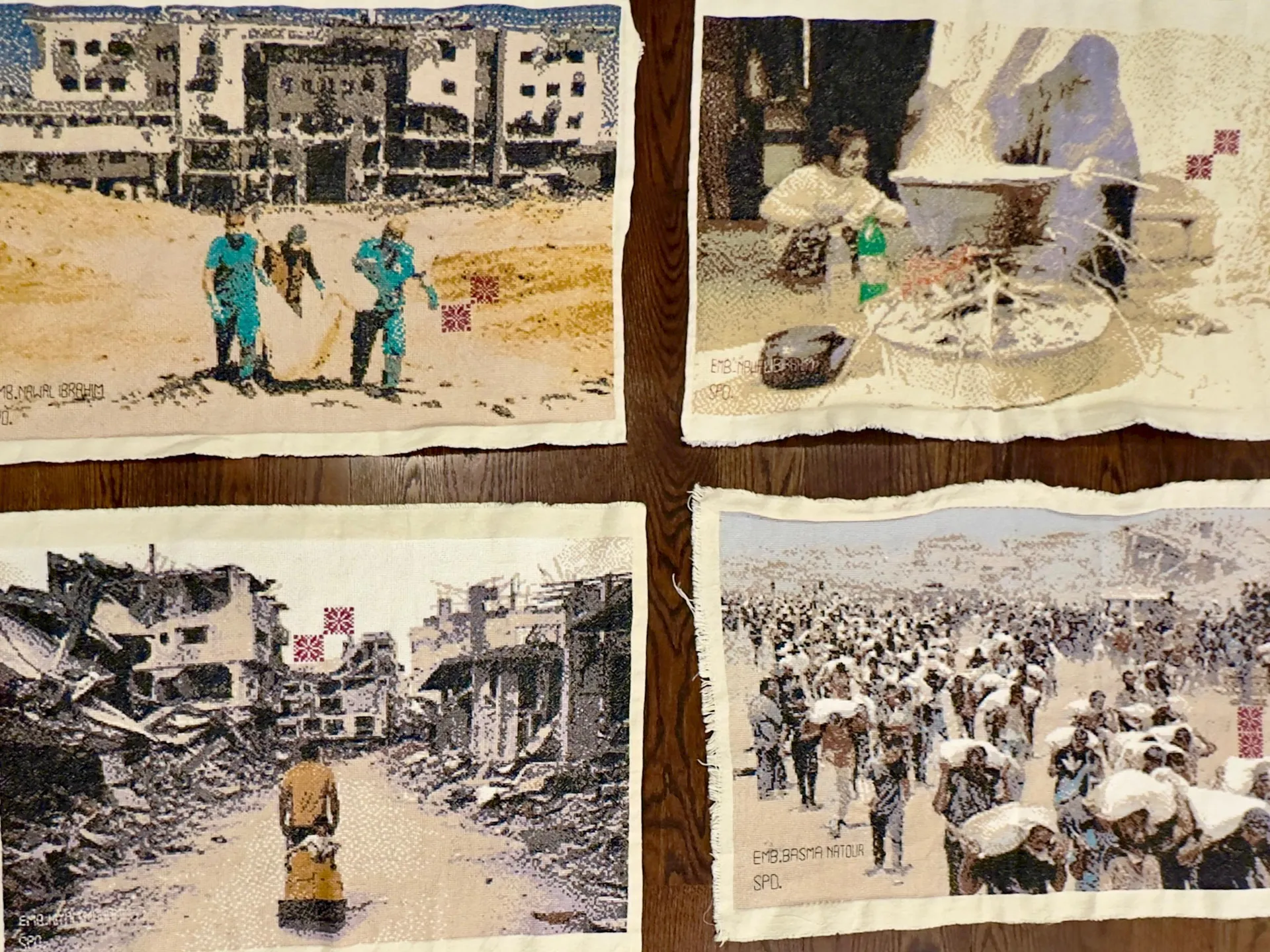
The Gaza Genocide Tapestry, a new chapter of the Palestine History Tapestry Project, is set to be exhibited at the Venice Biennale from 9 May to November 2026. Housed at the Palazzo Mora, the installation is titled "- – – – – – – – – – -" and serves as a visual record of the destruction in Gaza. The project merges traditional tatreez embroidery with contemporary testimony to document the conflict in real time, operating under the premise that language has reached its limit in describing the scale of the devastation.
The exhibition comprises 100 embroidered panels, each containing 55,000 stitches, created by Palestinian women in occupied Palestine, Lebanon, and Jordan. Following the 2023 military assault on Gaza, the project merged with the Palestine Museum US to accelerate production, shifting the narrative focus to women in refugee camps such as Ein el-Hilweh and Ramallah. Due to intensified bombardment and displacement, women in Gaza became subjects of the narrative rather than narrators, necessitating the reliance on women in neighbouring regions to complete the work.
Co-curated by a journalist and Ibrahim Muhtadi, the tapestry is framed as a *lam shamel*, or family reunion, connecting the labour of displaced Palestinian women across borders. The initiative follows the tradition of the Bayeux Tapestry and the Great Tapestry of Scotland, representing the largest body of Palestinian embroidery narrating the history of the region. The work was initiated in 2011 by Jan Chalmers in Oxford and previously included the Keiskamma History Tapestry in South Africa before expanding its scope to address the current crisis.
Specific contributions include panels based on artwork by Hind Rajab, Janan Abdu, and Mohammed Alhaj, embroidered by women in Lebanon and Ramallah. The process involved translating suffering into stitched patterns through a series of weekly meetings between the curators and field coordinators. Each panel had to be translated by Muhtadi into a format that could be embroidered, then sent to women to stitch through field coordinators in each location, raising constant ethical and practical questions regarding selection and representation.
The project aims to insist that these stories are not lost to the sheer volume of images that pass briefly before the public eye. By requiring hours, days, and weeks of labour for each fragment, the tapestry defies the reductive nature of standard reporting. The exhibition will be available for viewing through November, offering a collective response to the failure of political systems to halt the conflict, where art becomes a primary site of real-time testimony.