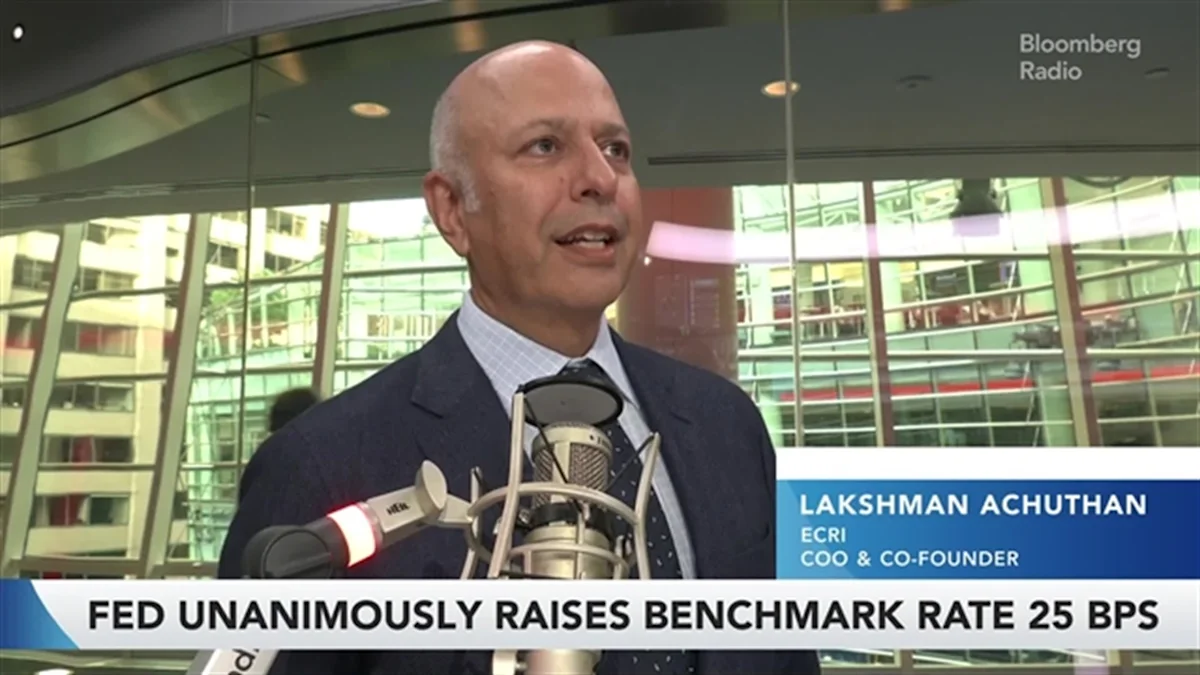
ECRI’s Lakshman Achuthan warns of ‘inflationary boom’ despite Fed rate hike
The US economy is running hot with growth north of 6 per cent, but forward-looking data suggests the Federal Reserve will need to hike rates again to tame persistent inflation.
US Treasuries advanced on Thursday as investors interpreted the Federal Reserve’s interest rate hike as a clear signal of the central bank’s determination to tame inflation. The move marks the first rate increase since 2023, a decision that has reassured markets despite significant political pressure. President Donald Trump had demanded an interest rate of 1 per cent or lower, previously threatening to cut off trade with countries running surpluses with the United States if the Fed did not act.
Lakshman Achuthan, COO and co-founder of ECRI, described the current economic environment as an “inflationary boom” characterised by strong growth and rising nominal numbers. Achuthan noted that the economy is running hot, with growth north of 6 per cent, although he questioned how much of this expansion is driven by artificial intelligence investment. He observed that while the growth figures are impressive, the underlying inflation cycle issues kicked up before recent hostilities in Iran, suggesting the pressure is structural rather than purely energy-driven.
Achuthan argued that forward-looking data indicates inflation trends are still moving upwards, suggesting the Fed will likely implement further rate hikes rather than stopping after the first. He expressed a preference for looking at forward data over coincident data, which he believes is what Fed officials are currently focusing on. “The trend in the forward data remains up,” Achuthan said, dismissing the idea that the cycle is “one and done.”
The economist highlighted that productivity statistics have not yet reflected the impact of AI investment, leaving structural inflation issues unresolved. Although productivity figures had edged up towards 3 per cent, they are now closer to 2 per cent, creating uncertainty about a structural inflation break. Achuthan noted that this lack of productivity gains means the economy does not have a clear structural inflation break, a point he believes Fed officials recognise despite their focus on coincident indicators.
Achuthan cautioned that while the economy is holding up over the next few quarters, he cannot predict conditions out to 2029. He warned that at some point, the squeeze will happen, either through falling growth with high inflation squeezing margins, or through falling inflation reducing profits. He emphasised that in a free market-oriented economy, business cycles persist regardless of political personalities, with both growth and inflation cycles currently moving to the upside.
The market reaction to the rate hike suggests investors are adjusting to the possibility of further increases. Achuthan noted that historically, the Fed tends to do more than one or two hikes in a cycle. With inflation expectations remaining relatively chill, he sees an opportunity for movement, but the forward trend remains a key indicator that the central bank’s work is not yet finished.