Dark energy and dark matter may be linked through a ‘dark dimension’
Theoretical models prompted by DESI observations suggest an interaction between the Universe’s two invisible components could explain changing dark energy and ease the Hubble tension.
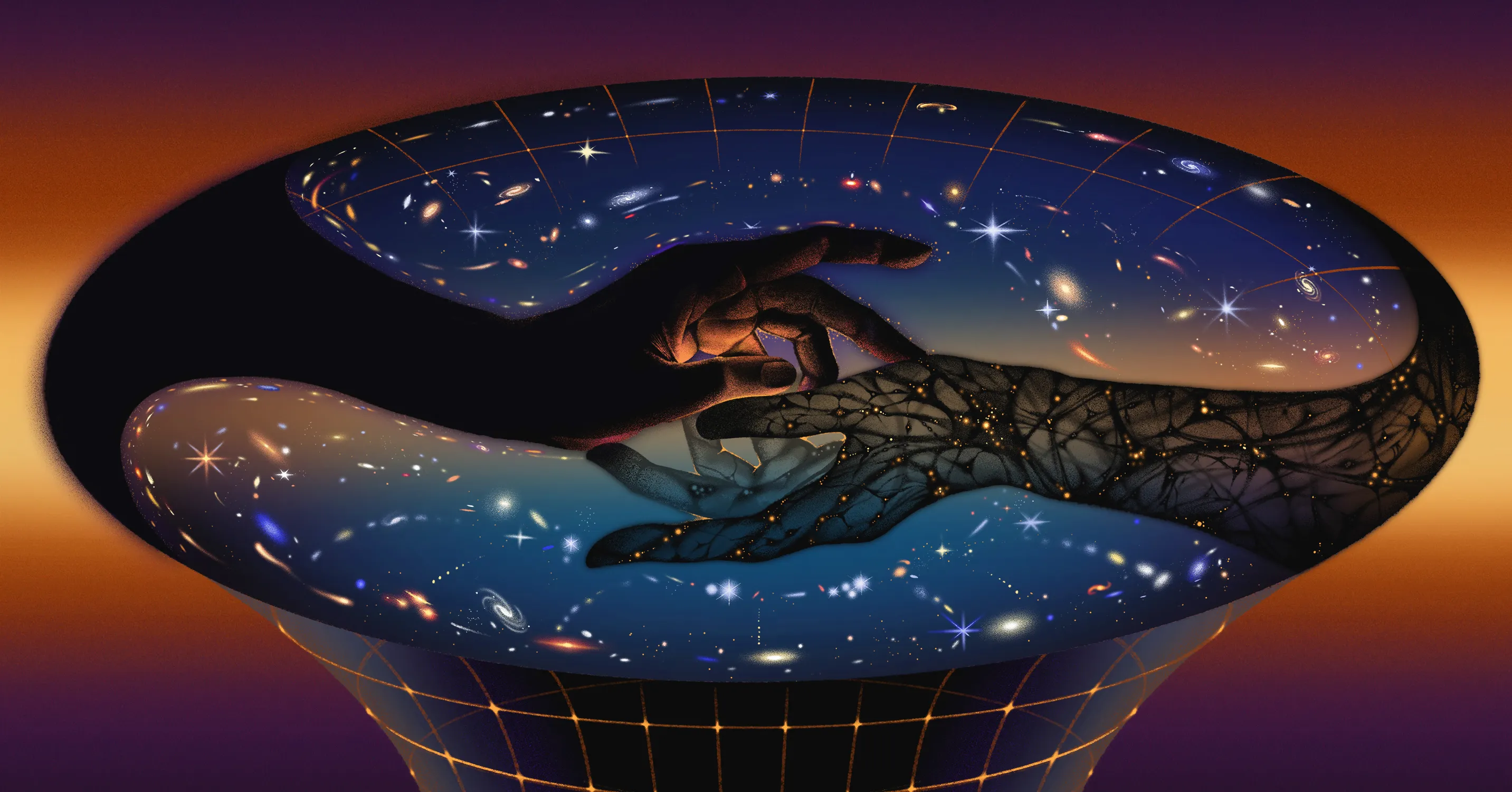
Dark energy may not be constant, according to observations from the Dark Energy Spectroscopic Instrument (DESI) and a 2025 study based on more than twice as much data. The findings suggest it may have reached a maximum roughly 2 billion years ago before weakening, although the evidence remains under debate.
The possibility has renewed interest in models in which dark energy and dark matter interact. Dark energy is estimated to account for about 70 per cent of the Universe and dark matter about 25 per cent, but neither has been directly observed. Researchers including Cumrun Vafa of Harvard University and Georges Obied of the University of Chicago propose that the two may exchange energy or change together.
A July 2025 model by Vafa, Obied and colleagues links the interaction to a proposed extra dimension that could be substantially larger than the other dimensions predicted by string theory. In the model, changes in the size of this “dark dimension” would affect both the strength of dark energy and the mass of dark matter.
The idea may also bear on the Hubble tension, the roughly 9 per cent difference between estimates of the Universe’s expansion rate based on its early and recent history. Models involving dark-sector interactions could make the discrepancy expected in some scenarios, but they do not amount to a confirmed resolution.
The models remain theoretical. Possible tests include searches for distinctive galactic tidal tails that could be produced if dark matter particles interact through an additional long-range force. Agreement between predictions and current observations does not establish that a dark dimension exists, validate string theory or confirm that dark energy is weakening, WIRED reported.