Colombian authorities attribute highway bomb killing 14 to FARC dissidents ahead of election
A coordinated blast on the Pan-American Highway has targeted a convoy of buses and cars, prompting President Gustavo Petro to condemn the perpetrators as terrorists and fascists in a restive region known for conflict and coca cultivation.
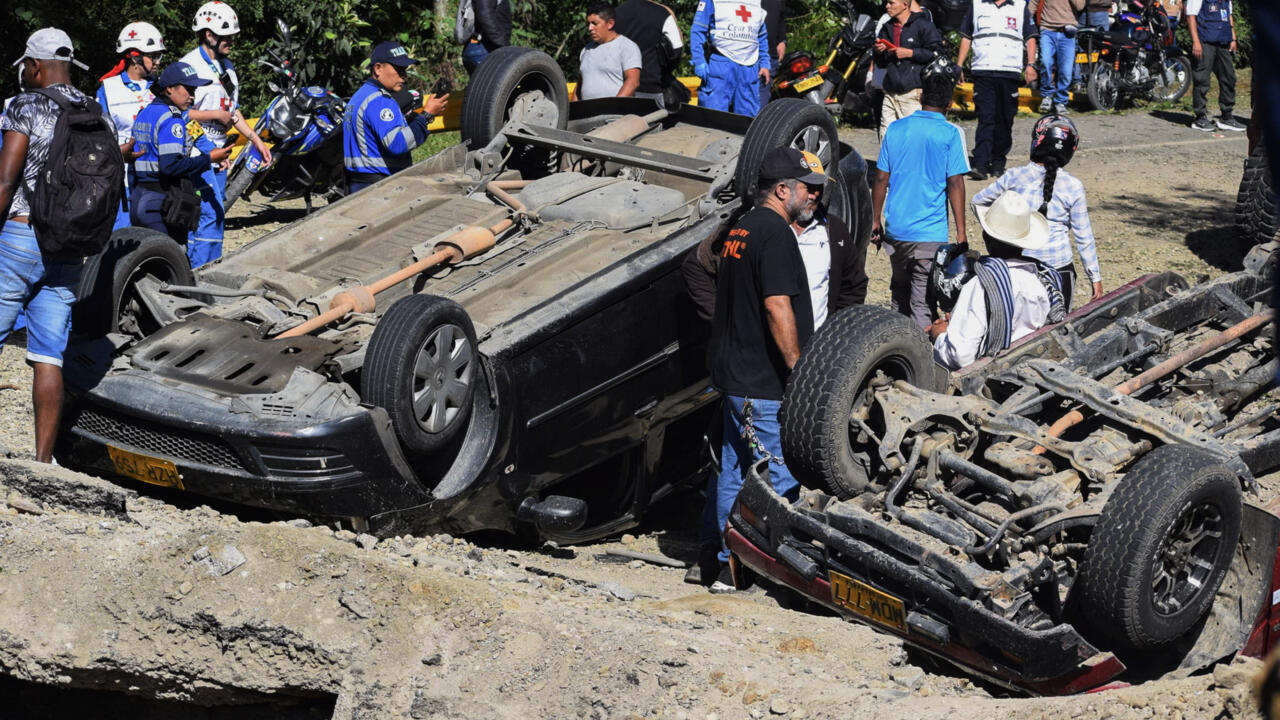
A devastating explosion on the Pan-American Highway in the Cauca department of southwest Colombia has killed at least 14 people and injured 38 others. The attack, which occurred on Saturday, targeted a convoy comprising buses, vans, and cars, resulting in a massive crater and several overturned vehicles. Authorities have attributed the blast to dissidents of the former FARC guerrilla army, a group that rejected the 2016 peace deal and continues to disrupt stability across the nation.
Governor Octavio Guzman confirmed the casualty figures, noting that five of the victims were minors. Rescuers are currently searching for missing persons amidst the wreckage, while bodies were found scattered on the ground covered in sheets. The force of the explosion was significant enough to block the road with a bus and another vehicle before detonating, according to military chief Hugo Lopez.
President Gustavo Petro has strongly condemned the assailants, labelling them terrorists, fascists, and drug traffickers. In his statement, the leftist leader linked the attack to Ivan Mordisco, the country's most-wanted criminal, whom he has compared to the late cocaine kingpin Pablo Escobar. The military chief described the event as a terrorist attack against the civilian population, prompting a call for soldiers to confront the perpetrators.
This incident marks a sharp escalation in violence just weeks before the May 31 presidential election, where security remains a central issue for voters. The highway bombing follows a separate attack on a military base in Cali on Friday, contributing to a recorded 26 attacks in the Valle del Cauca and Cauca departments over the past two days. Defence Minister Pedro Sanchez announced that military and police presence has been boosted in the affected areas.
The political implications are severe as the election approaches, with all major candidates reporting death threats. The contest features leftist Senator Ivan Cepeda, who advocates negotiating with armed groups, against right-wing candidates Abelardo de la Espriella and Paloma Valencia, who pledge a hard line against rebels. This latest violence follows a similar incident last June when conservative frontrunner Miguel Uribe Turbay was shot while campaigning in Bogota.
Witnesses describe a deepening sense of insecurity in the region, which is historically restive and known for conflict and coca cultivation. One coffee grower who witnessed the explosion expressed fear for the country's future, questioning where else such an event could occur. The government's response involves not only immediate rescue operations but also a strategic shift to address the growing threat from armed groups financing their operations through drug trafficking and extortion.