Carney’s Alberta visit underscores federal tension as court blocks secession bid
Prime Minister Mark Carney and Premier Danielle Smith finalise crude oil agreement, while the government prepares to appeal a provincial court decision halting a separatist referendum.
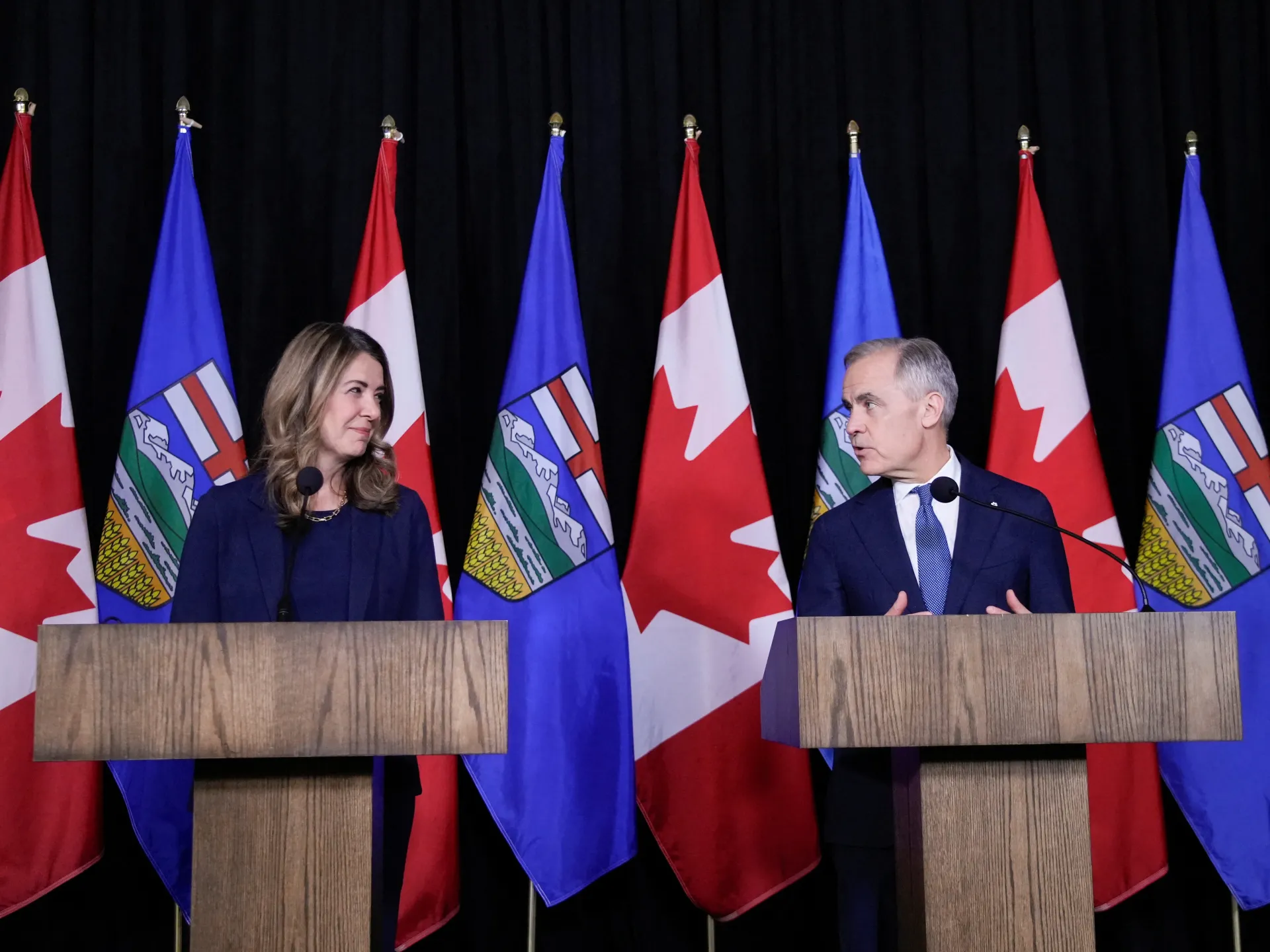
Canadian Prime Minister Mark Carney travelled to Alberta on Friday to unveil a preliminary crude oil pipeline agreement with Premier Danielle Smith, a move that arrives against a backdrop of intensifying political friction over provincial sovereignty. The visit coincides with a significant legal setback for the separatist movement, following a provincial court ruling that blocked a secession referendum due to failures in Indigenous consultation.
The agreement between Carney’s Liberal government and Smith’s administration represents a negotiated compromise on energy infrastructure. Key terms include the implementation of more stringent industrial carbon taxing and the establishment of a new carbon capture project. Carney had previously emphasised that the deal was subject to multiple preconditions, reflecting the federal government’s continued focus on environmental regulations even as it seeks to advance energy exports.
The political timing of the trip is complicated by a recent ruling from Justice Shaina Leonard, who determined that the province’s chief electoral officer acted incorrectly by permitting the collection of signatures for a secession vote. The court found that the process failed to trigger mandatory consultation with Indigenous peoples, whose treaty rights would be fundamentally contravened by an independent Alberta.
The legal challenge was initiated by a First Nations bid to halt the referendum, which had been pushed by the separatist group Stay Free Alberta. The group had submitted a petition to Elections Alberta containing more than 300,000 signatures, a figure sufficient to trigger a provincial vote if approved. Justice Leonard’s decision effectively nullified this effort, citing the lack of proper engagement with Indigenous communities prior to the signature drive.
Premier Smith has rejected the court’s findings, describing the decision as incorrect in law and announcing that her government will appeal. While Smith has not personally endorsed secession, her government has overseen legislative changes to lower the signature threshold required for such a referendum. Polls indicate that approximately one-third of Albertans support independence, a sentiment that separatist groups like the Alberta Prosperity Project have sought to capitalise on by arguing that Ottawa has over-regulated the province’s oil and gas sector.
The separatist movement’s ambitions have extended beyond domestic politics, with leaders of the Alberta Prosperity Project meeting with the US Department of State earlier this year to discuss the logistics of a potential secession. This engagement occurs as Carney attempts to maintain a united Canadian front in response to trade tensions and tariffs imposed by US President Donald Trump.
Academic observers warn that the federal government must navigate these tensions carefully. Adrienne Davidson, a political science professor at McMaster University, noted that dismissing the sovereignty debate could backfire politically for Carney. She suggested that an heavy-handed federal response might be perceived as Ottawa attempting to dominate provincial affairs, potentially exacerbating regional discontent rather than resolving it.