BES III physicists present strongest evidence to date for glueballs
New data from the Beijing Spectrometer III experiment aligns particle mass with lattice QCD predictions, marking a significant milestone in quantum chromodynamics research.
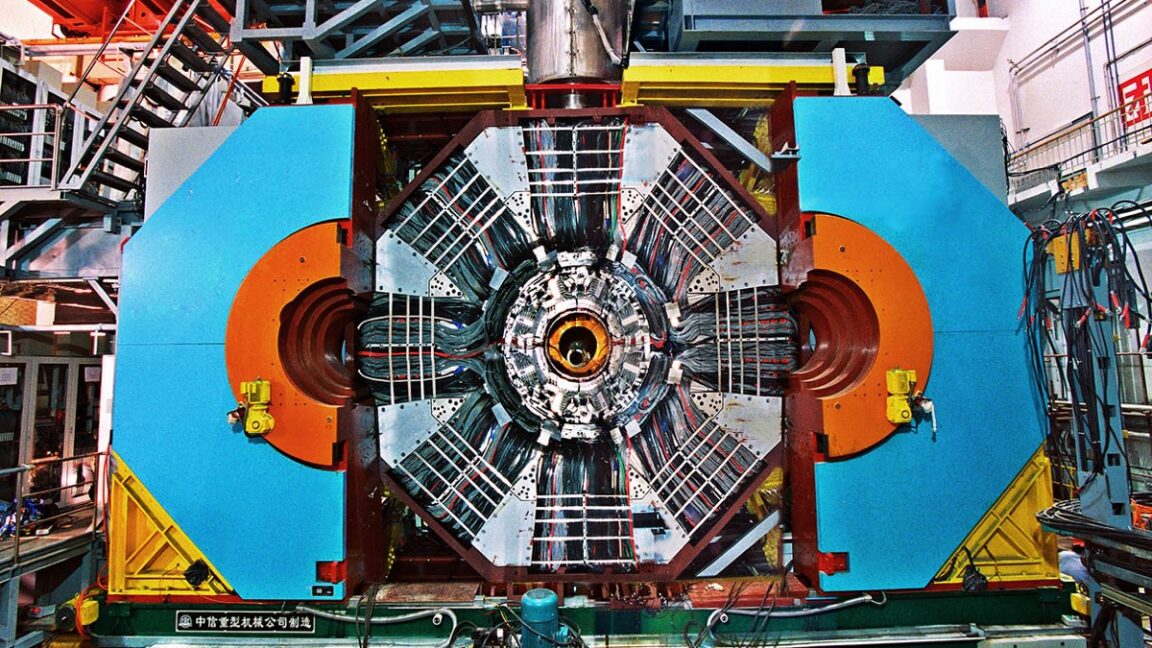
Physicists from the Beijing Spectrometer III (BES III) experiment have presented compelling new evidence for the existence of glueballs, composite particles made entirely of gluons. Analysis of over 10 billion J/psi particle decays revealed that the X(2370) particle matches predicted mass, spin, and parity properties, and is identified as a flavour singlet composed of approximately 90 per cent gluons. The findings, published on arXiv and presented at the International Conference on High Energy Physics, are described as the strongest evidence to date for particles dominated by a glueball component, though independent verification is required.
The X(2370) particle was first discovered in 2011 at BES III, with an initial mass measurement of 2.370 GeV/C². Since the updated collider began collecting data in 2008, it has recorded over 10 billion J/psi particles, enabling more accurate measurements of rare events. The latest analysis refined the mass measurement to 2.395 GeV/C², aligning precisely with lattice Quantum Chromodynamics (QCD) theory predictions. This agreement between experimental data and theoretical models represents a significant step forward in confirming the existence of particles composed solely of gluons.
Colin Morningstar, a particle physicist at Carnegie Mellon University, described the findings as an experimental triumph. He noted that the results provide the strongest evidence yet that particles dominated by a glueball component can exist in nature. The identification of X(2370) as a flavour singlet, meaning it is not associated with a particular quark flavor, serves as a vital experimental clue supporting its composition of predominantly gluons.
While the BES III results are compelling, independent verification from other facilities is necessary to confirm the discovery. Potential candidates for this verification include the proposed Super Tau-Charm Facility (STCF) in China or the Electron-Ion Collider under construction at Brookhaven National Laboratory in the US. BES III remains the only machine currently devoted exclusively to hunting for gluons, meaning independent confirmation could take some time.
The research highlights the ongoing quest to understand the strong nuclear force and the composition of matter. Gluons, the carriers of the strong force, bind quarks together to form protons and neutrons, but they also interact with each other, potentially forming glueballs. The confirmation of these particles would validate key predictions of the Standard Model of particle physics and deepen the understanding of how mass is generated within the universe.