Beijing and Moscow pledge multipolar order as trade hits $240bn
Leaders commit to reducing US hegemony, finalising Siberia 2 pipeline route, and settling trade in roubles and yuan.
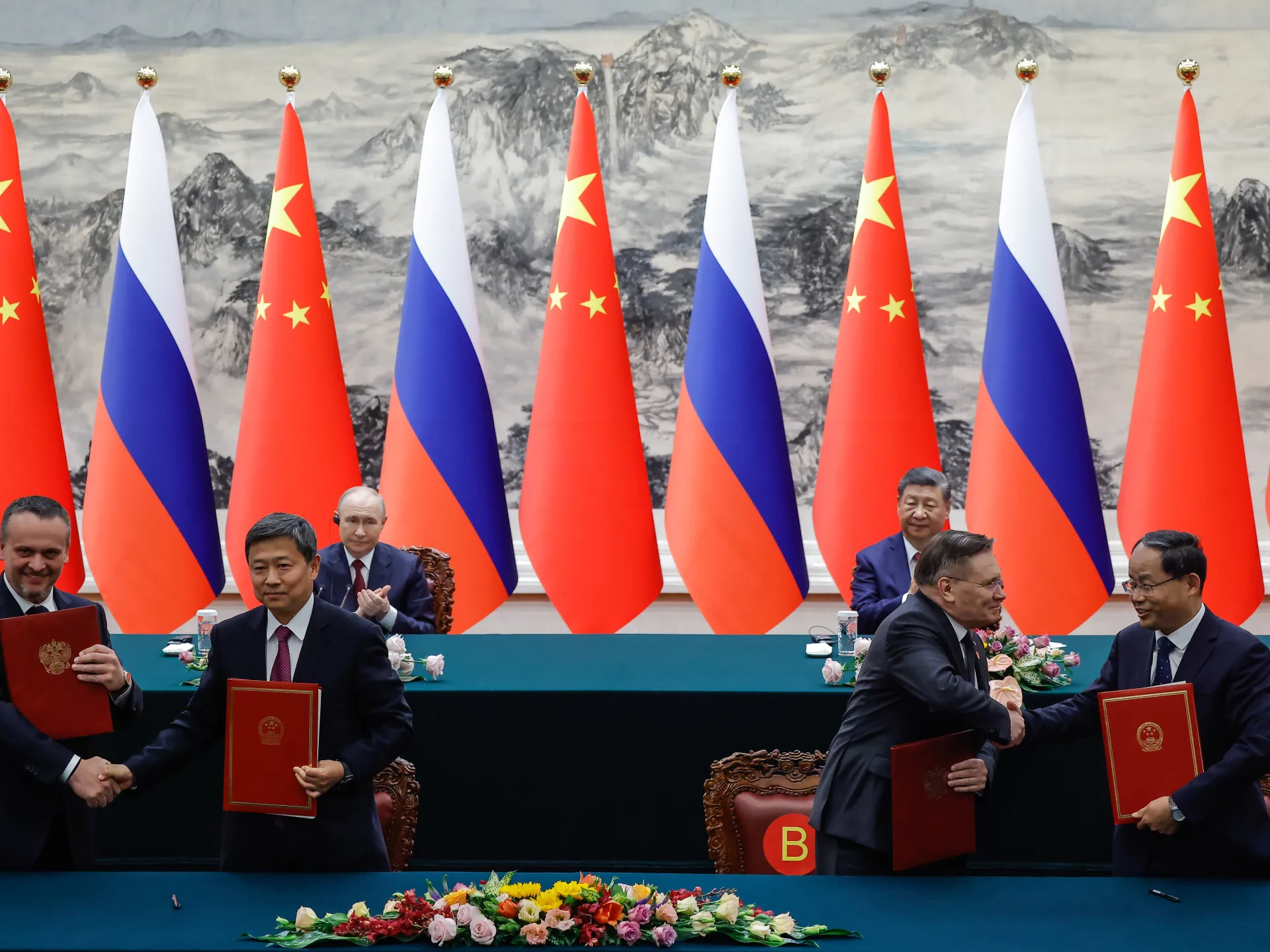
Russian President Vladimir Putin and Chinese President Xi Jinping concluded their summit in Beijing with the signing of a 47-page joint declaration and approximately 40 bilateral documents. The agreement, described by Russian presidential aide Yuri Ushakov as a policy statement on establishing a “multipolar world” and a “new type of international relations,” signals a deepening strategic alignment between the two nations. The meeting occurred shortly after United States President Donald Trump completed a two-day summit with Xi in China.
Central to the declaration is a shared commitment to dismantle what both leaders describe as unilateral hegemony. Xi told Putin that the “tide of unilateral hegemony is running rampant,” echoing sentiments previously expressed by Putin, who has argued that the era of a unipolar world order is ending. The Chinese Foreign Ministry stated that both sides would advocate for a distribution of economic, military, and diplomatic power among three or more countries, rather than concentrating influence in the hands of one or two.
Economic integration remains a cornerstone of the partnership, with bilateral trade reaching nearly $240bn last year and growing by 20 percent in the first four months of this year. The Kremlin confirmed that nearly all import and export transactions between the two countries are now conducted in roubles and yuan. This shift has created a trade system that Moscow describes as stable and protected from external influence and negative global market trends.
Significant progress was also announced regarding energy infrastructure, specifically the long-delayed Siberia 2 gas pipeline. Leaders reached an understanding on the route and construction of the project, which will transport 50 billion cubic metres of Russian gas annually to China via Mongolia once completed. This development expands energy flows at a time when European markets have largely closed to Russian products following the war in Ukraine.
The depth of the economic relationship is further illustrated by Russia’s reliance on Chinese supply chains. Reports indicate that Russia now imports more than 90 percent of technology targeted by US and EU sanctions via China, utilising Chinese suppliers for components vital to drone production and defence industries. Beyond energy and defence, the leaders agreed to expand student exchange programmes and align China’s 15th Five-Year Plan with Russia’s development strategy until 2030. The Kremlin also noted that this year marks the 70th anniversary of the partnership between Russian news agency TASS and Chinese news agency Xinhua.