XRISM captures neutron star feeding on stellar wind in BP Crucis system
Data from the NASA-JAXA XRISM observatory provides the first direct observation of a pulsar capturing high-speed plasma from its giant companion, offering new insights into accretion processes in the extreme universe.
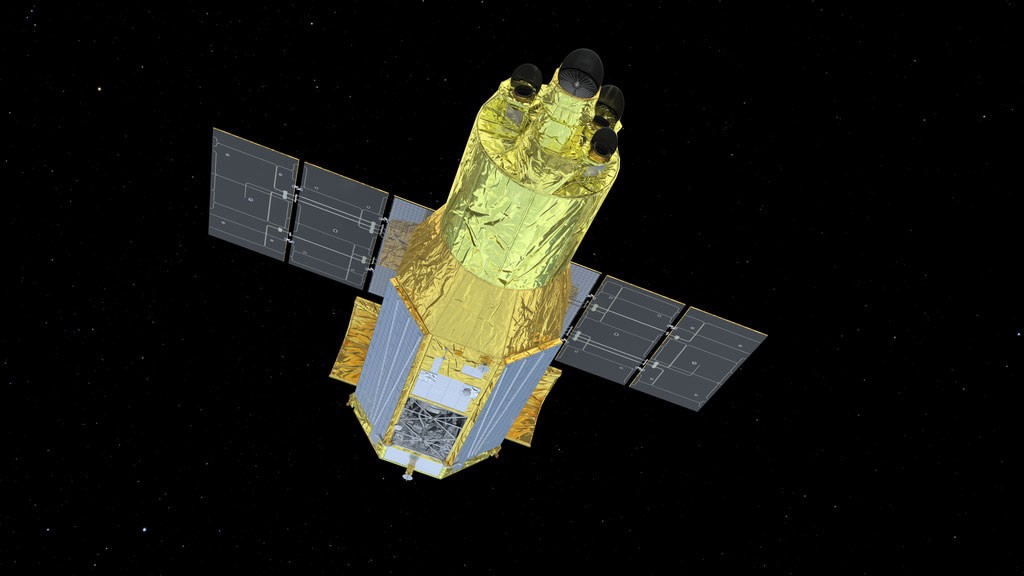
Astronomers using the Japan-led XRISM (X-ray Imaging and Spectroscopy Mission) observatory have directly observed a giant star’s outflow, known as a stellar wind, being captured by its compact companion. This interaction provides the power source for strong X-ray flares in the BP Crucis system. The research, published in the journal Science Advances, marks a significant step in NASA’s exploration of the extreme universe to better understand how the cosmos works.
The target system, located approximately 13,000 light-years away in the southern constellation Crux, is a high-mass X-ray binary. The primary star, Wray 977, is a blue hypergiant with a mass 40 times that of the Sun and a size 60 times larger. Due to its immense heat and luminosity, ionized gas constantly streams away from the star, a phenomenon astronomers classify as a stellar wind. Its companion is a neutron star designated GX 301-2, the crushed core of a star that exploded as a supernova. This compact object packs more than the Sun’s mass into a sphere roughly 20 kilometres across and rotates every 11 minutes, sweeping an X-ray beam toward Earth.
Data collected by XRISM on 1 February 2025 revealed high-speed plasma flowing towards the pulsar at approximately 540,000 kph. The observatory’s Resolve instrument, jointly developed by NASA and the Japan Aerospace Exploration Agency (JAXA), captured highly detailed X-ray spectra during about 16 hours of observation near the end of a strong flare. These spectra revealed rapidly changing emission and absorption lines, with absorption lines from highly ionized iron indicating the speed and direction of plasma close to the pulsar.
Roi Rahin, a researcher at the University of Maryland, Baltimore County, and NASA’s Goddard Space Flight Center, noted that these observations provided the first clear indications of wind plasma falling onto a compact object. The team determined that the iron absorption lines were displaced to lower energies, a redshift indicating motion away from the observer. This implies the gas is flowing toward the pulsar, allowing researchers to test their understanding of these processes in much greater detail.
The researchers propose that as the pulsar enters the stellar wind, it sweeps up gas into a thick, turbulent disk. This gas spirals down to the pulsar, heats up, and emits X-rays to power the flares. As the pulsar moves deeper into the stream, the disk breaks down, and plasma flows directly onto the neutron star. The pulsar takes about four days to transit the stream, with the strongest eruptions occurring closer to the star where the plasma stream is denser.
Brian Williams, the mission’s project scientist at NASA Goddard, described the BP Crucis system as an ideal laboratory for studying wind-fed pulsar accretion. He highlighted that XRISM’s sensitive, high-resolution Resolve spectrometer is an ideal instrument for advancing the understanding of these complex astrophysical processes.