NASA highlights zodiacal light captured in India’s remote Hanle Dark Sky Reserve
A photograph of the false dawn, taken at an altitude of 4,500 metres, features in NASA’s Astronomy Picture of the Day, with new data suggesting Mars is the source of the interplanetary dust responsible for the phenomenon.
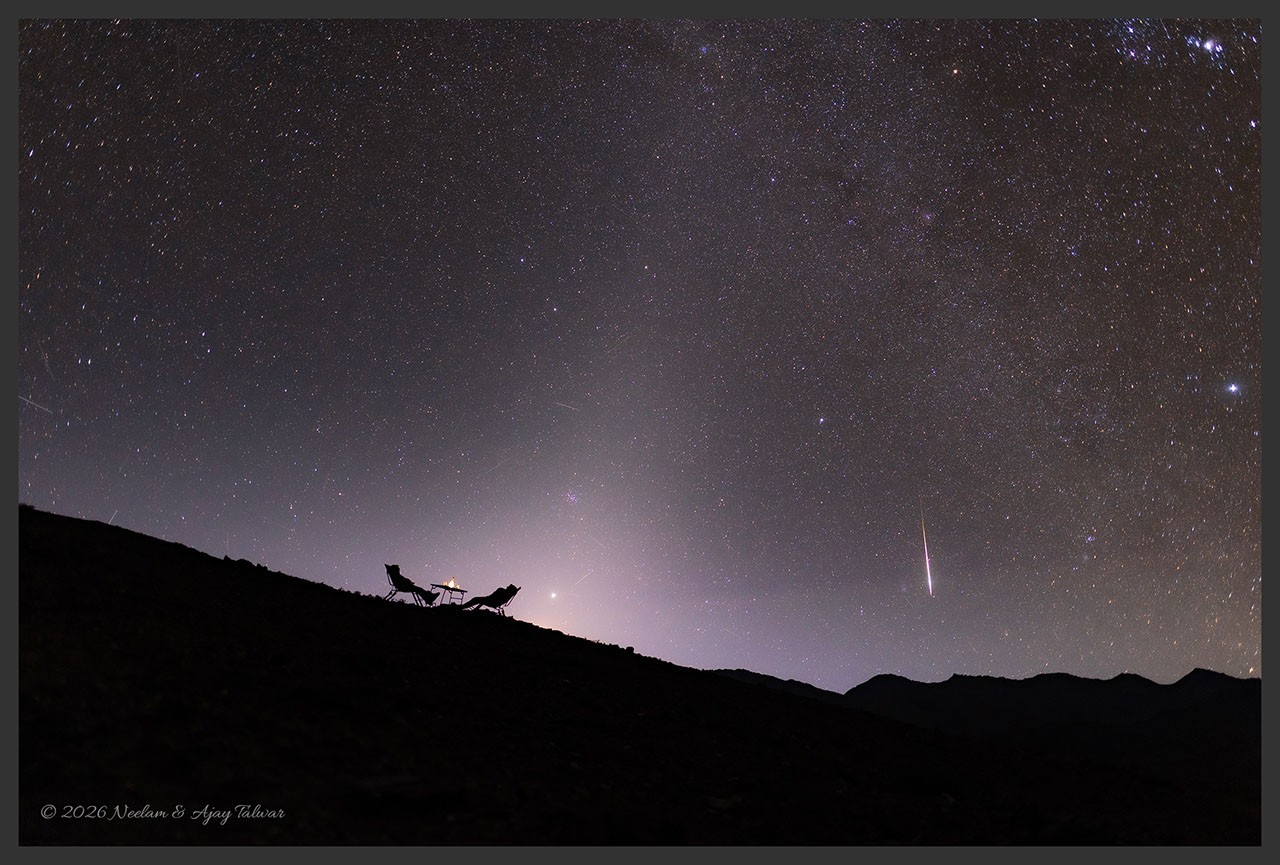
NASA’s Astronomy Picture of the Day (APOD) has featured a striking photograph of zodiacal light, a faint luminous band in the night sky also known as the false dawn. The image, credited to astrophotographers Neelam and Ajay Talwar, captures the phenomenon at the Hanle Dark Sky Reserve in Ladakh, India.
The serene view was recorded just before the beginning of astronomical twilight during a September star party. Situated at an altitude of approximately 4,500 metres, the remote reserve is described as a haven for hardy stargazing and astrophotography enthusiasts seeking minimal light pollution.
In the frame, the bright planet Jupiter appears immersed in the faint zodiacal glow near the eastern horizon. Following the luminous band toward the zenith reveals the open star cluster M44 and a yellowish-tinged Mars near the centre of the image.
The APOD feature notes that serendipitous detections of interplanetary dust by NASA’s Juno spacecraft suggest Mars itself is the source of the dust. This material back-scatters sunlight to create the zodiacal light visible in Earth’s night sky.
While the specific date of the photograph is not explicitly stated, it was taken during a star party in September and featured in the APOD archive on 19 September 2026. The service, which provides a daily image or photograph of the universe with a brief explanation by a professional astronomer, is a joint effort by ASD at NASA/GSFC, NASA Science Activation, and Michigan Tech. U.
NASA has also announced that the main APOD site is moving from apod.nasa.gov to science.nasa.gov/apod, continuing its daily exploration of the cosmos.