Xi Jinping arrives in Pyongyang to counter North Korea’s deepening ties with Russia
Analysts say the early timing of the state visit signals Beijing’s concern over Pyongyang’s alignment with Russia, while Kim Jong Un seeks economic access and international legitimacy.
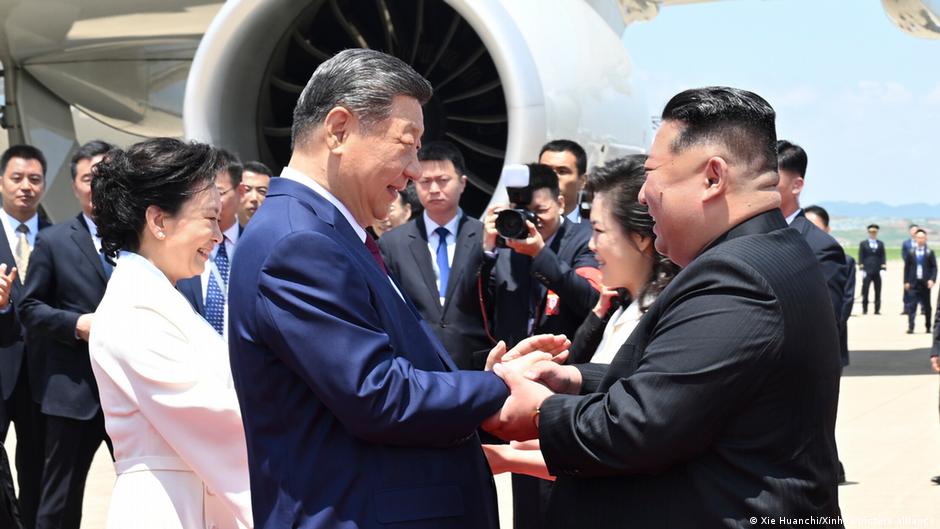
Chinese President Xi Jinping arrived in Pyongyang on Monday for a two-day state visit, marking his first trip to North Korea since 2019. The visit coincides with the 65th anniversary of the China-North Korea Treaty of Friendship, Cooperation, and Mutual Assistance, although Xi arrived a month prior to the official date. Upon arrival at the international airport, Xi and his wife, Peng Liyuan, were welcomed by North Korean leader Kim Jong Un and his wife, Ri Sol Ju, with a 21-gun salute and military band performances.
The diplomatic engagement occurs against a backdrop of deepening military and trade ties between Pyongyang and Moscow following Russia’s invasion of Ukraine in 2022. Since then, North Korea has provided critical weapons, artillery, and manpower to Moscow, a shift that has altered traditional regional dynamics. Analysts suggest Beijing aims to consolidate its influence and counter Pyongyang’s growing alignment with Russia, while Kim Jong Un seeks to bolster North Korea’s economy and enhance its international legitimacy through closer access to Chinese economic power.
Choo Jae-woo, a professor of foreign policy at South Korea’s Kyung Hee University, stated that China feels it is "lagging behind" in its relationship with North Korea compared to Russia. He noted that Xi’s decision to visit a month early, rather than on the July 11 anniversary, demonstrates Beijing’s anxiety about North Korea getting too close to Moscow. Choo pointed out that China has recently permitted large-scale exports across the border into North Korea, and Chinese tourists are visiting North Korean resort projects.
Kim Sang-woo, a former South Korean politician and member of the Kim Dae-jung Peace Foundation, suggested Xi aims to demonstrate China’s status as a global hegemon alongside the US. He argued the visit is intended to highlight uncertainties in US commitment to the Indo-Pacific region, sending a message to countries such as South Korea, Japan, India, the Philippines, and Australia. Kim Sang-woo added that Pyongyang wants to show it is a country that others must take notice of, aided by China’s renewed recognition of the alliance.
Kim Jong Un is reportedly seeking greater access to China’s economic power to bolster North Korea’s economy, which has reported 3% GDP growth in each of the last two years. According to a 2022 estimate by the US-based National Committee on North Korea, Pyongyang relies on China for approximately 95 percent of its trade. Bilateral trade stood at $2.74bn, with China exporting petroleum, food, and machinery, while importing items such as iron.
Kim is also seeking to enhance North Korea’s international legitimacy, potentially aiming for membership in the Shanghai Cooperation Organization (SCO) or the BRICS alliance. Choo Jae-woo noted that Kim wants the North to be seen as a "normal state" and to use this visit to expand his diplomatic efforts. He described this as an attempt to "piggyback on China and Russia" to gain standing as a full member of international society.
A letter published in state-run Rodong Sinmun newspaper ahead of the visit quoted Xi stating that the traditional friendship between China and North Korea remains "unbreakable, enduring, and constantly radiates vitality." Kim and Xi last met in September 2025 at a military parade in Beijing.