Webb Telescope reveals how massive star clusters escape their birth clouds
Data from NASA’s James Webb Space Telescope indicates that more massive star clusters emerge more quickly from their natal clouds, a finding supported by a new near-infrared image of Messier 51 released in May 2026.
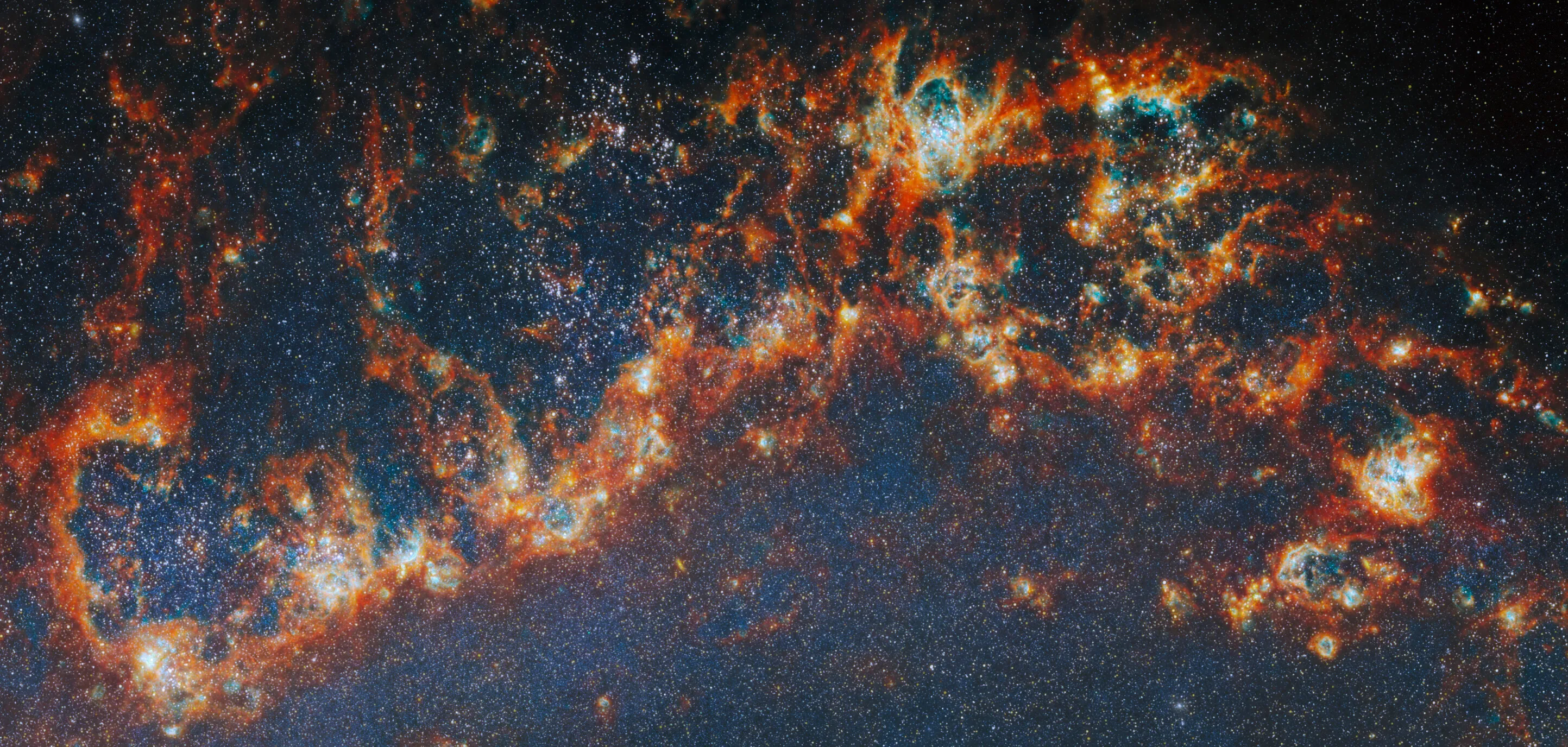
NASA’s James Webb Space Telescope has completed a comprehensive study of nearly 9,000 star clusters across four nearby galaxies, including the iconic Messier 51 (M51). The research provides new data on the lifecycle of these stellar groupings, revealing that more massive clusters emerge from their birth clouds more quickly than their less massive counterparts.
The findings are accompanied by a near-infrared image released on 6 May 2026, which shows a section of one of the spiral arms of Messier 51. The image highlights the dense environments where star formation occurs, offering a visual context for the data gathered during the survey of the four galaxies.
According to the study, understanding the mechanics of star formation is critical for comprehending broader astronomical processes. The data contributes to the scientific understanding of galactic evolution, the internal dynamics within a galaxy, and the mechanisms and locations where planets form.
The image credit for the release is attributed to ESA/Webb, NASA & CSA, A. Pedrini, A. Adamo from Stockholm University, and the FEAST JWST team. The visual data serves as a key component of the public release, illustrating the specific region of Messier 51 that was part of the wider observational campaign.
While the specific methodology for determining the emergence timeline of the clusters is not detailed in the source material, the core finding remains clear: mass plays a significant role in how rapidly a star cluster clears its surrounding natal material. This observation aids astronomers in mapping the structural changes galaxies undergo over time.
The study underscores the capability of the James Webb Space Telescope to resolve individual star clusters in distant galaxies. By analysing nearly 9,000 such clusters, the telescope has provided a statistical basis for understanding how stellar populations evolve within the complex structures of nearby galaxies.