Webb Telescope Reveals Hidden Planet in Beta Pictoris System
Astronomers using NASA’s James Webb Space Telescope have discovered Beta Pictoris d, a giant exoplanet hidden within a bright debris disk. The finding marks the second known system with three imaged planets and demonstrates a new technique for detecting worlds through their atmospheric fingerprints.
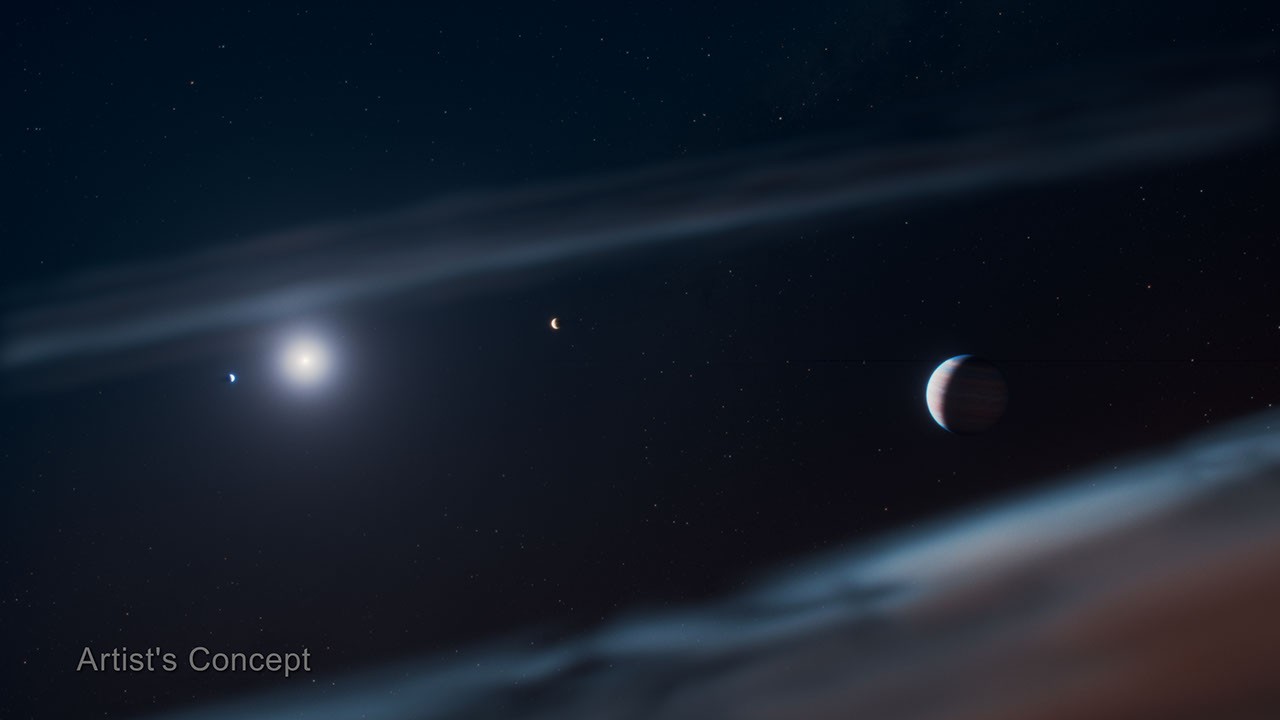
Astronomers using NASA’s James Webb Space Telescope have identified a new giant exoplanet, Beta Pictoris d, within the Beta Pictoris star system. Located 63 light-years from Earth, the system is approximately 23 million years old and previously hosted two known giant planets, Beta Pictoris b and c. The discovery makes Beta Pictoris only the second planetary system known to contain at least three imaged planets. Unlike its siblings, Beta Pictoris d was not found by isolating a point of light but by detecting the unique chemical signature of its atmosphere.
The planet was identified using the telescope’s Near-Infrared Spectrograph (NIRSpec) while the team was studying the atmosphere of Beta Pictoris b. Researchers detected a distinctive pattern of carbon monoxide absorption lines in the data, appearing as peaks and troughs where a smooth spectrum from surrounding dust was expected. This spectroscopic approach allowed scientists to distinguish the planet from the bright debris disk that had previously obscured it.
The team estimates that Beta Pictoris d is at least twice the mass of Jupiter and orbits at a distance of approximately 30 astronomical units. This places it in the widest orbit of the three known planets, comparable to the region occupied by Neptune in the Solar System, but still inside the inner edge of the system’s debris disk. The planet is likely the smallest of the three giant worlds in the system.
Follow-up observations using the Mid-Infrared Instrument (MIRI) detected water vapor and methane, further confirming the planet’s identity and providing details about its atmospheric composition. Jean-Baptiste Ruffio, a research scientist at the University of California, San Diego, noted that the spectrum revealed the planet’s temperature, chemistry, and motion immediately, rather than requiring separate imaging campaigns.
A separate study led by Ben Sutlieff of the University of Edinburgh and Markus Bonse of the European Southern Observatory independently confirmed the existence of Beta Pictoris d using data from the Very Large Telescope and Webb’s Near-Infrared Camera. The findings, led by Aidan Gibbs of the University of California, San Diego, were published in the Astrophysical Journal Letters.
Scientists suggest the planet’s presence may explain the sharply defined inner edge and other structures within the famous debris disk. The discovery demonstrates a powerful new method for finding exoplanets in complex environments, marking the first time a directly imaged planet has been discovered primarily through moderate-resolution spectroscopy.