Webb Telescope captures young galaxy cluster in active merger
NASA, ESA and CSA collaboration releases July 2026 observation showing two massive elliptical galaxies anchoring merging sub-clusters
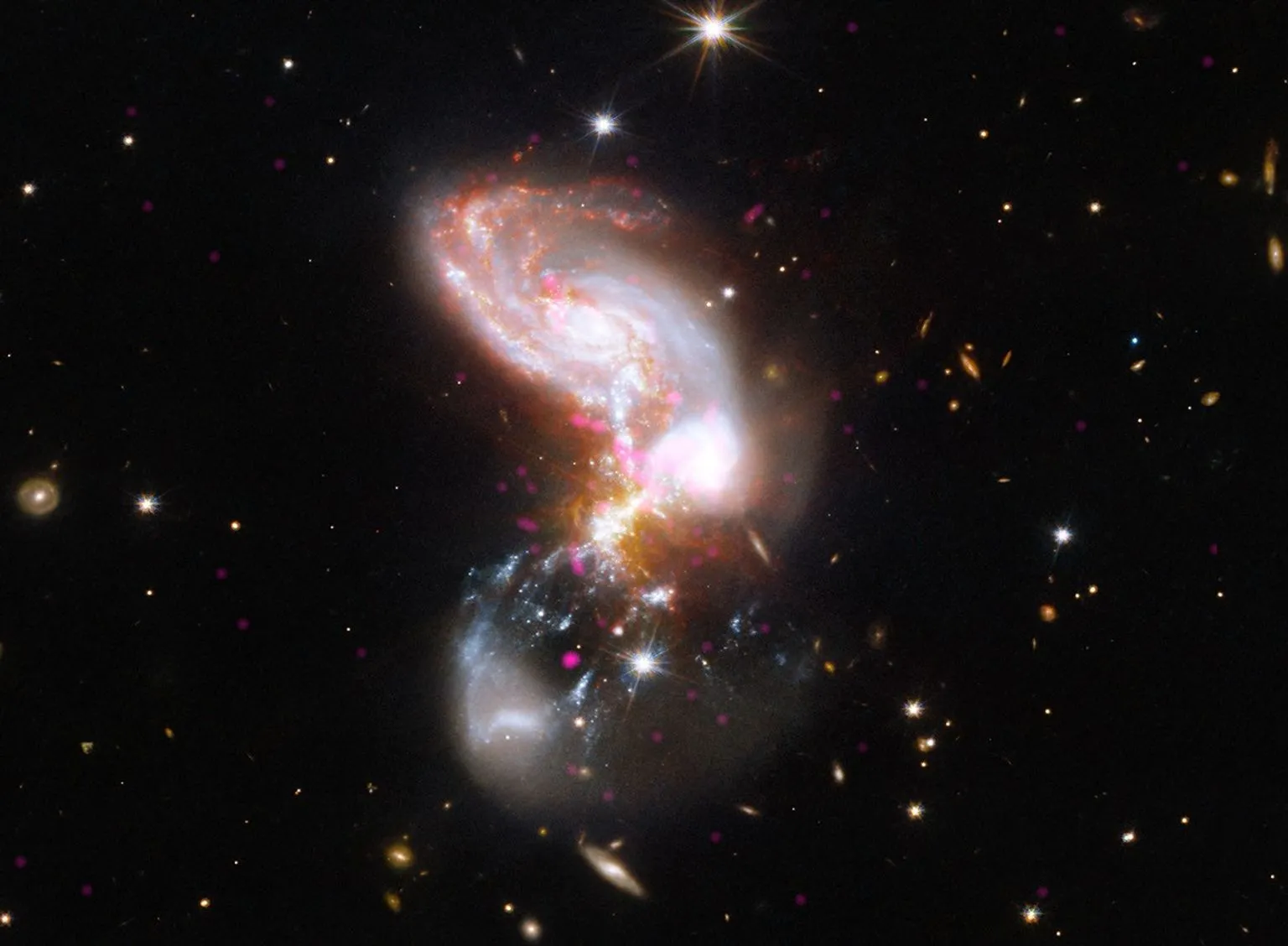
NASA’s James Webb Space Telescope has released a new image of the galaxy cluster MACS J0553.4-3342, offering a view of the cosmos as it existed 4.4 billion years ago. The observation, captured on 3 July 2026 and published on 16 July 2026, highlights a system in the midst of significant structural evolution.
The cluster is characterised by two sub-clusters of roughly equal mass that are actively merging. This dynamic interaction provides astronomers with a snapshot of galaxy cluster formation during a period when the universe was significantly younger than it is today.
At the heart of each sub-cluster lies a massive, bright elliptical galaxy. These galaxies appear as the two most luminous points in the centre of the image, surrounded by large, glowing halos. Elliptical galaxies are typically older, massive structures often found at the centres of galaxy clusters, and their prominence in this image underscores their role in anchoring the larger system.
The James Webb Space Telescope is a collaboration involving NASA, the European Space Agency (ESA), and the Canadian Space Agency (CSA). The image credit acknowledges the joint effort, with additional contribution from S. Fujimoto. Observations of such distant clusters allow scientists to study the early universe and trace the evolutionary paths of galaxies over billions of years.
By capturing this specific configuration, the telescope provides data that helps contextualise how large-scale structures in the universe assemble and mature. The visual evidence of two merging components offers a detailed look at the gravitational interactions that shape the cosmic landscape.