Webb Telescope captures intense glow at heart of galaxy M77
An image taken on 7 May 2026 shows gas heating up as it orbits the central black hole, while bright spikes are identified as optical artefacts of the telescope.
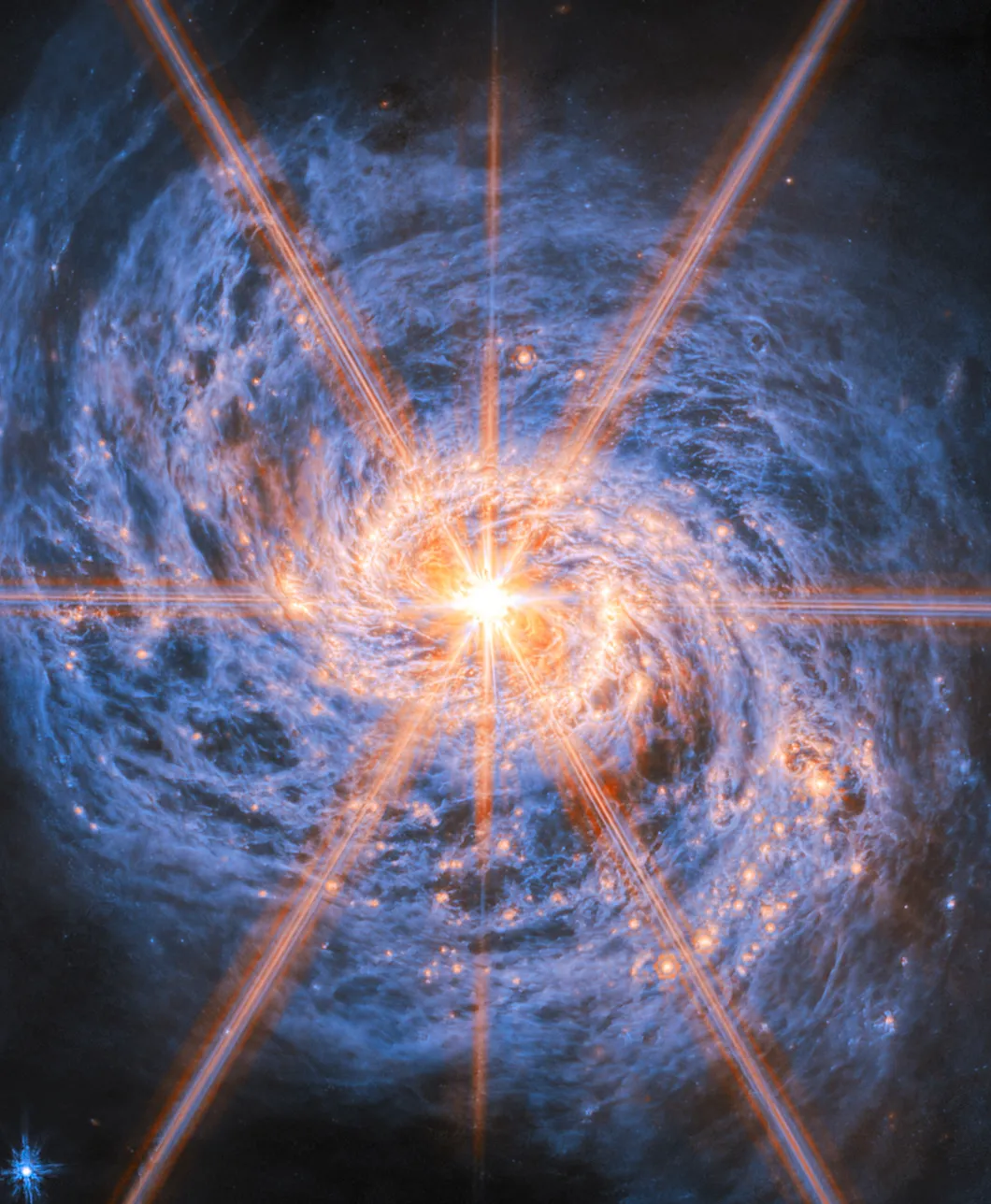
On 7 May 2026, NASA’s James Webb Space Telescope captured a high-resolution image of the central region of galaxy M77. The observation highlights an intense glow resulting from gas being drawn into a tight orbit by the strong gravity of the galaxy’s central supermassive black hole. As the gas accelerates, it heats up and releases significant radiation.
The bright lines radiating from the centre of the image are identified as diffraction spikes. These are optical artefacts caused by the telescope’s structure rather than physical features of the galaxy. The James Webb Space Telescope is a collaborative mission involving NASA, the European Space Agency (ESA), and the Canadian Space Agency (CSA).
The image was credited to ESA/Webb, NASA & CSA, and A. Leroy. It was released as part of a NASA news update titled "Beacon of Light" on 18 May 2026.
The event date is in the future relative to the current real-world date. Scientific explanations regarding gas dynamics and radiation are based solely on the provided NASA summary.